







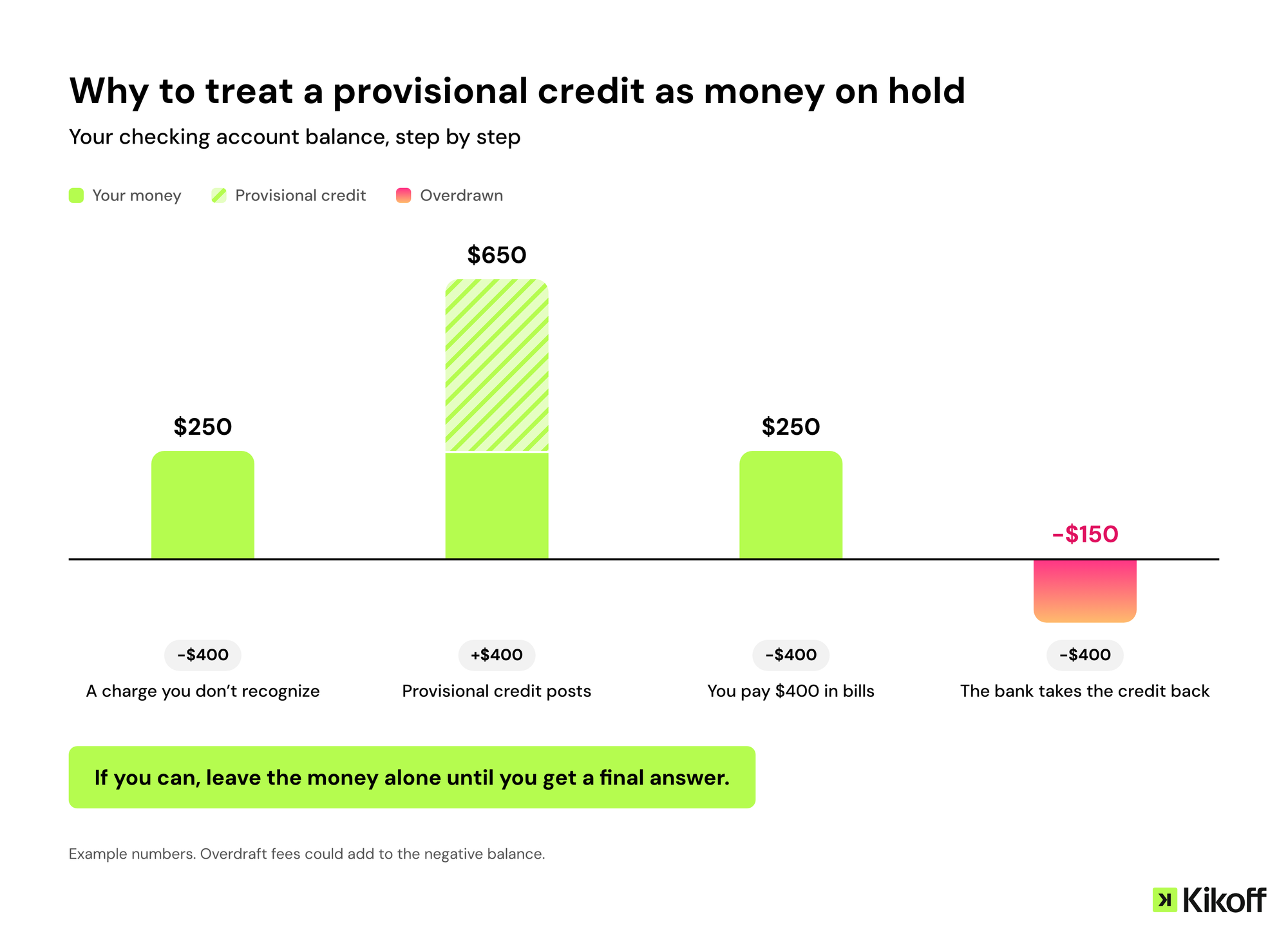
Provisional credit is a temporary credit your bank or card company adds while it looks into a charge you disputed. It means "we're still checking," not "you were right." You can spend it, but the bank can take it back if it decides against you, which can leave you overdrawn. For debit cards and bank transfers, a federal rule called Regulation E sets the deadlines and the warning you get. Credit cards follow a different rule.
How provisional credit works
Say a debit card charge you didn't make shows up. Your bank needs to hear from you within 60 days after it sends the statement that first shows the charge. If your card was lost or stolen, report it within two business days of noticing, which keeps what you could owe at $50 or less.
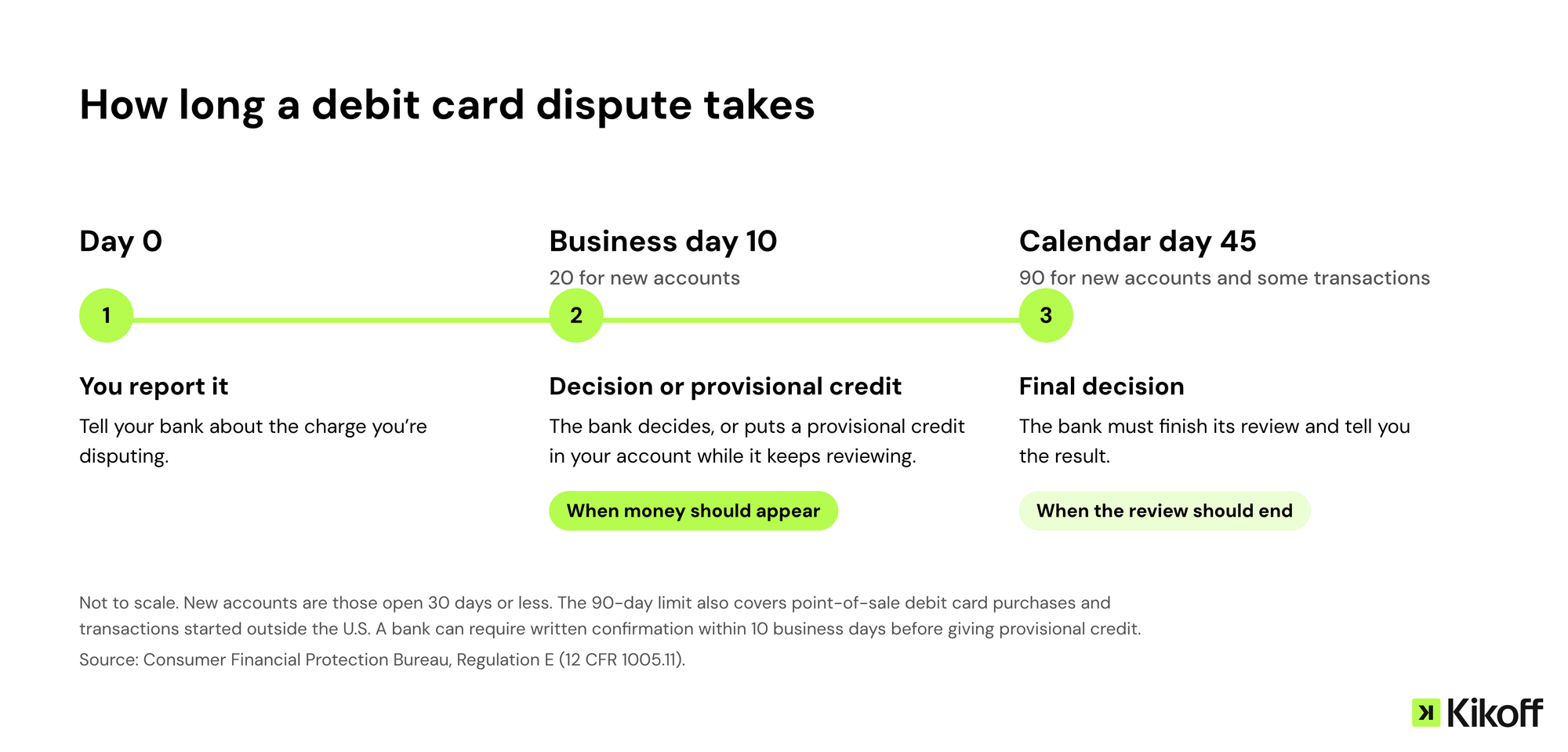
The bank then has 10 business days to decide whether there was an error. If it needs longer, it can take up to 45 days, but only if it provisionally credits your account for the disputed amount within those 10 business days. It has to tell you the amount and date within two business days of posting it, and you get full use of the money.
The bank gets 90 days instead of 45 for debit card purchases (not ATM withdrawals), transfers started outside the U.S., and transfers within 30 days after the first deposit to a new account. For those new accounts, the first window is 20 business days.
Why the credit may be short or missing
- The bank finished fast. If it decides within 10 business days, it doesn’t have to post a provisional credit. You’ll get a final answer instead.
- Up to $50 held back. If the charge looks unauthorized, the bank can hold back up to $50, because that’s the most you may owe for a card reported quickly.
- No written follow-up. If you report by phone, the bank can ask you to confirm in writing within 10 business days. If it doesn't get that, it doesn't have to post the credit.
Before you hang up, ask, "Do you need this in writing, and where do I send it?" Then send it that day.
Read more >> Are Credit Cards Safer Than Debit Cards?
Payment apps count too
The CFPB says any person-to-person payment that counts as an electronic fund transfer is covered by Regulation E. That includes money a scammer sends from your account after tricking you into sharing your login. The bank also can’t make you file a police report or contact the store before it starts investigating.
If you sent the money yourself, even to a scammer, these rules generally don’t cover it. Report it to your bank and the app anyway.
Credit cards work differently
Credit card disputes fall under a different federal rule, Regulation Z, which doesn’t require provisional credit. Your card company may post a temporary credit or set the charge aside anyway. That’s its policy, not the law, so ask what it does. Disputing a card charge is closely related to a chargeback.
What the rule does give you: while the dispute is open, you don't have to pay the disputed amount or related interest and fees, and it can't be reported as late. The company can subtract it from your available credit in the meantime.
Read more >> How to Handle and Prevent Fraudulent Charges on Your Account
When provisional credit gets taken back
If the bank finds an error, it has one business day to correct it, and the credit becomes permanent. If it decides the charge was valid, it has to tell you the date and amount when it takes the credit back. For five business days after that notice, it has to keep paying checks and preauthorized payments, such as autopay, without overdraft charges for them. That covers only payments it would have paid with the credit still there. You can also ask for the documents it relied on.
For credit cards, the company has to explain its decision and give you at least 10 days to pay before reporting the amount as late.
If you disagree, file a free complaint with the Consumer Financial Protection Bureau online. You can also send the bank new proof, such as receipts or screenshots, though it isn’t required to reopen the case.
Does provisional credit affect your credit?
Checking accounts don't show up on your credit reports, so a debit dispute won't either. A disputed credit card charge can't be reported as late while the dispute is open. If a late mark shows up anyway, that's an error you can dispute with the credit bureau for free. Kikoff's free AI Credit Disputes can help you dispute inaccurate items with the bureaus.
Read more >> Does Withdrawing Cash From a Debit Card Affect Your Credit Score?
Bottom line
Provisional credit is temporary money that covers you while your bank checks a disputed charge. You can use it, but it can be taken back with notice. The dispute settles only that charge. It can't tell you whether whoever used your card also tried opening credit in your name. Kikoff's Credit Monitoring gives you a weekly look at your credit from one bureau with Kikoff Basic, so an account you didn't open is easier to spot. Plans start at $5 a month.
Frequently Asked Questions
Article Sources
Disclaimer: The information provided in this blog post is meant for informational purposes only and does not constitute financial advice.