


Fraudulent charges are effectively unauthorized transactions made on your account by someone who has gained access to your payment information without your permission.
Discovering a charge you didn't make is one of the most stressful financial surprises, but knowing exactly what to do next makes all the difference. In this post, we'll walk through how to identify fraudulent charges, how to dispute them, and how to protect yourself from fraud in the future.
Let's jump in.
How to handle fraudulent charges on your account
When you spot a charge you don't recognize, acting quickly is the single most important thing you can do. The faster you report it, the more protected you generally are under federal consumer protection laws.
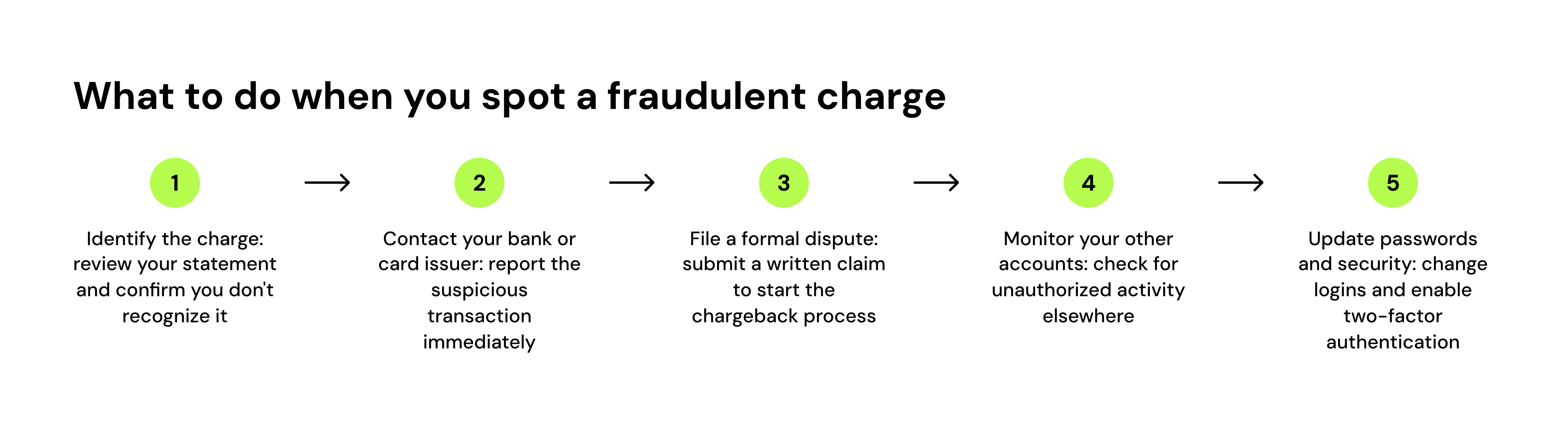
Identify the charge
The first step is to make sure the charge is actually fraudulent before escalating.
Sometimes a charge that looks unfamiliar is simply a merchant billing under a different business name, a subscription you forgot about, or a family member making a purchase on a shared account. Look up the merchant name in a search engine to see if it corresponds to a business you recognize, and double-check with anyone who may share access to the account before assuming the worst.
If the charge is still unrecognizable after that, it's safe to treat it as potentially fraudulent and move to the next step.
Contact your bank or card issuer immediately
Once you've confirmed the charge is unauthorized, call the number on the back of your card or log into your account portal to report it.
Most banks and credit card issuers have a dedicated fraud reporting line available 24/7, and many allow you to flag suspicious transactions directly within their app. When you report the charge, the bank will generally place a temporary hold on the transaction while they investigate. This said, the sooner you report it, the better, since federal law limits your liability for fraudulent charges based on how quickly you notify your issuer.
Your card issuer will typically issue you a replacement card with a new number as a standard precaution.
File a formal dispute
Beyond the initial phone call, your bank will ask you to submit a formal written dispute for the transaction.
This is basically a request to investigate and reverse a charge you didn't authorize, and it kicks off a formal chargeback process. Your bank is required by law to acknowledge your dispute within 30 days and resolve it within two billing cycles. During the investigation, you generally won't be held responsible for the disputed amount, and you'll receive provisional credit in most cases.
Keep a record of every communication with your bank throughout this process, including dates, representative names, and any reference numbers you're given.
Monitor your other accounts
A fraudulent charge on one account is often a signal that your information has been more broadly compromised.
Every individual who has any active financial accounts should check all of them after spotting fraud, since fraudsters frequently use stolen credentials to test multiple accounts at once. Look for any other unauthorized transactions, changes to your personal information, or new accounts opened in your name. Checking your credit report is a smart move here too, since new accounts or hard inquiries you don't recognize can be an early sign of identity theft.
If you have a Kikoff plan, you can use the dispute tools to flag any inaccurate items that may have appeared on your credit report as a result of fraudulent account activity.
Update your passwords and security settings
After reporting the fraud, immediately update the passwords for any financial accounts that may be affected.
Use a strong, unique password for each account, and enable two-factor authentication wherever it's available. If you reused the same password across multiple platforms, change all of them, since credential stuffing attacks, where stolen login info is tried across dozens of sites, are one of the most common ways fraudsters gain broad access to accounts.
Know your rights under federal law
Understanding what protections you have as a consumer makes the dispute process far less intimidating.
Credit card fraud protections
Under the Fair Credit Billing Act (FCBA), your maximum liability for fraudulent credit card charges is $50, and most major issuers offer zero-liability policies that take that down to $0.
To receive full protection, you generally need to report the unauthorized charge in writing within 60 days of the statement date on which the charge appeared. This is why reviewing your statements monthly is so important. In practice, most credit card companies resolve fraud disputes quickly and issue provisional credit while the investigation is underway.
Debit card fraud protections
Debit cards carry slightly more risk than credit cards when it comes to fraud liability.
Under the Electronic Fund Transfer Act (EFTA), your liability depends heavily on how quickly you report the unauthorized transaction. Here's a breakdown of how timing affects your liability:
- Report within 2 business days: maximum liability is $50
- Report after 2 business days but within 60 days: maximum liability is $500
- Report after 60 days: you may be liable for the full amount
This means protecting your debit card information is especially important, since the window for full protection is much narrower than with credit cards.
Disputing billing errors vs. fraudulent charges
Not every dispute involves fraud.
Sometimes merchants make billing errors, be it a double charge, an incorrect amount, or a charge for a service you canceled. These are handled under similar consumer protection laws, but the process can differ slightly from an outright fraud claim. In either case, contacting your bank and filing a dispute is the right first move, and your issuer will classify the claim appropriately.
How to prevent fraudulent charges
Handling fraud after it happens is important, but preventing it in the first place is even better.
Use virtual card numbers
Many banks and third-party tools allow you to generate a virtual card number, effectively a temporary card number tied to your real account, for use in online transactions.
This means even if the merchant's site is compromised or your virtual number is stolen, the fraudster can't use it to make purchases elsewhere or trace it back to your real card number. Virtual card numbers are a no-brainer for anyone who shops frequently at smaller or unfamiliar online retailers.
Set up transaction alerts
Most banks allow you to set up real-time alerts for every transaction made on your account, which is one of the most effective ways to catch fraud early.
You can usually configure alerts by transaction amount, merchant type, or simply for all activity. This said, even if you opt for alerts only above a certain threshold, fraudsters often start with small test charges to verify card validity before making larger purchases. Setting alerts for all transactions, or at least for amounts as low as $1, is the most protective option.
Shop on secure networks
Avoid making financial transactions on public Wi-Fi networks, be it at a coffee shop, airport, or hotel.
Public networks are generally unsecured, which makes it easier for bad actors to intercept your data. If you need to access a financial account while on the go, use your mobile data connection or a reputable VPN instead. At home, make sure your router password is strong and your firmware is up to date.
Be cautious with phishing attempts
Phishing is one of the most common ways fraudsters steal payment information, and it's gotten increasingly sophisticated.
Phishing attempts usually arrive as emails, text messages, or phone calls that appear to be from a legitimate source, like your bank, a retailer, or a government agency, asking you to verify your account details. Legitimate financial institutions will never ask you to provide your full card number, password, or PIN via email or text. When in doubt, hang up or close the message and contact the company directly using the official number or website you already have on file.
Protect your physical cards
Card skimming, where a device is placed over a legitimate card reader to capture your information, is still a common form of payment fraud.
Inspect ATMs and gas station card readers before inserting your card, looking for anything that seems loose, misaligned, or added on top of the original hardware. Where possible, use contactless payment methods like tap-to-pay or mobile wallets, since these generate a one-time transaction code that can't be reused even if intercepted. Luckily, most modern chip-and-tap transactions are significantly harder to skim than older magnetic stripe swipes.
Freeze your credit when you're not actively applying
If you're not planning to apply for new credit in the near future, placing a credit freeze with all three bureaus (Equifax, Experian, and TransUnion) is one of the strongest protections against identity-driven fraud.
A freeze prevents new credit accounts from being opened in your name, even if a fraudster has your personal information. It's free, it doesn't affect your existing accounts or credit score, and you can lift it temporarily whenever you need to apply for something. Every individual who has experienced any form of data breach should consider this step immediately.
How fraud can affect your credit
Fraudulent activity doesn't just drain your bank account; it can also damage your credit if left unchecked.
Unauthorized accounts
If a fraudster uses your personal information to open new credit accounts in your name, those accounts will appear on your credit report.
If the fraudster then fails to make payments on those accounts, the resulting negative history will show up as your responsibility unless you dispute it. Disputing inaccurate items on your credit report is your right under the Fair Credit Reporting Act (FCRA), and luckily, apps like Kikoff make it easy to generate dispute letters and send them to the bureaus for review.
High balances from fraudulent charges
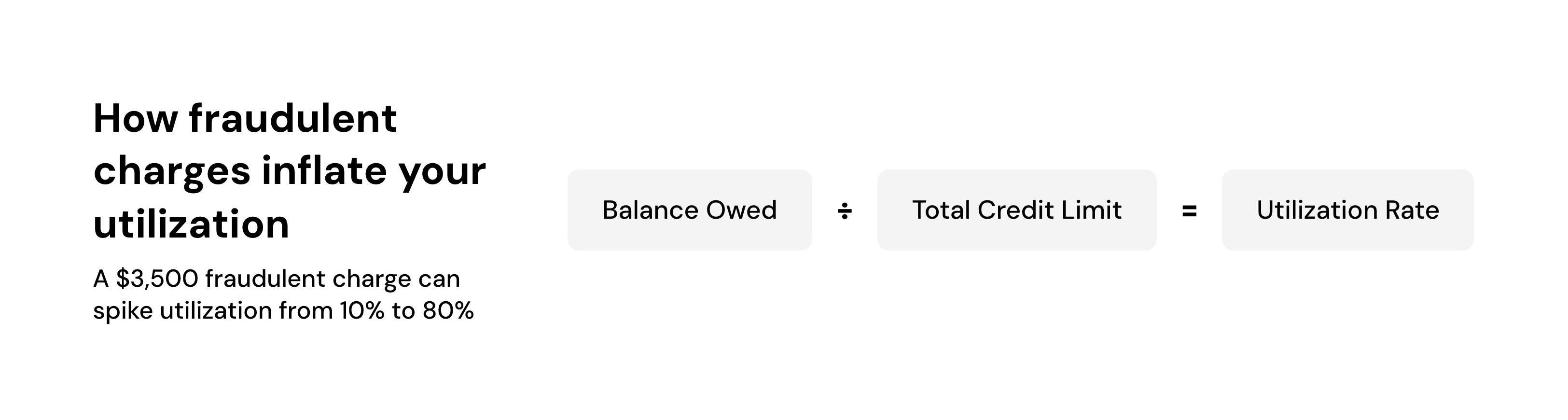
Fraudulent charges that inflate your credit card balance can temporarily hurt your credit utilization rate, which makes up 30% of your credit score.
Credit utilization is calculated as the amount you owe divided by your total available credit, and a sudden spike caused by unauthorized charges can look like financial stress to the credit bureaus. Once the dispute is resolved and the charges are reversed, your utilization should return to normal, but it's worth keeping an eye on it throughout the process.
How to dispute credit report errors after fraud
If fraudulent activity has already affected your credit report, the FCRA gives you the right to dispute any inaccurate information directly with the credit bureaus.
You can file disputes with each bureau individually by mail or online, and they're required to investigate and respond within 30 days. Documenting everything, including police reports, bank correspondence, and dispute confirmation numbers, makes the process significantly smoother.
Conclusion
Fraudulent charges are disruptive, but they don't have to be catastrophic if you respond quickly and know your rights.
Report unauthorized charges to your bank as soon as you spot them, file a formal dispute, and take steps to secure your accounts right away. From there, building strong prevention habits, like real-time alerts, virtual card numbers, and regular credit monitoring, will make you a much harder target going forward.
If fraud has left any inaccurate marks on your credit report, you don't have to let them sit there. Kikoff offers free dispute tools to help you flag errors and send them to Equifax for review, with no credit check required to get started.
Frequently Asked Questions
About the editor

Disclaimer: The information provided in this blog post is meant for informational purposes only and does not constitute financial advice.