
Having equity in your car means it’s worth more than you owe on it. If the car would sell for $12,000 and the loan payoff is $9,000, you have $3,000 in equity, and that money is yours when you sell or trade in. If you owe more than the car is worth, you have negative equity. That’s common early in a loan, because cars usually lose value fastest when they’re new. You can still sell, trade in, or keep driving. You just need to know the size of the gap first, because someone has to cover it.
How to figure out your car’s equity
Equity is the car’s value minus what it would take to pay off the loan. Here’s how to get both numbers right.
- Start with your payoff amount. Your statement balance may leave out interest that’s built up since your last payment. Get a payoff quote, the exact amount to close the loan by a set date, from your lender’s app or website, or by calling.
- Next, look up the car’s value. Kelley Blue Book and Edmunds give separate trade-in and private-sale estimates. Trade-in value is usually lower, because the dealer needs room to resell the car. For a firm number, get a written offer from a dealer or an online car buyer.
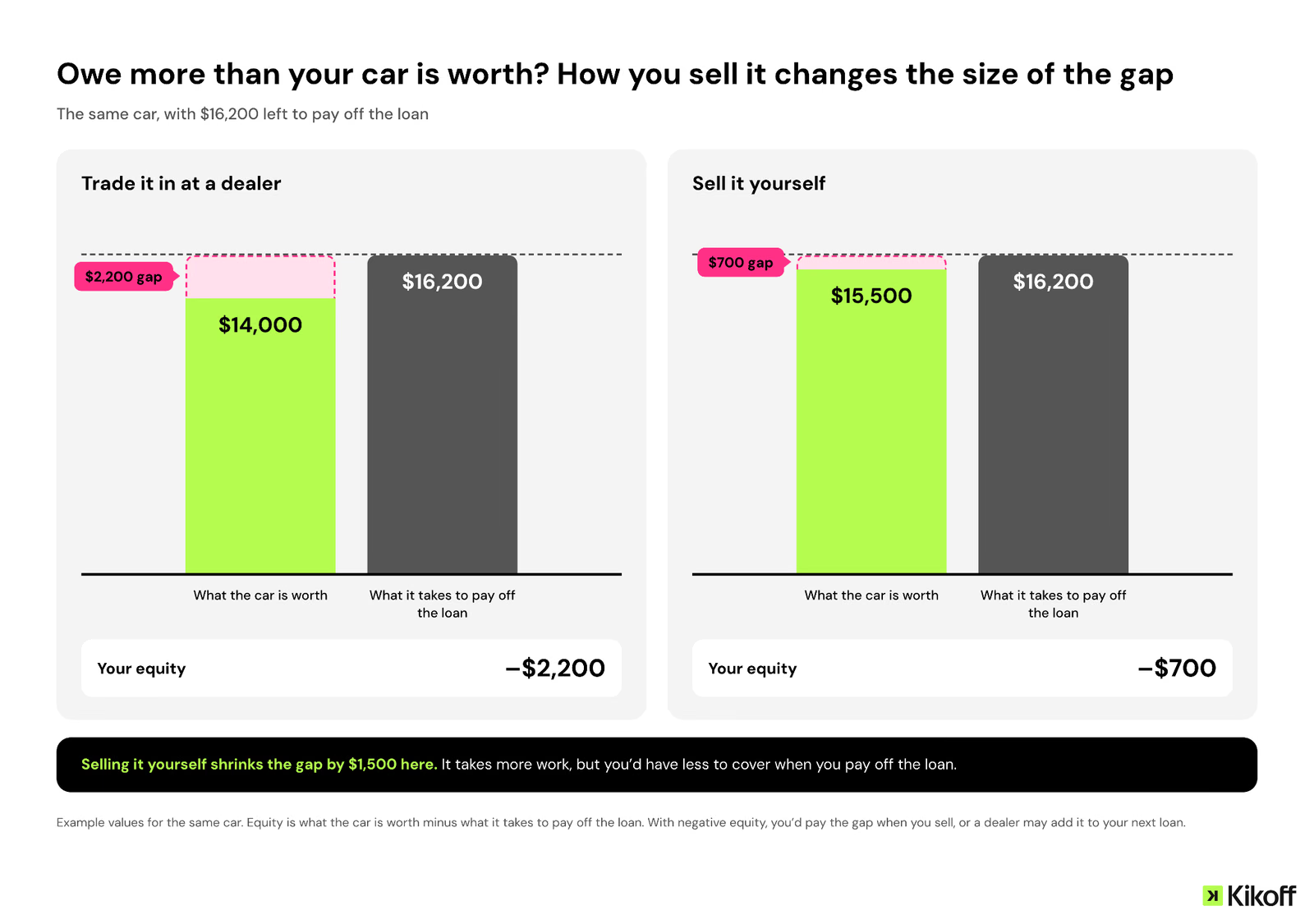
- Then subtract the payoff from the value. A positive result is your equity. A negative one is what you’d still owe after the car is gone.
Here’s the same car, two ways.
What positive and negative equity mean for you
Equity doesn’t change anything about driving the car day to day. It shows up when the loan ends early.
That middle row is where negative equity can hurt most. Standard car insurance pays up to the car’s value, not what you owe. GAP insurance is optional coverage meant to pay the difference between your loan balance and the insurance payout if the car is stolen or totaled. Prices vary a lot, so compare the dealer’s price with your own car insurer’s before you buy. You can cancel GAP and other optional add-ons, and you may be owed a refund if you sell, refinance, or pay off the loan early.
Why you might owe more than the car is worth
Negative equity is mostly math:
- Cars lose value fastest in their first few years. Your loan balance usually falls more slowly.
- Early payments carry more interest. On a simple-interest loan, interest is charged on what you still owe, so it takes the biggest share of each payment at the start. A higher APR makes that worse.
- Long loan terms, financed taxes and fees, and balances rolled over from your last car all raise what you owe without raising what the car is worth.
Read more >> What Is a Good APR for a Car Loan?
If you owe more than your car is worth
If you don’t need to sell, keeping the car and paying on time is often the simplest path. Each payment narrows the gap.
- Pay a little extra if you can. Even $20 a month helps. Ask your lender to apply it to principal, the loan balance you still owe. Your contract and state law decide whether there’s a penalty for paying early, so check first.
- If you need to sell, compare offers. A private sale may close more of the gap. Your lender holds a lien, its legal claim on the car, until the loan is paid, so you’ll need to cover any difference before the title can move to the buyer. Ask your lender how that works, and check your state motor vehicle agency’s title-transfer rules.
- If you trade in, watch for a rolled-over balance. According to the CFPB, adding what you still owe to a new loan makes that loan more expensive. If a dealer promises to pay off your negative equity, make sure it isn’t folded into your new financing. A week after the sale, call your old lender to confirm the loan is paid off.
If the payments themselves are the hard part, call your lender as soon as you can and ask about a payment plan or a new due date. Get any agreement in writing. Calling early gives you the most room, because in many states a lender can repossess your car as soon as you default, without notice. In most states, it can also sue you for the difference if the car sells for less than you owe. Your state attorney general’s office can tell you which rules apply where you live. The National Foundation for Credit Counseling (NFCC) can connect you with free or low-cost debt counseling at 800-388-2227. If repossession has started or you get court papers, contact a local legal aid office or a licensed attorney.
Read more >> How to Pay Off a Car Loan Early
Ways to use positive equity
- Put it toward your next car. When you trade in, your equity counts toward the purchase, so you borrow less. Make the same one-week call to your old lender to confirm the loan is closed.
- Sell and keep the difference. Once the lender is paid and releases the lien, the rest is yours.
- Refinance at a lower rate. Positive equity can make it easier to qualify, and if your credit is stronger than when you bought the car, a new loan may cost less.
Read more >> How to Refinance a Car Loan
Borrowing against your car. A cash-out refinance or a car title loan turns your equity into cash, but the car becomes collateral. If you miss payments, you could lose the car you need to get to work. Before you sign, compare the APR with a personal loan from a credit union.
Bottom line
Car equity is what your car is worth minus what you’d need to pay off the loan, and it matters most when you sell, trade in, or the car is totaled. You can’t control how fast a car loses value. You can shape the rate on your next loan, which decides how much of each payment goes to the car instead of interest, and lenders check your credit history when they set it. Kikoff’s Credit Account reports your on-time payments to Equifax, Experian, and TransUnion, with no credit check to sign up, so that history can start growing before you shop. Plans start at $5 a month.
Frequently Asked Questions
Article Sources
Disclaimer: The information provided in this blog post is meant for informational purposes only and does not constitute financial advice.