.jpg)


Many factors influence car loan rates, including your credit score, market rates, the car you're buying, and the individual lender. If you're hoping to buy a car in the near future, you understandably want to know what counts (and doesn't count) as a good rate, as well as what is a good APR for a car loan.
What is a good APR for a car loan?
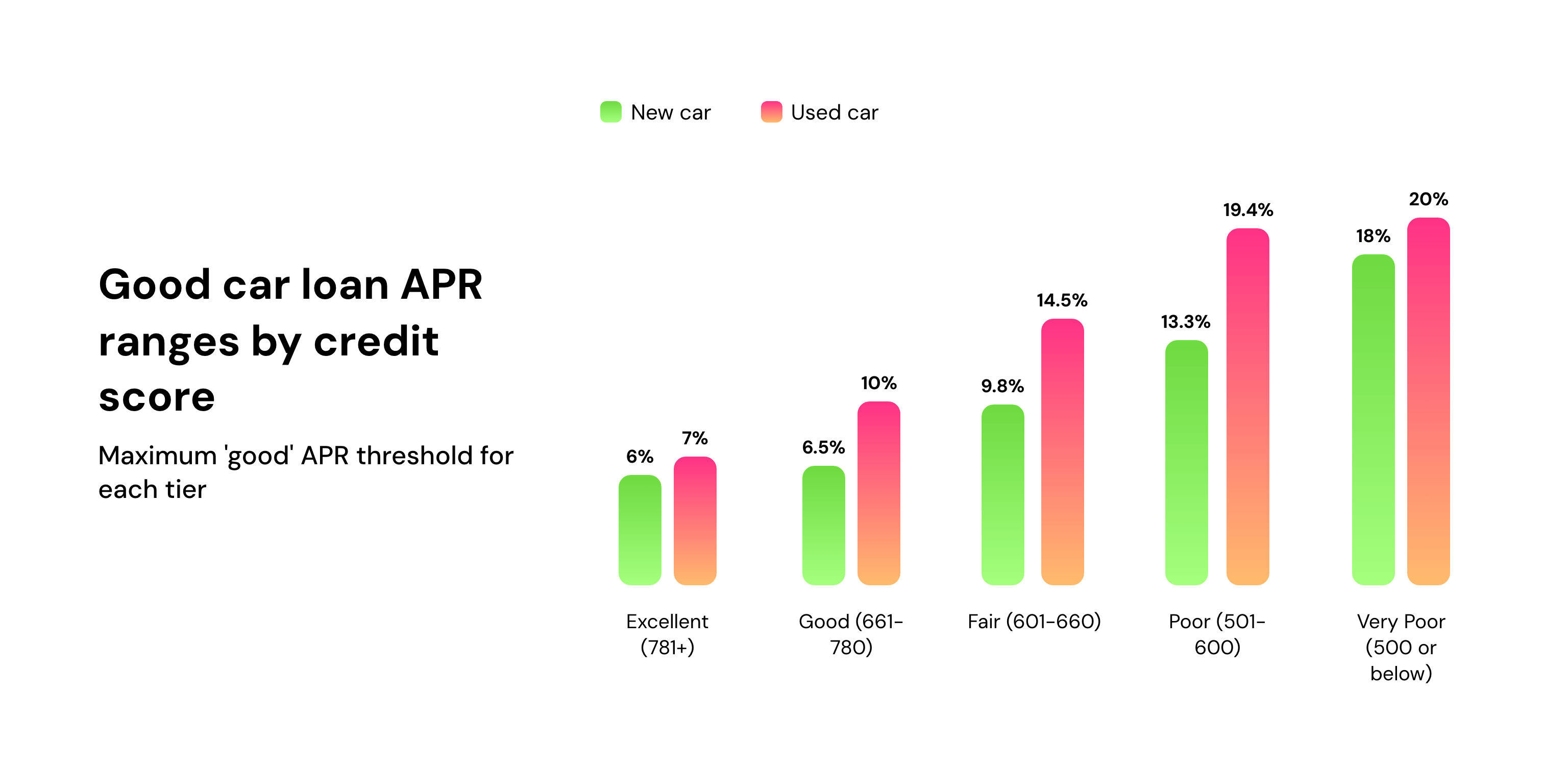
People with excellent credit often qualify for new car loans under 6% interest and used car loans under 9% (as of early 2026).
However, car loan interest rates vary widely, and your credit score is one of the most important factors determining rates.[1] Borrowers with very poor credit might only qualify for loans with 20% interest or more.
Good car loan APR ranges by credit score
Generally, single-digit APRs are considered "good." However, if you have bad, fair, average, or even good credit, it might not be possible to qualify for the best possible rates.
That's why it's important to get a sense of good car loan APRs for your specific credit score range.
Excellent credit (781 and above)
Auto loan lenders often describe this category as "super-prime" because people with excellent credit scores will qualify for interest rates that are even better than competitive rates.
If you have excellent credit, you should be able to qualify for car loans with 4–6% interest or even lower. Loans for used cars might be slightly higher, but if a lender offers a loan with 7% interest or greater, you'll probably be able to find a better deal somewhere else.
Good credit (661-780)
This category is usually described as "prime" by auto lenders. If your score is in this range, you can't expect to qualify for the absolute best rates. However, you should still be able to secure a competitive rate. You also shouldn't have any trouble getting approved.
With good credit, you should be able to get a new car loan for 6.5% or lower. If you're shopping for a used car, look for rates of 10% or less.
Fair credit (601-660)
Lenders sometimes describe this category as "non-prime." If you have fair credit, you won't qualify for the best rates available, but most lenders will still approve you.
If you have fair credit, look for a rate of about 9.8% or less for new car loans. For used cars, 14.5% or lower is good. If you're in this range, it's especially important to shop around. Some lenders will likely approve you for much lower rates than others.
Poor credit (501-600)
Auto lenders usually refer to this credit score range as "subprime," meaning that borrowers are higher-risk and interest rates are much higher. Because subprime loans are statistically much riskier, many lenders don't offer them at all.
In this range, a rate of around 13.3% or less for a new car is good. For a used car, a good rate is 19.4% or lower.
If you fall into this credit score range or below, it's a good idea to shop around for lenders specializing in loans for people with poor credit.
"Buy here, pay here" car dealerships will usually offer fast approval, but they almost always charge extremely high interest rates.[2] It's a good idea to check with local credit unions and even online lenders before getting a buy-here, pay-here car loan.
Very poor credit (500 and below)
This credit score range is sometimes described as "deep subprime." If your credit score is 500 or lower, lenders see you as a major risk, and they charge very high interest rates to offset that risk. Many lenders may not approve you at all.
If you can get approved for a new car loan, a rate of 18% or lower is good. For a used car loan, anything below 20% is good. However, it's not uncommon for lenders to charge more than 20% interest on car loans to people with very poor credit.
New car vs. used car APR
Many people don't realize that car loan rates can vary depending on whether you're getting a new or used vehicle. Used car loans often come with higher APRs because used cars pose a greater risk to lenders.
Used cars depreciate faster. If you default on your loan and your lender repossesses the car, they might not recoup all of their money by selling it.
When it comes to getting a good rate on a car loan, your credit score matters more than whether you're buying new or used. Typically, the APR on a used car loan will be a percentage point or two higher than the APR on a new car loan.
Want to boost your credit before you buy?
Even a modest improvement in your credit score could lead to major savings when you buy a car. And if you're ready to improve your credit but aren't sure how to do it, Kikoff can help. We're a credit-builder app for everyone, even people with bad credit or no credit.
When you sign up with us, you can start building credit with a credit line. We also offer rent reporting, debt negotiation, secured credit cards, and other resources to help take your credit to the next level.
Joining is free, and we don't check your credit. Create your account with us today!
Frequently Asked Questions
About the editor

Article Sources
Disclaimer: The information provided in this blog post is meant for informational purposes only and does not constitute financial advice.