


When you finally pay off a debt, it feels like closing a chapter. But without documentation proving it happened, that chapter can stay open a lot longer than it should.
A paid-in-full letter is your proof. It is the written confirmation from a creditor or debt collector that a balance has been paid completely and that nothing more is owed, effectively drawing a clear line under that account.
Getting one is not just a formality. It is one of the single most important steps you can take after settling a debt, and understanding exactly what it is and how to use it can make a real difference in your financial recovery.
Let's jump in.
What a paid-in-full letter is and what it proves
A paid-in-full letter is an official written document issued by a lender, creditor, or collection agency confirming that a specific debt has been paid in its entirety. It paints a picture of a clean slate, showing that you met your full financial obligation with no remaining balance.
Every individual who has ever paid off a collection account, a personal loan, a medical bill, or any outstanding debt should have one of these letters on file. It is not just a feel-good document; it is evidence that can be used to dispute inaccurate credit report entries, protect yourself from future collection attempts, and demonstrate financial responsibility to future lenders.
The letter generally includes the creditor's name, your account information, the amount that was paid, and a statement confirming the account is satisfied. This means you have a paper trail that is hard to argue with, which is primarily what makes it so valuable.
Without this letter, a creditor or collector could, in some cases, dispute whether a payment was made or how much was paid. Luckily, getting one is usually straightforward, as long as you know to ask.
When you need a paid-in-full letter
This said, not every paid debt will automatically come with documentation you can use. You need to actively request this letter in most cases, and knowing when to do so can save you lots of headaches down the road.
You should request a paid-in-full letter any time you pay off a collection account, since these are the accounts most likely to cause problems on a credit report if not properly documented. The same applies when paying off old debts directly with original creditors, be it a credit card balance, a medical bill, or a personal loan.
If you are preparing to apply for a mortgage or major loan, lenders will often want to see proof that past delinquencies have been resolved. A paid-in-full letter is basically the gold standard of that proof.
You also want one if you ever receive any future contact from a collection agency claiming you still owe a debt you have already paid. Having the letter on hand lets you dispute the claim quickly and effectively, without spending weeks chasing paperwork.
How to request a paid-in-full letter
Requesting a paid-in-full letter is super straightforward, and it is something you should do as soon as your final payment clears. The process is mainly a matter of contacting the right party and being specific about what you are asking for.
Start by reaching out to the creditor or collection agency in writing, either by email or certified mail, so you have a record of the request. In your message, include your full name, account number, the amount paid, and the date the payment was made, then ask explicitly for a paid-in-full letter or a letter of account satisfaction.
Every individual who makes this request should follow up if they do not hear back within 10 to 14 business days. Do not assume the letter is on its way just because the payment went through.
When you receive the letter, review it carefully before filing it away. Just make sure it includes the account number, the creditor's name, the amount paid, the date, and a clear statement that the balance is zero and the account is satisfied.
Keep both a physical copy and a digital copy stored somewhere secure, since you may need to reference it months or even years later.
What a paid-in-full letter should include
Not all paid-in-full letters are created equal, and a vague or incomplete letter may not do you much good if you ever need to use it. Here is a breakdown of what a proper letter should contain.
The letter should include the creditor or collection agency's official name and contact information. It needs your name and the account number associated with the debt, along with the original creditor's name if the debt was sold to a collector.
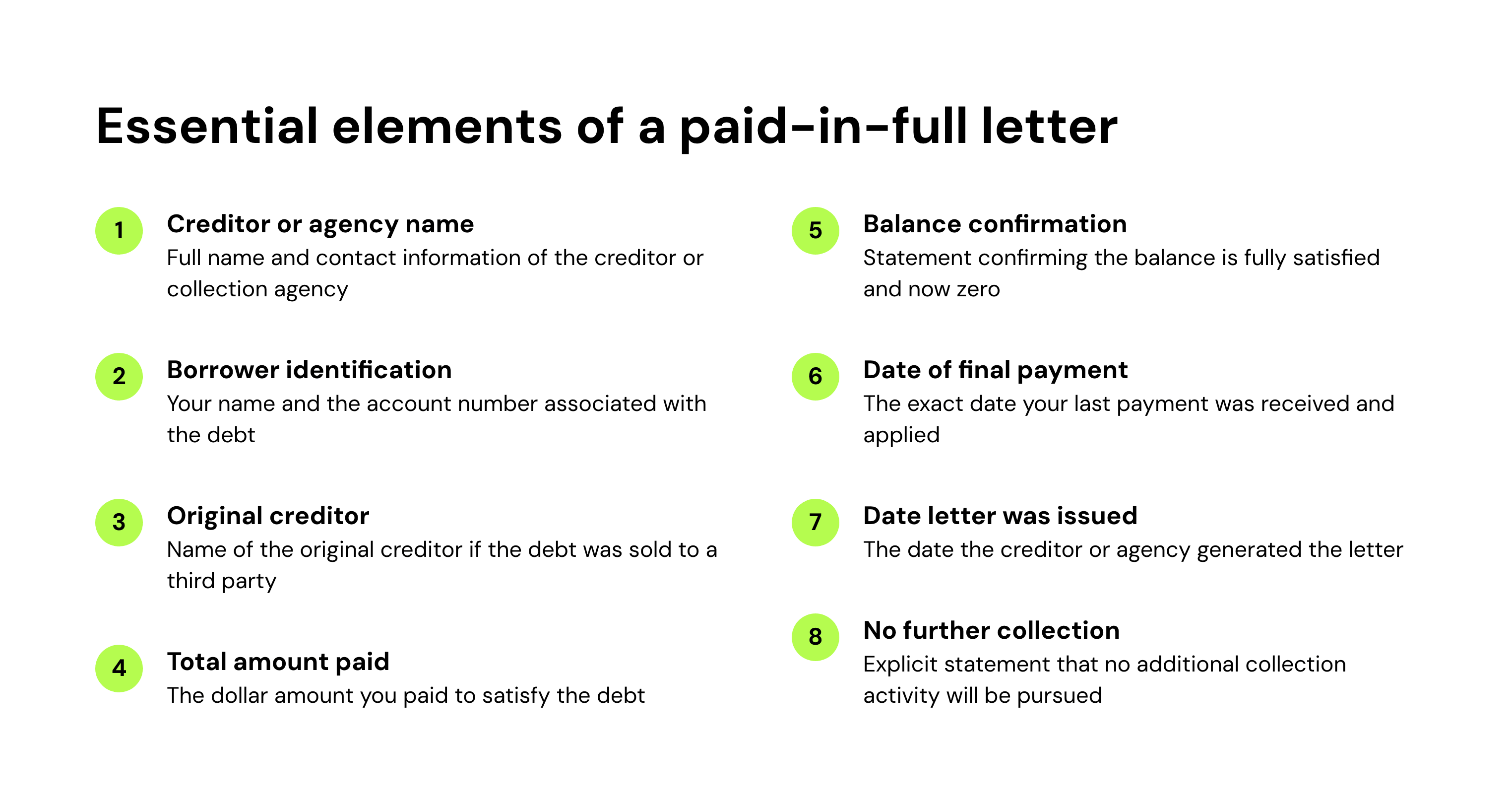
It should state the total amount paid and confirm that this amount fully satisfies the outstanding balance. The date of the final payment and the date the letter was issued should both appear clearly.
Finally, the letter should include an explicit statement that the account is paid in full, that the balance is zero, and that no further collection activity will be pursued. A letter that is missing any of these elements is worth going back to the creditor to request a corrected version.
Paid-in-full vs. settled-in-full: an important distinction
This is where lots of people get tripped up, and it is a distinction that matters a great deal for your credit report. A paid-in-full letter and a settled-in-full letter are not the same thing, and the difference can affect your credit profile for years.
Paid in full means you paid the entire original amount owed. Settled in full, on the other hand, means you negotiated with the creditor to pay less than the full balance, and the creditor agreed to accept that reduced amount as complete satisfaction of the debt.
From a credit reporting standpoint, a settled account is generally viewed less favorably than one that was paid in full. It signals to future lenders that you did not repay the full obligation, which can make you appear as a higher credit risk.
This said, settling a debt is often far better than leaving it unpaid, and there are situations where negotiating a settlement is a smart financial move. Kikoff offers free debt negotiation support to help users navigate exactly these kinds of decisions without the pressure of a debt settlement company taking a cut.
Just make sure that whichever outcome you reach, you get the appropriate letter in writing before you consider the matter closed.
How a paid-in-full letter affects your credit report
A paid-in-full letter does not automatically update your credit report; that is a step you have to take yourself. But having the letter puts you in a strong position to dispute inaccurate or outdated information effectively.
When a debt is reported as paid in full, the negative account status is updated, and while the account may still appear on your report for up to seven years, the notation that it has been fully resolved is a meaningful improvement. Future lenders and creditors can see that you followed through on the obligation.
Every individual who has had a collection account should check their credit report after receiving a paid-in-full letter to make sure the update is reflected accurately. If the account still shows an outstanding balance or an incorrect status, you can use the letter to dispute the error with the credit bureaus.
Luckily, disputing errors is a no-brainer process when you have the documentation to back up your claim. Kikoff's free dispute tools make it easy to flag inaccurate items on your credit report without needing to hire anyone or pay a fee.
This means that a paid-in-full letter is not just a receipt; it is a tool you can use to actively improve what lenders see when they pull your credit file.
What to do after receiving your paid-in-full letter
Getting the letter is step one, but knowing what to do next is just as important. The goal is to make sure the payment is accurately reflected everywhere it should be, and to use the moment as a launching pad for stronger financial habits.
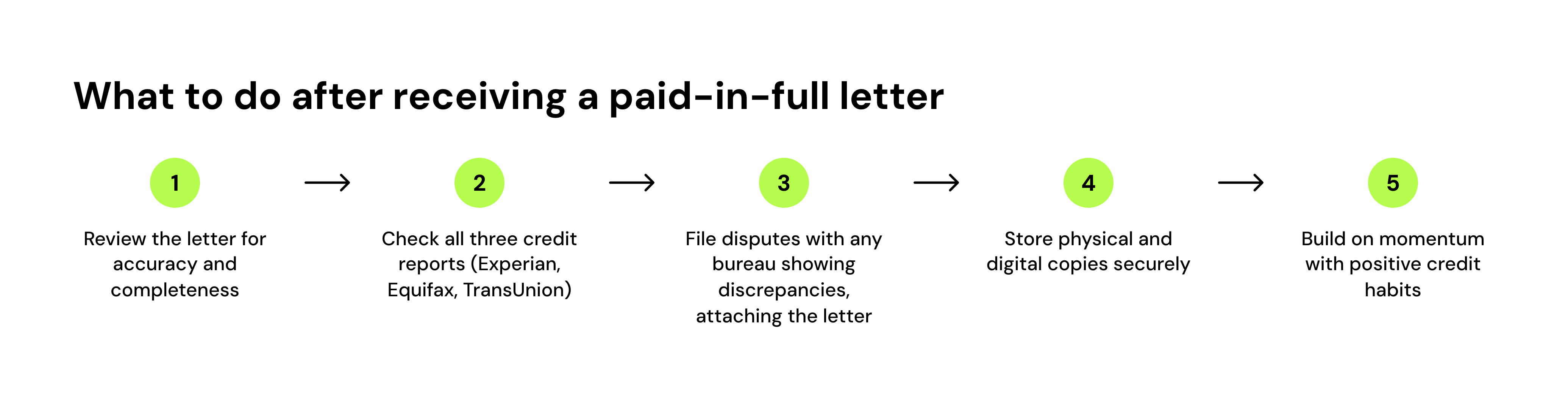
First, check all three of your credit reports, through Experian, Equifax, and TransUnion, to see how the account is currently listed. If there are any discrepancies between what the letter says and what the report shows, file a dispute with the relevant bureau and attach the letter as supporting documentation.
Next, store your letter somewhere you can find it easily, since collection errors and duplicate collection attempts are more common than most people realize. Having the letter accessible means you can respond quickly if a problem surfaces.
This is also a good time to take stock of your broader credit picture. Paying off a debt is a real accomplishment, and building on that momentum, be it by opening a responsible credit account, reducing utilization elsewhere, or establishing on-time payment history, can accelerate your credit recovery.
Usually, the people who make the fastest credit progress are the ones who treat each resolved debt as the starting point for something better, not just the end of something difficult.
Conclusion
A paid-in-full letter is one of the most practical documents you can have in your financial toolkit. It protects you from future collection attempts, gives you leverage to dispute credit report errors, and paints a picture of an obligation that was fully honored.
If you are in the process of paying off debts and working toward stronger credit, Kikoff is built for exactly that journey. Kikoff is a credit-building platform that helps every individual who wants to establish or rebuild their credit history through responsible, accessible tools, including free debt negotiation support and free dispute tools to help clean up your report.
Getting your credit on track does not have to be overwhelming, and you do not have to do it alone. Start building positive history today at kikoff.com.
Frequently Asked Questions
About the editor
Disclaimer: The information provided in this blog post is meant for informational purposes only and does not constitute financial advice.