



Seeing a derogatory mark on your credit report can feel like a gut punch, especially when you're working hard to get your finances on track. Luckily, you have more options than you might think, and some of those marks may be removable sooner than their scheduled expiration date. Let's jump in and break down exactly what you can do.
Every individual who has ever borrowed money, missed a payment, or dealt with a collections agency has likely encountered a derogatory mark at some point. Understanding what these marks are, how long they last, and what steps you can take is the single most important thing you can do for your credit health right now.
What derogatory marks on your credit report actually are
A derogatory mark is basically any negative item on your credit report that signals to lenders you've had trouble managing debt.
Every individual who reviews their credit report for the first time is often surprised by how many different types of negative entries exist, and how differently each one can affect your score. This means that not all derogatory marks are created equal, and the impact each one has generally depends on its type, age, and severity.
Your credit report paints a picture of your entire borrowing history, and derogatory marks are the chapters lenders pay closest attention to.
Lenders use this information to assess risk, which is primarily why a single collection account or bankruptcy can result in a significantly higher interest rate, be it a mortgage, car loan, or credit card application.
This said, the presence of derogatory marks doesn't mean you're permanently locked out of good credit, and there are real, actionable steps you can take to address them. Lots of people successfully rebuild their credit profiles even after serious negative events.
Types of derogatory marks and how long they stay on your report
Here's a breakdown of the most common types of derogatory marks and their typical reporting timelines.
Late payments are usually the first negative mark people encounter, and they occur any time a payment is reported 30 or more days past due. They generally stay on your credit report for seven years from the date of the original missed payment, though their impact on your score fades over time. A single late payment can meaningfully lower your score, which is mainly why payment history is considered the single most important factor in most credit scoring models.
Collections accounts appear when a debt is sold or transferred to a collections agency after the original creditor gives up trying to collect. These also stay on your report for seven years, typically from the date the original account first became delinquent. Lots of consumers don't realize that paying off a collections account doesn't automatically remove it from their report.
Charge-offs happen when a lender writes off your debt as a loss, usually after 120 to 180 days of nonpayment, and they remain visible for seven years. A charge-off is essentially the creditor acknowledging they don't expect to collect the full balance, though the debt may still be sold and pursued. This is super damaging to your credit score and signals serious delinquency to future lenders.
Bankruptcies are generally the most severe derogatory mark, with Chapter 7 bankruptcies staying on your report for ten years and Chapter 13 for seven years. Foreclosures, which occur when a lender repossesses your home due to missed mortgage payments, typically remain for seven years as well. Both of these events paint a picture that lenders view as high-risk for an extended period.
How to dispute inaccurate derogatory marks
Every individual who finds an error on their credit report has the legal right to dispute it under the Fair Credit Reporting Act, or FCRA.
The FCRA requires credit bureaus to investigate disputes and remove any information they cannot verify as accurate within 30 days. This means that inaccurate, outdated, or unverifiable derogatory marks can and should be challenged effectively.
The dispute process involves submitting a formal complaint to the three major credit bureaus: Equifax, Experian, and TransUnion. You can file disputes directly through each bureau's website, by mail, or by using a platform like Kikoff that generates dispute letters for all three bureaus at no cost. Just make sure your dispute is specific and includes any supporting documentation, be it payment records, account statements, or identity verification.
Once a dispute is filed, the bureau contacts the original data furnisher to verify the information. If the furnisher cannot confirm the accuracy of the item, the bureau is required to delete or correct it. Luckily, this process has become more accessible in recent years, and you don't need to hire a third party to navigate it successfully.
Common errors worth disputing include accounts that don't belong to you, incorrect payment statuses, duplicate entries, and accounts that are past their legal reporting window. Every individual who takes the time to thoroughly review all three of their reports often finds at least one item worth challenging. The bureaus are legally obligated to take your dispute seriously, and this said, persistence is often required if an initial dispute is rejected.
Sending a goodwill letter to remove negative marks
A goodwill letter is basically a written request asking a creditor to remove a legitimate negative mark as an act of goodwill, usually citing your otherwise positive history with them.
This strategy is mainly used for isolated late payments or minor delinquencies, especially when you have a long and otherwise clean account history with the creditor. It's no-brainer territory if you've been a reliable customer and the negative mark was a one-time mistake.
There's no guarantee a creditor will honor a goodwill request, but lots of people have success with this approach, particularly with smaller creditors or when the delinquency was due to a documented hardship. Keep your letter concise, honest, and focused on your track record and current situation. Generally, you'll want to send it directly to the original creditor rather than the credit bureaus, since the creditor is the one with authority to remove what they reported.
Negotiating pay-for-delete agreements
Pay-for-delete is an arrangement where you offer to pay a collections account in full or settle it, in exchange for the collector removing the negative entry from your credit report.
This means you're essentially trading payment for a cleaner report, which is primarily useful when the debt is legitimate but still hurting your score. Not every collector will agree to this, but it's worth requesting in writing before making any payment.
Every individual who pursues this strategy should get the agreement in writing before sending any money, as verbal promises from collectors are not enforceable. Collections agencies are not required by law to agree to pay-for-delete, but lots of them will negotiate, especially on older debts where recovery is uncertain. Just make sure the written agreement clearly states that the tradeline will be deleted from all three bureaus upon receipt of payment, not just marked as paid.
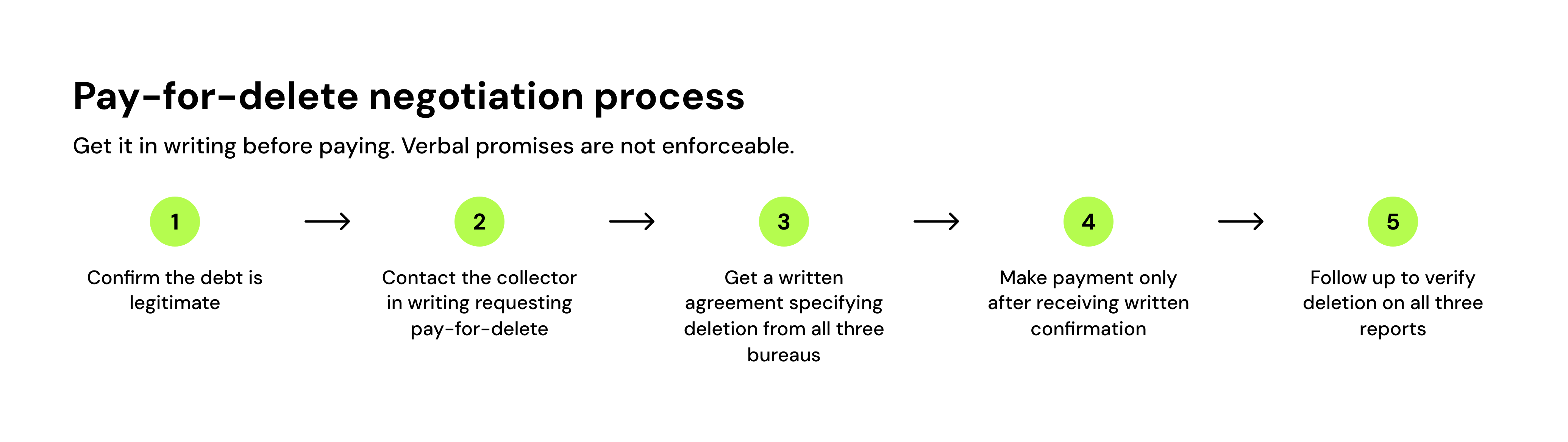
Be aware that even paid collections can remain on your report if no deletion agreement is in place, which is mainly why the sequence of steps here matters so much. This said, some newer credit scoring models weigh paid collections less heavily than unpaid ones, so paying without a deletion agreement can still be beneficial. Effectively managing this negotiation requires patience and documentation throughout the process.
Building new positive history alongside removing negatives
Removing derogatory marks is super important, but it only tells half the story of credit recovery.
Every individual who focuses solely on removing negatives without adding new positive accounts often finds their score improvement is slower than expected. The most effective approach combines dispute and removal efforts with active credit-building.
Opening a secured credit card, a credit-builder loan, or a retail credit account and using it responsibly adds fresh positive data to your report each month. Payment history is the single most important scoring factor, so even a few months of on-time payments can begin to shift how your report paints a picture of your creditworthiness.
Luckily, there are products specifically designed for people in credit recovery that make this process accessible without requiring a high credit score to get started.
Kikoff's credit-building products are designed for exactly this situation, offering tools that help you establish a positive payment history while you work on resolving the negative items holding your score back. This means you're attacking the problem from both sides, which is primarily the most effective path to a meaningfully improved credit profile. Generally, consistency over time is what lenders want to see, and each on-time payment is a step toward that goal.
Keep utilization low, avoid opening lots of new accounts in a short window, and let your positive history accumulate. Lots of consumers underestimate how quickly a credit profile can shift once derogatory marks are addressed and positive accounts are being reported. Be it a few months or a couple of years, the trajectory matters as much as the starting point.
Conclusion
Removing derogatory marks from your credit report is effectively a combination of knowing your rights, taking the right steps in the right order, and staying consistent over time.
Every individual who approaches this process with a clear strategy, be it disputing inaccuracies, sending goodwill letters, or negotiating pay-for-delete, is giving themselves a real shot at a cleaner, stronger credit profile.
Kikoff offers free dispute letter generation for all three credit bureaus and free debt negotiation tools, which is primarily what sets it apart as a credit-building platform rather than just another financial app. This means you can address the negative marks already on your report while simultaneously building new positive history through Kikoff's credit-building products.
Luckily, you don't have to navigate any of this alone. Get started today at kikoff.com.
Frequently Asked Questions
About the editor

Disclaimer: The information provided in this blog post is meant for informational purposes only and does not constitute financial advice.