



If you've spotted "AMEX/DSNB" on your credit report and had no idea what it was, you're not alone.
In this post, we'll break down exactly what AMEX/DSNB is, when removing it could help your credit, and when leaving it alone is actually the better call.
Should you remove AMEX/DSNB from your credit report?
Whether you should remove AMEX/DSNB from your credit report depends entirely on what kind of entry it is. If it's an account in good standing, removing it could actually hurt your score. If it's a negative entry, then yes, removing it is generally worth pursuing.
Let's jump in.
What is AMEX/DSNB?
AMEX/DSNB is effectively the credit reporting name for accounts issued through American Express's retail card division, specifically cards tied to department stores and retail partners.
DSNB stands for "Department Stores National Bank," which is the banking subsidiary that American Express uses to issue co-branded retail credit cards for stores like Macy's, Bloomingdale's, and similar retailers.
Every individual who has one of these retail cards will see this entry on their report, which is completely normal and expected.
When AMEX/DSNB on your report is a good thing
If your AMEX/DSNB account is in good standing, it's actively helping your credit and you should think twice before trying to remove it.
An account in good standing contributes positively to multiple credit score factors at once.
It builds payment history (35% of your FICO score) every time a payment is reported on time, and it contributes to your available revolving credit, which directly affects your credit utilization rate (30% of your FICO score).
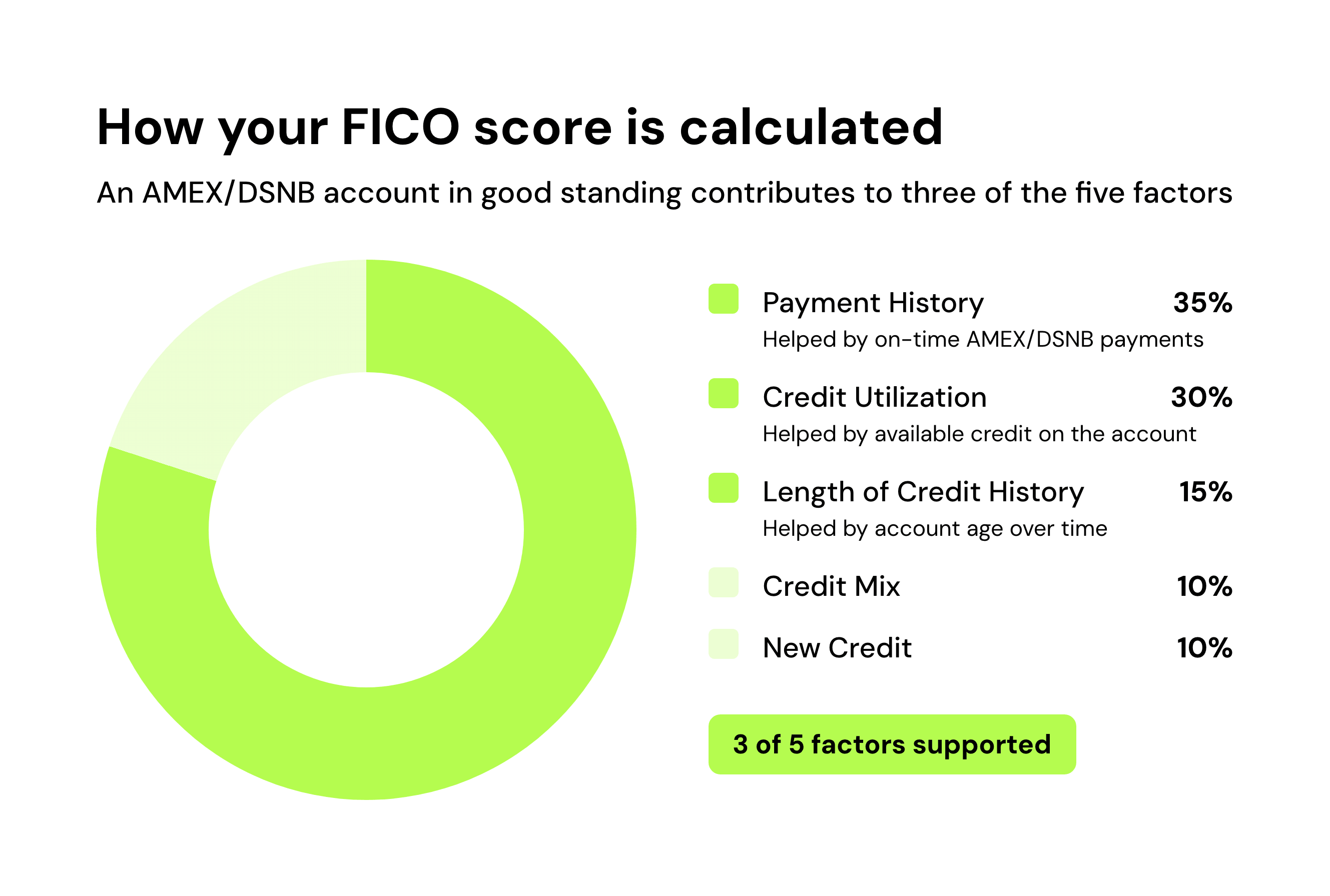
It also adds to the length of your credit history (15%), especially if the account has been open for several years.
Closing or removing a healthy account can cause your utilization to spike and your average account age to drop, both of which can hurt your score meaningfully.
When you should try to remove AMEX/DSNB from your report
If the AMEX/DSNB entry reflects a negative mark, be it a late payment, a charge-off, or a collection, then removal is worth pursuing.
The entry contains inaccurate information
If anything about the AMEX/DSNB entry is wrong, you have the right to dispute it.
The FCRA gives every individual the right to challenge inaccurate information on their credit report, and the bureaus are required to investigate and respond generally within 30 to 45 days.
You can dispute directly with Equifax, Experian, and TransUnion, or use a tool like Kikoff, which provides free dispute letter generation.
The account went to collections
If an AMEX/DSNB account was charged off and sent to a collections agency, you can pursue how to remove collections through debt validation and pay-for-delete negotiations.
How long does a negative AMEX/DSNB entry stay on your report?
Negative information generally stays on your credit report for seven years from the date of the original delinquency. After that window, the entry must be removed under the FCRA.

Building positive credit to offset a negative mark
If you do have a negative AMEX/DSNB entry that's difficult to remove, one of the most effective things you can do is build credit to outweigh it over time.
The single most important factor in your credit score is payment history, so establishing a consistent record of on-time payments on active accounts can gradually restore your score even while a negative entry is still present.
Kikoff is a credit-building platform that helps users add positive, reported payment history to their credit profile with no hard credit check required to sign up.
Conclusion
AMEX/DSNB on your credit report is not automatically a problem, and in many cases it's quietly helping your credit without you realizing it.
If the entry is accurate and in good standing, leave it alone. If it contains errors, reflects a delinquency, or belongs to someone else entirely, you have the tools to address it.
Dispute inaccuracies, validate debts before paying, and if a negative mark is dragging your score down, start building positive history alongside it.
Kikoff makes it easy to get started with no hard credit check required.
Frequently Asked Questions
About the editor

Disclaimer: The information provided in this blog post is meant for informational purposes only and does not constitute financial advice.