






A charge-off is one of the most damaging marks that can appear on your credit report, and understanding how to deal with it is essential for anyone working to rebuild their financial standing.
In this post, we'll walk through exactly what a charge-off is, how it affects your credit, and the specific steps you can take to try to remove one from your report, or at least minimize its impact over time.
What is a charge-off and why does it matter?
A charge-off is effectively a lender's declaration that a debt is unlikely to be collected after a prolonged period of non-payment, typically 120 to 180 days past due.
When a creditor charges off a debt, it doesn't mean the debt disappears. It means the creditor has written it off as a loss on their books, and the balance is still owed, often sold to a collections agency that will then pursue repayment on the original creditor's behalf.
From a credit reporting perspective, a what is a charge-off is one of the most serious negative marks a credit report can carry. It signals to lenders that you failed to meet a significant financial obligation, which paints a picture of high lending risk.
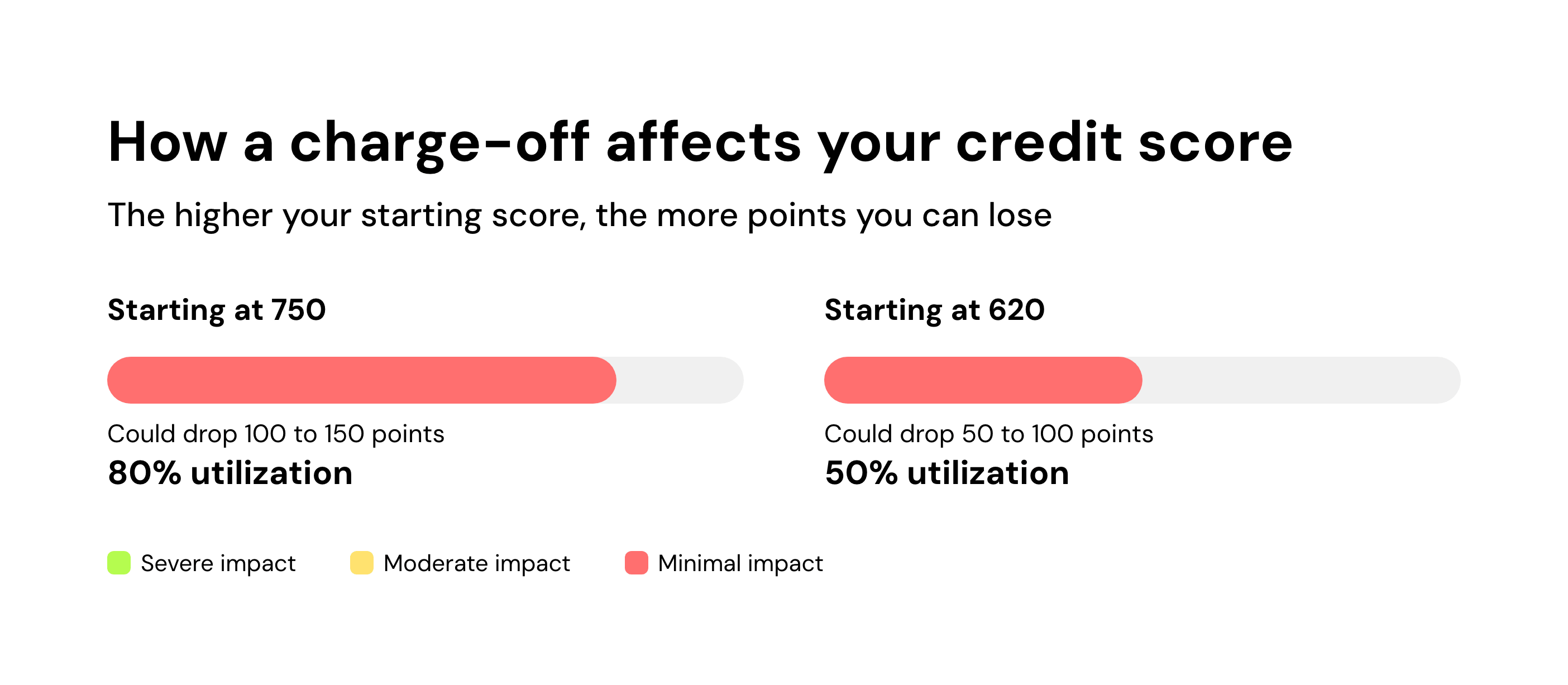
A single charge-off can drop your credit score by 50 to 150 points depending on where your score started, and it can remain on your credit report for up to seven years from the date of the original delinquency.
This said, understanding your options gives you the best chance of either removing it or reducing its long-term impact on your credit.
How to remove a charge-off from your credit report
Let's jump in to the actionable strategies for addressing a charge-off on your report.
Check if the charge-off is accurate
The single most important first step is to verify that the charge-off is actually accurate.
Credit reports contain errors more often than most people realize, and a charge-off listed incorrectly is something every individual has the right to dispute.
Pull your free credit reports from all three bureaus at annualcreditreport.com and review each one carefully, looking for discrepancies in the account name, balance, dates, or account status. Even small errors in the reported information can be grounds for a dispute.
If anything looks off, you have the legal right under the Fair Credit Reporting Act to dispute the entry with the bureau that is reporting it.
Dispute inaccurate charge-offs
If the charge-off contains errors, filing a formal dispute is your strongest avenue for removal.
You can submit a dispute directly to Equifax, Experian, or TransUnion through their online portals, by mail, or by using a tool like Kikoff, which provides free dispute letter generation for all users with no subscription required.
When filing a dispute, be specific about what is inaccurate and include any supporting documentation you have, such as payment records, account statements, or correspondence with the creditor.
The bureau is required by law to investigate the dispute, generally within 30 days, and must remove or correct any information it cannot verify as accurate.
Luckily, if the charge-off was reported in error, this path can result in a clean removal from your report entirely.
Request a "pay for delete" agreement
If the charge-off is accurate, one strategy some consumers use is negotiating a "pay for delete" arrangement with the creditor or collections agency.
In a pay for delete agreement, you offer to pay the outstanding balance, or sometimes a negotiated portion of it, in exchange for the creditor removing the charge-off from your credit report.
This said, this approach is not guaranteed to work. Many creditors and collection agencies will decline, and the major credit bureaus' policies technically discourage pay for delete agreements since their reporting guidelines require accurate information.
However, some creditors, particularly smaller collections agencies, are willing to negotiate, and getting any agreement in writing before making a payment is absolutely essential.
Just make sure that any agreement specifying removal is documented and signed by a representative of the creditor before you send a single dollar.
Negotiate a settlement and request a "paid charge-off" status
If pay for delete isn't possible, negotiating a settlement and getting the account status updated to "paid charge-off" or "settled" is a worthwhile fallback.
While a paid charge-off still appears on your credit report, it signals to future lenders that you resolved the obligation, which is generally viewed more favorably than an unpaid charge-off.
Creditors will sometimes settle for less than the full balance, especially if the account has been sold to a how to remove collections agency, which typically purchases debts for pennies on the dollar.
This means you may have more room to negotiate than you'd expect, particularly if you approach the negotiation directly and in writing.
Wait it out
If the charge-off is accurate and no creditor is willing to negotiate removal, waiting is sometimes the most realistic path forward.
Charge-offs are required to fall off your credit report after seven years from the date of the original delinquency, at which point the negative mark disappears entirely without any action on your part.
In the meantime, building positive credit history through consistent on-time payments on other accounts can gradually offset the impact of the charge-off.
Every individual who takes active steps to add positive payment history while a charge-off ages will typically see their credit score recover meaningfully over time, even before the charge-off falls off.
Kikoff is a great option for building that positive history, reporting on-time payments to all three major credit bureaus with no hard credit check to sign up.
How long does a charge-off stay on your credit report?
A charge-off remains on your credit report for seven years from the date of the first missed payment that led to the charge-off, which is known as the "original delinquency date."
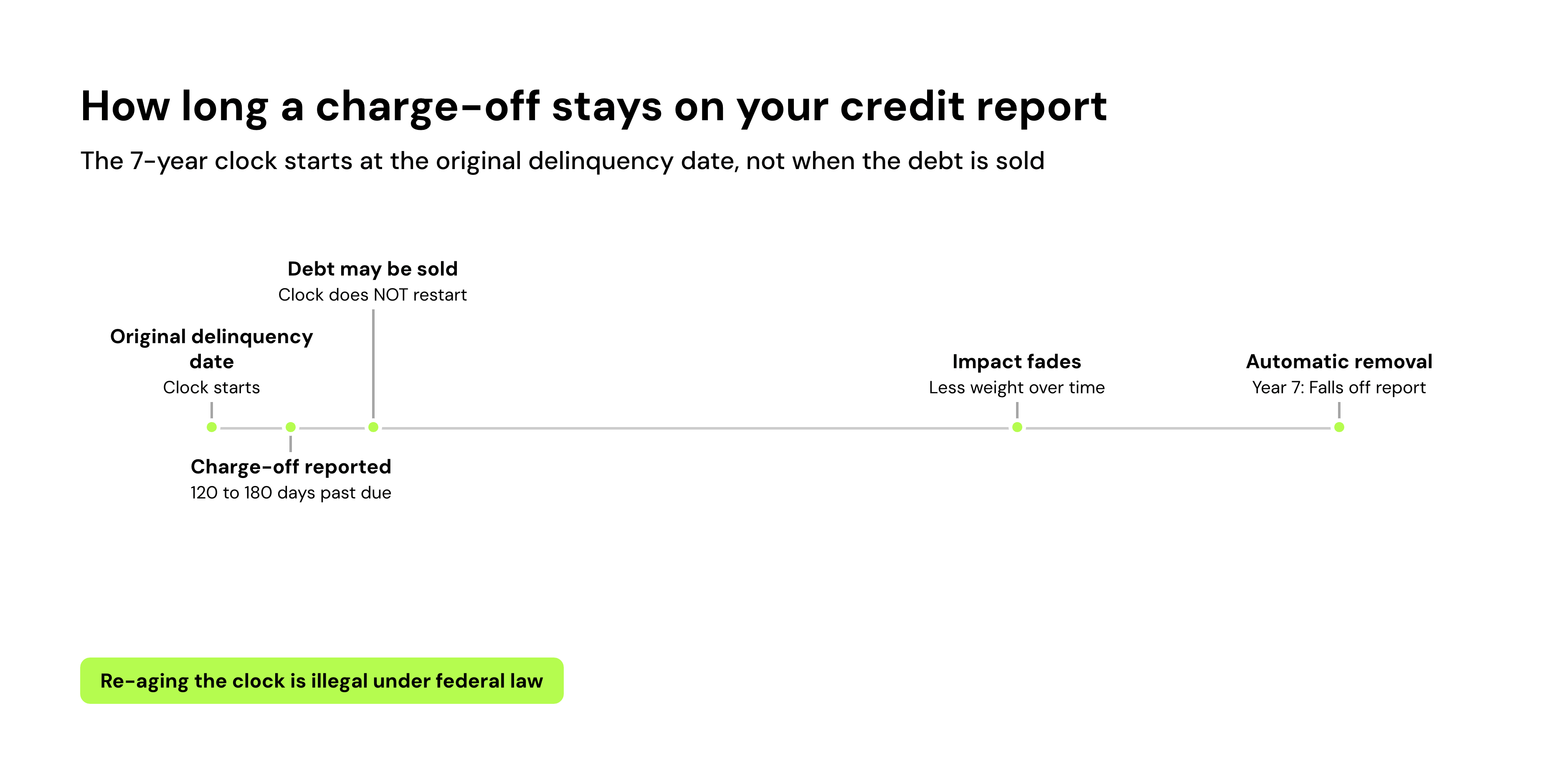
This is true regardless of whether the debt is later paid, settled, or sold to a collections agency.
It is also worth noting that if a debt is sold to a new collections agency, the seven-year clock does not restart. The original delinquency date governs the removal timeline, and any collector that attempts to re-age a debt by reporting a newer date is violating federal law.
The impact of a charge-off on your credit score also generally diminishes over time, particularly as you build positive history to counterbalance it.
Does paying a charge-off remove it from your credit report?
Paying a charge-off does not automatically remove it from your credit report.
Unless a creditor explicitly agrees in writing to delete the entry in exchange for payment, the account will simply update to reflect a "paid charge-off" or "settled" status, which still appears as a negative mark.
That said, paying or settling a charge-off can still be beneficial. Some lenders require all collections and charge-offs to be resolved before approving a mortgage or other major loan, so clearing the balance may be a necessary step regardless of whether the entry is removed.
This said, always negotiate the terms before paying, since once payment is made, you lose most of your leverage.
How charge-offs affect your credit score
A charge-off damages your credit score mainly through two channels: the initial impact of the charge-off itself, and any accompanying collections account if the debt is sold.
The payment history factor, which makes up 35% of your FICO score, is where charge-offs hit hardest, since they represent an extended failure to pay as agreed.
If the debt is also sent to a collections agency, that becomes a separate negative entry on your report, compounding the damage.
Basically, the higher your credit score before the charge-off, the more dramatic the drop will be, since lenders place more weight on a strong credit history going negative than they do on an already poor one taking another hit.
Over time, the scoring impact of a charge-off will typically diminish as the entry ages, especially if you are consistently building positive payment history in the meantime.
How to rebuild credit after a charge-off
Addressing the charge-off is just one part of the recovery process, and rebuilding positive credit habits is equally important.
Focusing on the factors that influence your credit score the most will give you the strongest recovery trajectory. Payment history at 35% and credit utilization at 30% are the two most impactful areas to focus on.

Opening a credit account with a platform like Kikoff is a super effective way to start stacking on-time payment history. Unlike a credit-builder loan, which only builds payment history and locks up your funds, a credit account impacts both payment history and credit utilization simultaneously, making it the more efficient tool for rebuilding credit.
Keeping utilization low on any revolving credit accounts, avoiding new hard inquiries unless necessary, and making every payment on time are the core habits that will gradually improve your score after a charge-off.
Conclusion
Removing a charge-off from your credit report is possible in certain cases, particularly when the entry contains inaccuracies or when a creditor is willing to negotiate, but it requires persistence and a clear understanding of your options.
Whether you're disputing an error, negotiating a settlement, or simply rebuilding positive history while the mark ages off your report, the key is to take action consistently.
For anyone looking to add positive payment history while working through the aftermath of a charge-off, Kikoff is a straightforward way to get started, with no hard credit check required and reporting to all three major credit bureaus.
Frequently Asked Questions
About the editor

Disclaimer: The information provided in this blog post is meant for informational purposes only and does not constitute financial advice.