.jpg)



What if you could lower your monthly mortgage payments without having to refinance? Refinancing often comes with significant closing costs and higher interest rates, but a mortgage recast may help you avoid both.
Take a closer look at how to recast a mortgage and how to tell whether this step is right for you.
What is a mortgage recast, and how does it work? 5 basic steps
A mortgage recast is when your lender reamortizes your loan after you make a lump-sum payment. Mortgage amortization is the process of spreading your loan out across several equal monthly payments. Each payment covers part of your principal and part of your interest.
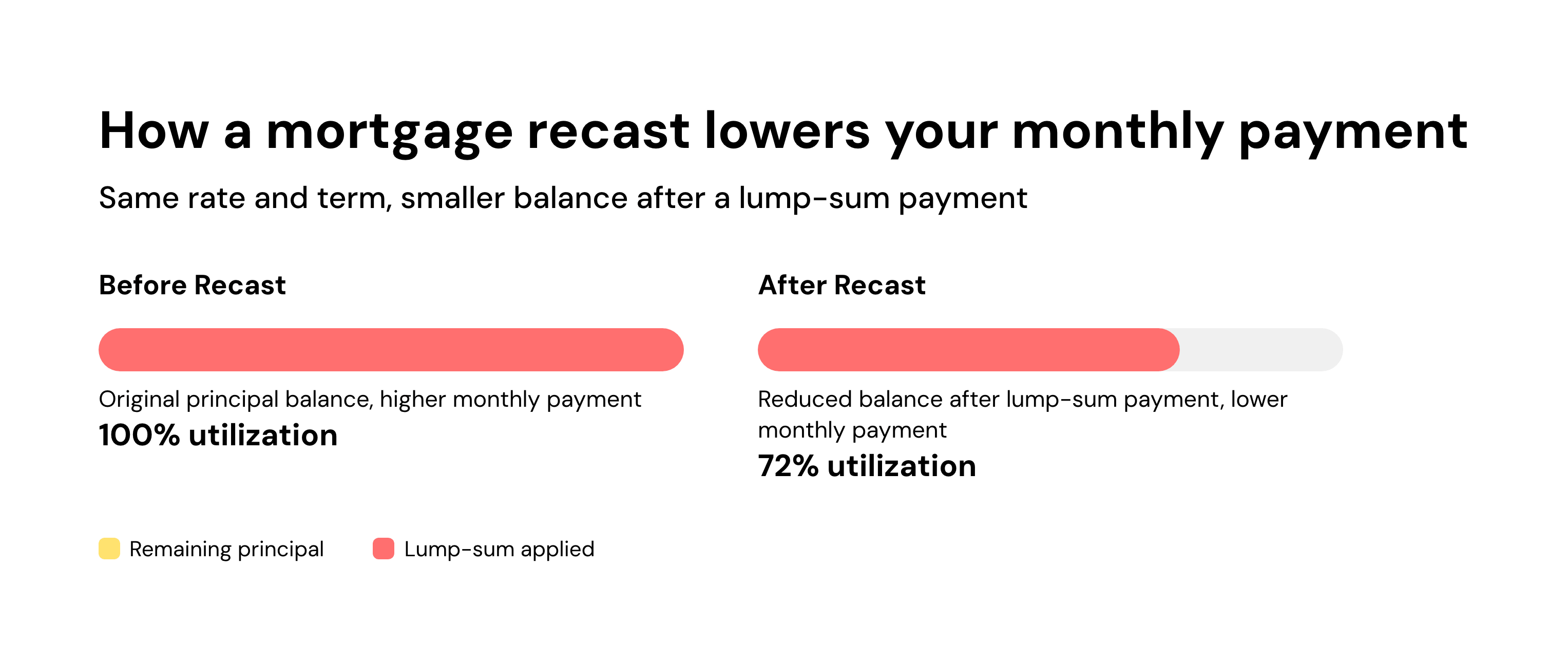
When you recast your mortgage, you pay a significant amount of money toward your principal balance. That lowers your total balance. Your lender then reamortizes your loan, which lowers your monthly payments while keeping your other loan terms the same.
If you’re hoping to recast a mortgage, here are the five general steps you’ll need to follow to do so.
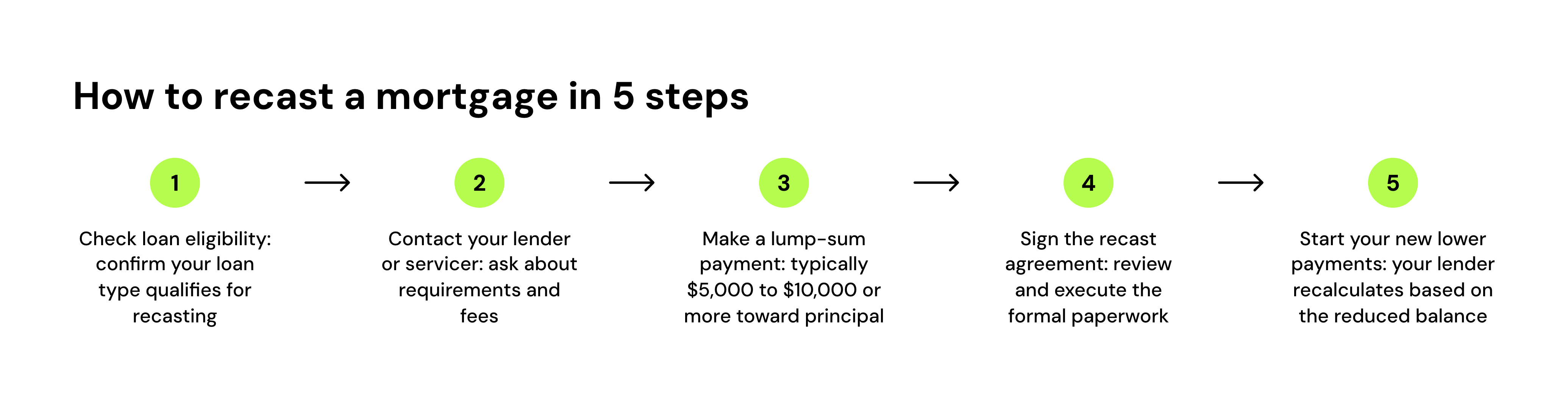
Step 1: Check if your loan is eligible
Before you start planning your mortgage recast, take some time to verify whether your loan is eligible. In most cases, government-backed loans cannot be recast. These are some of the most common government-backed mortgages:
- Federal Housing Administration (FHA) loans
- United States Department of Agriculture (USDA) loans
- U.S. Department of Veterans Affairs (VA) loans
If your mortgage isn’t backed by the government, you have a better chance of being able to recast it. When in doubt, ask your lender.
Step 2: Contact your lender or servicer
If you determine that your loan is eligible to be recast, get in touch with your lender to familiarize yourself with their recasting terms and start the process. Many lenders require you to have held your mortgage for a certain period of time, and most look for a solid recent payment history.
Step 3: Make a lump-sum payment
In order to recast your loan, your lender will likely require you to make a lump-sum payment toward your principal balance. That sum is typically $5,000 to $10,000, but some lenders may require substantially more.
Step 4: Sign the recast agreement
A recast agreement is much simpler than a refinance. Lenders don’t generally do credit checks for mortgage recasts, and they likely won’t require you to get a home appraisal either. Once you sign the agreement, your lender will reamortize the loan, which lowers your monthly payments while keeping the loan term the same.
Step 5: Start making your new lower payments
Because the loan has been reamortized, you’ll now owe less per month. Unlike a refinance, your interest rate and the length of your loan term stay the same.
Pros of recasting a mortgage
These are some of the main advantages of recasting your mortgage:
Is less costly than refinancing
If you refinance your mortgage, you’ll likely have to pay closing costs, which are generally 2% to 6% of the total loan amount. Recasting usually only costs a few hundred dollars.
Involves a quick, relatively simple process
Recasting a mortgage doesn’t involve taking out an entirely new loan. That means you can avoid the following:
- A home appraisal
- A credit check
- A long and complex application
If you’ve thought about refinancing but are looking for a simpler alternative, a mortgage recast could be worth considering.
Lowers your monthly payments
This is one of the primary advantages of a recast. By lowering your payments, you can decrease your monthly debt burden and potentially free up hundreds of dollars per month.
Keeps your interest rate the same
If you locked in a historic low interest rate when you initially took out your mortgage, refinancing might substantially raise that rate. With a recast, your interest rate stays the same.
Cons of recasting a mortgage
Recasting a mortgage has its advantages, but you should also consider these potential downsides:
Requires a large lump sum
Not everyone has enough cash to recast their mortgage. Lenders usually require a lump sum payment of at least $5,000 to $10,000, and some require substantially more.
Doesn’t lower your interest rate
Depending on the current interest rate environment, the fact that a mortgage recast keeps your interest rate the same can also be a disadvantage. If you want to lower your interest rate, you’ll probably need to refinance.
Is not available for all loan types
This is a major downside to consider. Depending on your loan type, you may not be eligible for a recast at all. If you have a government-backed loan, you’re probably not eligible.
May leave you with less access to cash
Even though a recast lowers your monthly payments, you still need to sink thousands of dollars in cash into your home. That means you may have less accessible cash in the case of an emergency.
How recasting your mortgage can help on your financial journey
Recasting your mortgage may not be possible or feasible in every case. However, if you know how to recast a mortgage and have the means to do so, you may free up more of your cash flow to put toward savings or debt repayment. When you handle your money with intentionality, you’ll likely see greater progress toward your financial goals.
If you’re looking to build credit while increasing your financial confidence, Kikoff is here to help. Download our app and start for free today.
Frequently Asked Questions
About the editor

Disclaimer: The information provided in this blog post is meant for informational purposes only and does not constitute financial advice.