
To open a business bank account, you’ll generally need an EIN (or your Social Security number), your business formation documents, a photo ID, and any license your business is required to have. The catch is that the bank treats your business as its own customer, so the paperwork depends on how your business is set up. Keeping business money in its own account also makes taxes and bookkeeping easier, and for an LLC or corporation, it helps keep the business legally separate from you.
What you need to open a business bank account
EIN or Social Security number
You need an EIN if your business is a corporation or partnership, has employees, or files certain federal tax returns, like excise taxes. If you’re a sole proprietor or single-member LLC with none of those, you can generally use your Social Security number instead.
You can still get an EIN even if you don’t need one, and some banks ask for one before opening an LLC’s account. It’s free from the IRS and takes a few minutes online.
Business formation documents
Depending on the structure of your company, you might need to present your business’s formation documents when opening your bank account.
Documentation rules may vary by institution. For instance, if you have a single-member LLC, some banks may not need to see your operating agreement. If you aren’t sure what documents you’ll need, check with the financial institution first.
If your business is an LLC or corporation, expect the bank to ask who owns and controls it, with names, birth dates, and ID details for the main owners.
Personal identification
Even if you’re opening a bank account for your business, you’ll still need personal identification. Expect the bank to ask for a photo ID, your SSN or individual taxpayer identification number (ITIN), and your contact information.
Business license or permits
You may or may not need to show a business license or permit when you open a business bank account. If your state’s laws require your particular business type to be licensed or have a permit, you’ll probably need to show one.
Ask the bank whether it needs to see your business license and whether a state or local permit counts.
4 steps to open a business bank account
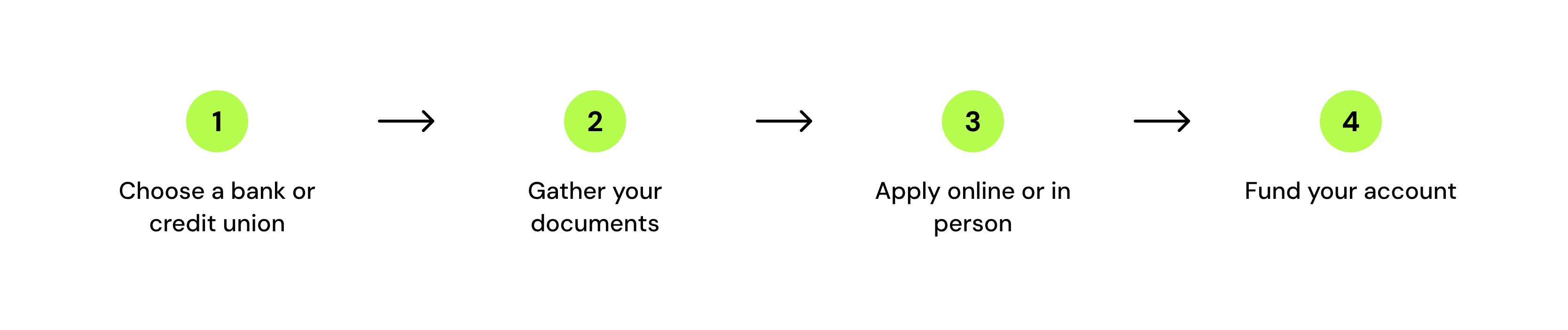
1. Choose a bank or credit union
Decide between a traditional bank or credit union and an online bank. Traditional banks have branches, which help if you want in-person support or deposit cash often. Online banks often have faster applications, but before you choose one, ask how to deposit cash and whether there’s a fee. That matters if your business takes a lot of cash.
Either way, compare each bank’s fee schedule and minimum balance rules, which can vary between banks and between accounts at the same bank.
How your deposits are insured. Deposits at an FDIC-insured bank are covered up to $250,000 per depositor, per bank. If you’re a sole proprietor, the FDIC adds your business account to your personal accounts at the same bank, and all of it shares that limit. An LLC or corporation’s deposits are insured separately from yours. At a credit union, ask whether it’s insured by the NCUA.
2. Gather your documents
Check your bank’s checklist online or call ahead, because requirements vary. Bring your original photo ID, and ask ahead whether the bank needs originals or copies of your formation papers.
3. Apply online or in person
If you’ve chosen an online or digital bank, applying online may be your only option. Traditional banks often let you decide between applying online and doing so in person.
4. Fund your account
After your application is accepted, you may have to make an opening deposit to officially activate the account. Before you apply, check the minimum opening deposit, minimum balance, and any monthly fee waiver requirements.
If the minimum is more than you can put in right now, ask whether a lower-minimum account is available. Some banks offer more than one business account tier.
Read more >> Are Online Savings Accounts Safe?
Can you open a business account with bad credit?
Generally, you can open a business bank account with bad credit. Much like personal checking and savings accounts, business bank accounts don’t usually require a credit check.
What banks do check is your banking history. Many banks and credit unions use a banking history report from a company like ChexSystems, which tracks things like unpaid overdrafts and accounts closed with a negative balance. A bank can turn you down over a ChexSystems record even if that history came from your personal accounts. You can request your own ChexSystems report for free once every 12 months and dispute anything inaccurate. If you’re turned down, ask the bank whether it offers a lower-risk account. The CFPB explains your options after a denial.
When you’re ready to borrow for your business, your credit is important. Lenders typically look at your personal credit history, the business’s revenue and cash flow, how long you’ve been in business, and any collateral. For a newer business, they may also ask for a personal guarantee. That means you’re personally responsible for repaying the debt if the business can’t, which puts your personal savings and property at risk. Before you sign one, free counseling through your local Small Business Development Center or SCORE can help you think through the terms, and a business attorney can tell you exactly what you’d be on the hook for.
Read more >> What Is ChexSystems and What Is It Used For?
Bottom line
Bad credit generally won’t stop you from opening a business bank account. Where your personal credit tends to show up is the next step, a first business credit card or loan, where a lender may ask you to personally guarantee the debt and look at your own credit history to decide.
Kikoff’s Credit Account can help you build that personal credit history before you apply. Kikoff reports your on-time payments to Equifax, Experian, and TransUnion, and there’s no credit check to sign up. Plans start at $5 a month.
Frequently Asked Questions
Article Sources
Disclaimer: The information provided in this blog post is meant for informational purposes only and does not constitute financial advice.