.jpg)
.jpg)


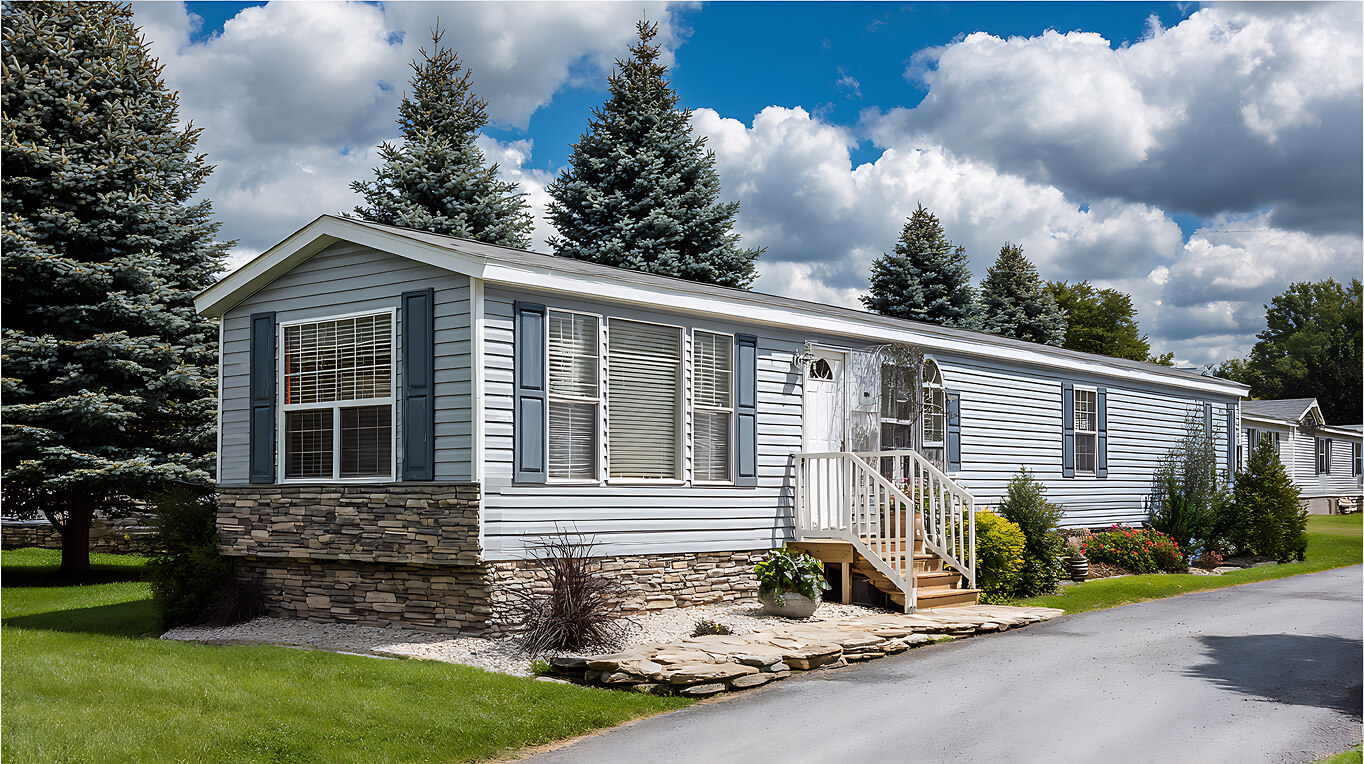
Mobile home financing depends on the home’s age, how it is titled, whether you own the land, and which loan program’s property rules it meets. A manufactured home classified as real property may qualify for a mortgage. A home classified as personal property may instead need a chattel loan or another manufactured-home loan.
That distinction affects more than the application. It can change the interest rate, repayment term, required down payment, closing documents, and consumer protections that come with the loan.
How does mobile home financing work?
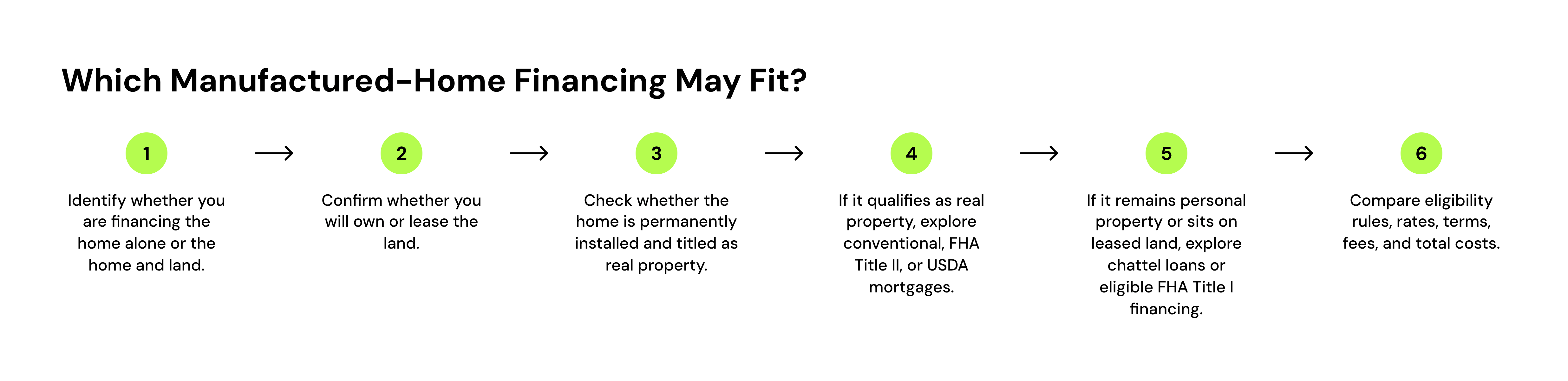
Start by finding out whether the home and land will be treated as real property or whether the home will remain personal property.
Real property generally means the home and land are legally treated as one piece of real estate. For many conventional mortgages, this requires the manufactured home to be permanently installed, titled as real property, and financed together with the borrower’s interest in the land.
Personal property financing covers the home without treating it as real estate. This is common when the buyer leases a site in a manufactured-home community, although state titling laws and loan-program rules vary.
Owning land does not automatically make a home eligible for a mortgage. The home must also meet the lender’s and loan program’s age, construction, foundation, title, appraisal, and occupancy requirements.
Before applying, confirm three things: how the home is titled, whether the land is included, and whether the lender finances that exact combination. A lender that offers ordinary mortgages may not offer manufactured-home or personal-property loans.
Mobile home vs. manufactured home
People often use “mobile home,” “manufactured home,” and “trailer” interchangeably, but the terms are not technically identical.
HUD’s national construction standards took effect on June 15, 1976. Homes built before that date are generally called mobile homes. Homes built after that date that comply with the federal standards are manufactured homes and should display a HUD certification label on each transportable section. HUD explains the certification and labeling requirements.
The construction date matters because many mortgage programs require a HUD-code manufactured home. For example, FHA Title II financing requires an eligible manufactured home to have been built on or after June 15, 1976.
A modular home is different. It is assembled from factory-built sections but follows the state or local building code that applies where it is installed rather than the federal manufactured-housing code.
Older mobile homes may still have financing options, but mortgage choices can be more limited. Ask lenders whether they finance pre-1976 homes before paying a nonrefundable application, inspection, or appraisal fee.
Mortgage vs. chattel loan
A mortgage is secured by real estate. For a manufactured home, the loan generally covers the home and the borrower’s interest in the land as real property.
A chattel loan is secured by personal property, such as a manufactured home that is not financed together with land. Chattel financing may be available when you lease the lot, the home remains separately titled, or the property does not meet a mortgage program’s real-estate requirements.
The CFPB has found that manufactured-home borrowers using personal-property loans generally pay higher interest rates than borrowers with manufactured-home mortgages. Refinancing can also be harder to find.
Do not compare the monthly payments alone. Review the annual percentage rate, loan term, total interest, upfront fees, prepayment terms, late fees, and what happens if you fall behind. If you lease the lot, include the current site rent and the possibility of future rent increases in your housing budget.
Read more >> What Is a Chattel Mortgage?
Can a single-wide manufactured home get a mortgage?
Yes, a single-wide manufactured home can qualify for some mortgages. Width alone does not determine whether the home is personal property.
For example, Fannie Mae permits eligible single- and multi-width manufactured homes used as principal residences. The home and the borrower’s interest in the land generally must secure the loan and be legally classified as real property. Fannie Mae lists its current manufactured-housing eligibility rules.
Other programs have their own rules. A single-wide home may still be ineligible because of its age, condition, foundation, title, location, appraisal, prior moves, or another program requirement.
What do lenders consider?
The lender evaluates both you and the property. Requirements vary, but these factors commonly matter.
Read more >> How to Get a Home Loan With Bad Credit
Credit history
Your credit reports and scores can affect whether you qualify and the rate or fees you are offered. There is no single minimum score for every manufactured-home loan. The threshold depends on the lender, loan type, down payment, property, and underwriting method.
Review your credit reports before applying and dispute inaccurate information. Then compare offers from lenders that handle the same property type.
Down payment
Down-payment requirements depend on the financing program. They should not be treated as one universal range.
For example, Fannie Mae currently lists a 5% minimum down payment for its standard manufactured-home mortgage and 3% for qualifying MH Advantage homes. FHA states that eligible mortgages may require as little as 3.5% down. USDA’s Section 502 program can offer 100% financing to borrowers and properties that qualify.
A low-down-payment program can still involve closing costs, mortgage insurance, program fees, reserves, and other expenses. Ask for a complete estimate of the cash needed to close.
Debt-to-income ratio
Your debt-to-income ratio, or DTI, compares your required monthly debt payments with your gross monthly income. Lenders use it to judge whether the proposed housing payment fits alongside your other obligations.
There is no universal 43% or 50% cutoff for every manufactured-home loan. Limits depend on the program, underwriting method, credit profile, and other compensating factors.
The home and site
The lender may also review:
- The manufacture date and HUD certification labels
- Whether the home is new, existing, or previously moved
- The foundation and installation
- The title and legal property classification
- Whether you own or lease the land
- The appraisal or other valuation
- The home’s condition, size, and intended use
- Local zoning, utilities, access, and site requirements
Government-backed manufactured-home financing
Government-backed options can help some buyers, but each program has different rules for the borrower, home, land, and lender.
FHA financing
FHA has two relevant paths. Title II insures mortgages on eligible manufactured homes treated as real estate. Title I can insure loans for a manufactured-home unit, a lot, or a home-and-lot combination. Under Title I, the borrower may lease the homesite if the site and lease meet HUD requirements.
FHA says eligible mortgages may require as little as 3.5% down, but the final requirement depends on the transaction and underwriting. The home must also satisfy the applicable FHA property standards.
USDA financing
USDA’s Section 502 home-loan program can finance eligible manufactured homes in qualifying rural areas. USDA offers no-down-payment options for eligible borrowers and properties, although individual lenders may apply their own credit standards.
USDA eligibility also depends on household income, location, occupancy, and property requirements. Single-wide homes can be eligible if they meet the program’s manufactured-housing rules.
How to compare mobile home financing offers
Get quotes for the same home, land arrangement, loan amount, and term so the comparison is meaningful. Ask each lender:
- Is this a mortgage or a personal-property loan?
- Will the home, land, or both secure the debt?
- Is the interest rate fixed or adjustable?
- What are the APR, term, monthly payment, and total borrowing cost?
- What cash will I need for the down payment, closing, delivery, installation, and site work?
- Are there prepayment penalties or balloon payments?
- Does the loan require the home to be new, permanently installed, or titled as real property?
- What happens to the loan if I sell the home or move it?
Mortgage borrowers generally receive a Loan Estimate. A manufactured-home loan not secured by real estate does not use that form, so ask the lender for the required Truth-in-Lending disclosures and a written breakdown of every cost.
Bottom line
The first step in financing a mobile or manufactured home is identifying exactly what you are buying: the home alone, the land alone, or both together. Then confirm the home’s age, title, foundation, and property classification before comparing lenders.
Because program and state rules vary, a HUD-approved housing counselor can help you compare realistic options for your situation. HUD can connect you with one at 800-569-4287.
Credit is only one part of a lender’s decision, but building positive payment history before you apply can strengthen the information in your credit profile. Kikoff’s Credit Account reports your on-time payments to all three credit bureaus, with no hard credit check to sign up. Kikoff does not determine whether you qualify for manufactured-home financing or what terms a lender offers.
Frequently Asked Questions
Article Sources
Disclaimer: The information provided in this blog post is meant for informational purposes only and does not constitute financial advice.