


.jpg)




When you lease a car, that lease can help build your credit as long as the leasing company reports the account and your payment history to at least one of the major credit bureaus. In that way, a lease builds credit the same way a loan does.
While on-time payments help, a missed one hurts. And because most lease run two to four years, you're committing to a payment that will show up on your report for the life of the lease. It's worth knowing what you're signing up for before you do.
Does leasing a car build credit? What to know
Yes, a car lease can help you build credit when your leasing company reports your on-time payments to the credit bureaus. But your credit doesn't automatically improve because you're approved for a lease. Building credit is all about positive behavior over time.
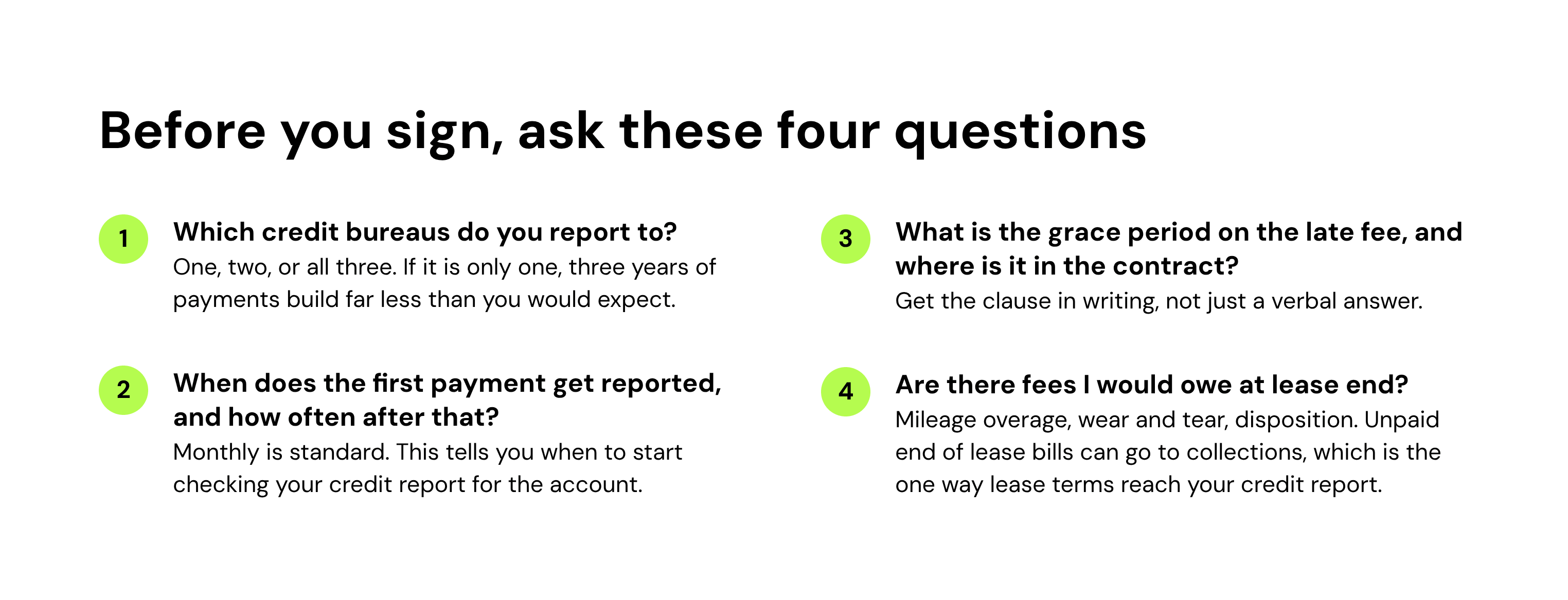
Before you sign a lease, ask the company which credit bureaus it reports to. It can take a billing cycle or two before your payment activity shows up on one or more of your credit reports, even if your leasing company is diligent with reporting.
How a car lease shows up on your credit report
Your leasing company may report your account to any combination of the three credit bureaus — Equifax, Experian, TransUnion. Once it does, the account shows your payment history, the account status, the balance, and the dates tied to the agreement.
A lease reports as an installment account, not a revolving account like a card. It doesn't affect your credit utilization — how much of your available credit you're using.
How a car lease can help your credit
Your car lease can help build credit because the agreement affects certain factors used to calculate your score, including:
- Payment history. This is the heaviest factor in your score, and it's the whole reason a lease can help. Each on-time payment adds to it.
- Credit mix. Scoring models look at the types of accounts you have, and a lease adds an installment account. This is a minor factor, worth around 10% of a FICO score, and it adds little if you already have an auto loan. Don't lease a car for your credit mix.
- Length of credit history. A new lease lowers your average account age at first. Kept in good standing, it works in your favor over the years. And when the lease ends, the closed account stays on your report for up to 10 years and keeps counting toward your history.
Read more >> The Importance of On-Time Payments in Building Credit
How a car lease can hurt your credit
A lease is reported like any other account, which means the same reporting that helps you when payments arrive on time works against you when one doesn't.
Late or missed payments
Your lease contract has a grace period before a late fee hits. Check your agreement's late charge clause for the exact window.
Credit reporting is a separate clock. Creditors generally don't report a payment as late until it's at least 30 days past due, which means a payment you catch up on before then usually never reaches your credit report. Once it does, it stays for seven years from the date of the missed payment. Miss enough payments, and the leasing company can repossess the vehicle.
Repossession rules and your rights vary by state. If you're already behind on a lease, a licensed attorney or nonprofit credit counselor can tell you what applies where you live. The National Foundation for Credit Counseling (NFCC) offers free or low-cost counseling at 800-388-2227.
Hard inquiry when applying
Applying costs a few points. The inquiry stays on your report for two years and stops affecting your score after about one. The bigger issue is that dealers often send your application to several lenders at once, which generates several inquiries.
Scoring models expect this: FICO's rate-shopping window is 45 days on newer versions and 14 days on older ones, and inquiries in either window count as one. Since you can't tell which version a lender uses, keep all your shopping inside 14 days.
How a car lease affects your debt-to-income ratio
A lease payment doesn't show up in your credit score as debt-to-income. In fact, credit reports don't contain income at all, so no scoring model can use it. But lenders calculate it themselves from your application by dividing your total monthly debt payments by your gross monthly income. This is your debt-to-income ratio.
Add the lease payment to what you already pay each month and you'll see the number a lender will see when you apply for something else. A high one can get you declined, even with a solid score.
Run the numbers >> Use Kikoff's average age of accounts calculator to see how a new account changes your credit history length.
Leasing vs. financing: Which is better for credit?
Neither leasing nor financing has a credit advantage: Both report as installment accounts, and both live or die on whether payments arrive on time.
The differences are that a lease caps your mileage and charges for wear, and you hand back the car at the end unless you buy it out, so the payment continues into the next lease. A financed car ends with a paid-off asset. Pick on those terms, not on credit.
Read more >> How to Pay Less Interest on a Car Loan
Other ways to build credit without a car lease
You don’t need a car lease to establish or improve your credit history. Here are some other options to explore:
- Make the debt payments you already have on time. It's the same factor a lease would help with.
- Open a small account that reports to the bureaus. And confirm which bureaus it reports to before you pay anything.
- Become an authorized user on someone else's card. Keep in mind that they can remove you at any time, and you're not building a record in your own name.
Read more >> 7 Ways to Improve Your Credit Fast
Bottom line
A lease can build credit, but only if the leasing company reports it, and only after you've already signed for the payment. Your credit does its work earlier than that, determining whether you're approved and what the lease costs.
If you want something reporting before your next application, the Kikoff Credit Account reports your on-time payments to Equifax, Experian, and TransUnion. Plans start at $5 a month, and there's no credit check to sign up.
Frequently Asked Questions
Article Sources
Disclaimer: The information provided in this blog post is meant for informational purposes only and does not constitute financial advice.