




Getting married doesn’t affect your credit score. Your credit reports stay in your name, your spouse’s stay in theirs, and U.S. law prohibits credit scoring from considering marital status.
What can change is how you use credit together. Once you open a joint account, add each other as authorized users, or apply for a loan as a pair, your credit histories start to overlap.
Does marriage affect your credit score?
No. Credit scores are calculated from one person’s credit history, so a spouse with poor credit won’t lower your score. There’s no such thing as a couple’s credit score.
Marriage also doesn’t change your right to credit on your own. A lender can’t deny you credit in your own name because you’re married. If you meet its standards, it generally can’t require your spouse to cosign.
What marriage doesn’t change. Not your credit score, not your credit reports, not the accounts already in your name, and not your right to apply for credit on your own. There’s no joint credit score, and your reports stay separate for life.
What changes is only what you open together. Joint accounts show up on both reports, and so does every payment.
What happens to your credit when you get married
You keep your individual credit reports
Each of the three credit bureaus keeps a separate file on you, tied to your Social Security number. Saying “I do” doesn’t combine those files with your spouse’s.
Joint checking and savings accounts don’t appear on credit reports at all. You can merge your bank accounts without touching either of your credit histories.
Name changes don’t merge your credit
If you take your spouse’s last name, you don’t have to contact the credit bureaus. Your new name becomes the primary name on your report, and your previous name stays listed alongside it. Your accounts and payment history stay with you.
Update your name with the Social Security Administration first, then with your banks and card companies. Each company passes your new name along to the bureaus the next time it reports.
Joint accounts show up on both reports
A joint account, such as a credit card or loan you open together, affects both of your credit scores. You’re each responsible for the full balance, no matter who made the charges. While on-time payments help both of you, late payments count against each of you too.
Read more >> Does Marrying Someone With Bad Credit Affect Your Credit Score?
How marriage can indirectly affect your credit
Opening joint accounts or adding authorized users
Couples usually share credit in one of three ways, and each ties your histories together in different ways.
An authorized user is someone added to another person’s credit card who can use it but isn’t responsible for paying it. Being one can add your spouse’s account history to your report, but their habits come with it. Before you’re added, ask the card company whether it reports authorized users to all three bureaus.
Applying for credit together
When you apply for a loan with your spouse, lenders review both of your credit histories. If one of you has poor credit, it counts against you both, which could mean a higher rate or a denial.
Mortgages show this clearly. For conventional loans sold to Fannie Mae, lenders find each borrower’s representative score (the middle of three scores, or the lower of two) and use the lowest one for pricing. Most loans with more than one borrower average those scores only to check eligibility.
Say your middle score is 720 and your spouse’s is 640. Your average of 680 may help you qualify, but your rate is likely to be priced on 640.
Applying under the spouse with stronger credit may get you better terms. The trade-off is that only that spouse’s income counts toward qualifying, and only that spouse builds payment history on the loan.
The lower score sets the rate. Say your middle score is 720 and your spouse’s is 640. Averaged, that’s 680 — but mortgage lenders generally don’t average. They price on the lower of the two.
Here, you’d qualify together and pay as if you were a 640 borrower, on the whole loan, for as long as you hold it. If the gap is wide and only one of you needs to be on the mortgage to qualify, it’s worth asking a lender to price it both ways.
A spouse’s debt habits affecting shared accounts
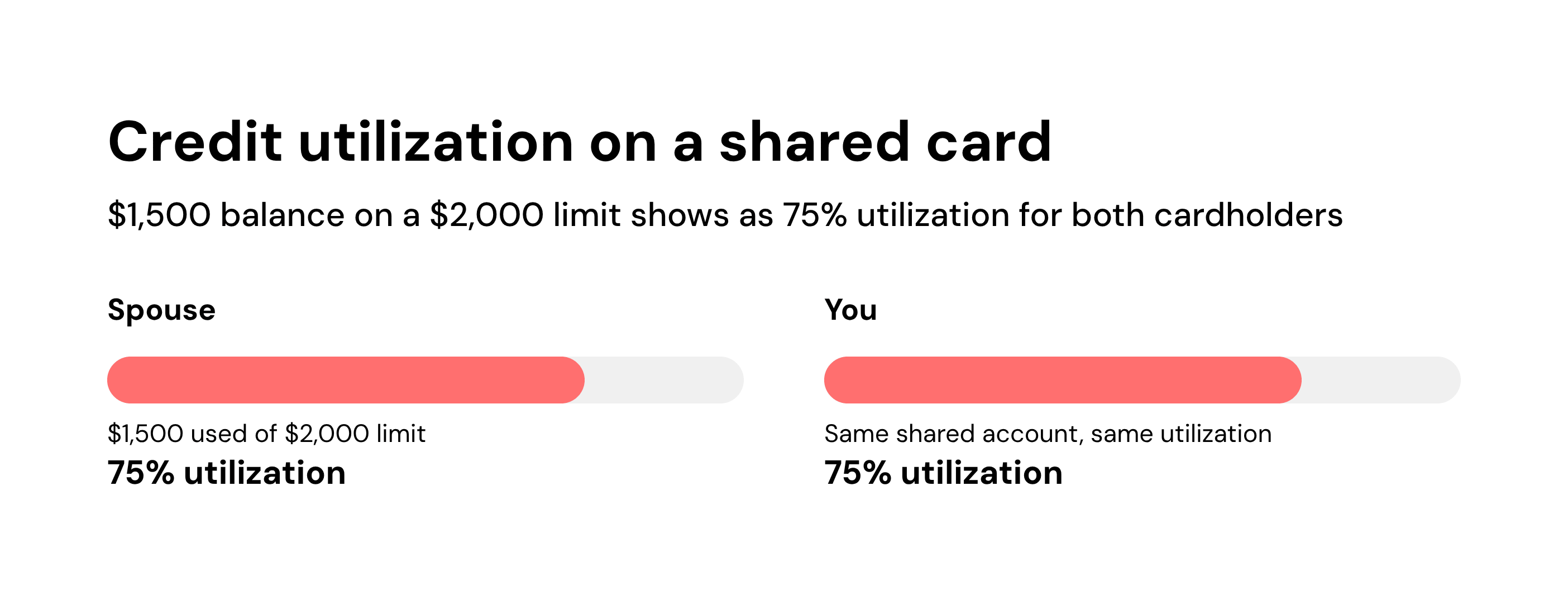
On a joint card, one person’s late payment shows up on both reports, and so does a high balance. If your spouse charges $1,500 on a shared card with a $2,000 limit, you’re both showing 75% utilization, which is how much of your available credit you’re using.
One late payment doesn’t undo the rest of your history, and the on-time months that follow still count. Setting up autopay on shared accounts can help keep a missed due date off both reports.
Where you live can also matter. Nine states use community property rules: Arizona, California, Idaho, Louisiana, Nevada, New Mexico, Texas, Washington, and Wisconsin. In these states, a debt one spouse takes on during the marriage may be treated as shared, even if it never appears on the other spouse’s credit report. Consider talking with a licensed attorney or nonprofit credit counselor for guidance specific to your situation where you live.
Read more >> How to Monitor Your Spouse's Credit Score
How to protect your credit after marriage
You don’t have to keep everything separate to keep your credit healthy. These steps help you share on purpose:
- Check both of your credit reports before you combine anything. You can get free reports from each bureau every week at AnnualCreditReport.com. Checking your own report doesn’t affect your score.
- Dispute anything that’s wrong. Disputes with the bureaus are free and fix errors only, so accurate late payments stay. Kikoff’s AI Credit Disputes tool can help you find errors and draft dispute letters in a few taps.
- Keep at least one account in your own name. It gives you a history that doesn’t depend on anyone else’s habits.
- Decide who pays which bill. Pick one person to manage each shared account, and turn on autopay for at least the minimum.
- Talk before you cosign or open a joint account. Ask how your spouse pays bills and how much of their limits they use. Those habits will show up on your report too.
Read more >> How to Build Credit From Scratch
Bottom line
Marriage doesn’t merge your credit, but the accounts you share do. Joint cards and loans tie your histories together, and an authorized user spot lasts only as long as the primary cardholder keeps you on the account.
History in your own name is the part no one else can take away. Kikoff’s Credit Account reports your on-time payments to all three credit bureaus, with no credit check to sign up. Plans start at $5 a month.
Frequently Asked Questions
Article Sources
Disclaimer: The information provided in this blog post is meant for informational purposes only and does not constitute financial advice.