


.jpg)
.jpg)



Marrying someone with bad credit doesn’t lower your credit score or combine your credit reports. You and your spouse continue to have separate credit histories after marriage.
Your spouse’s credit can still affect your shared finances, however. It may influence a joint loan application, the terms you receive or your ability to reach goals that depend on both incomes.
Does marriage affect your credit score?
Marriage itself doesn’t affect your credit score. Credit bureaus don’t create a combined credit report when you get married, and your spouse’s accounts don’t automatically become part of your credit history.
Your name also doesn’t automatically appear on your spouse’s debts. An account generally affects your credit when you are:
- A joint account holder
- A coborrower
- A cosigner
- An authorized user on an account the creditor reports to the credit bureaus
Each of these arrangements works differently. A joint borrower or cosigner is legally responsible for repaying the debt. An authorized user can generally use the account but isn’t responsible for the balance unless they separately agreed to be liable.
When your spouse’s credit can affect you
Your spouse’s credit history may become relevant when you apply for credit together or connect your name to one of their accounts.
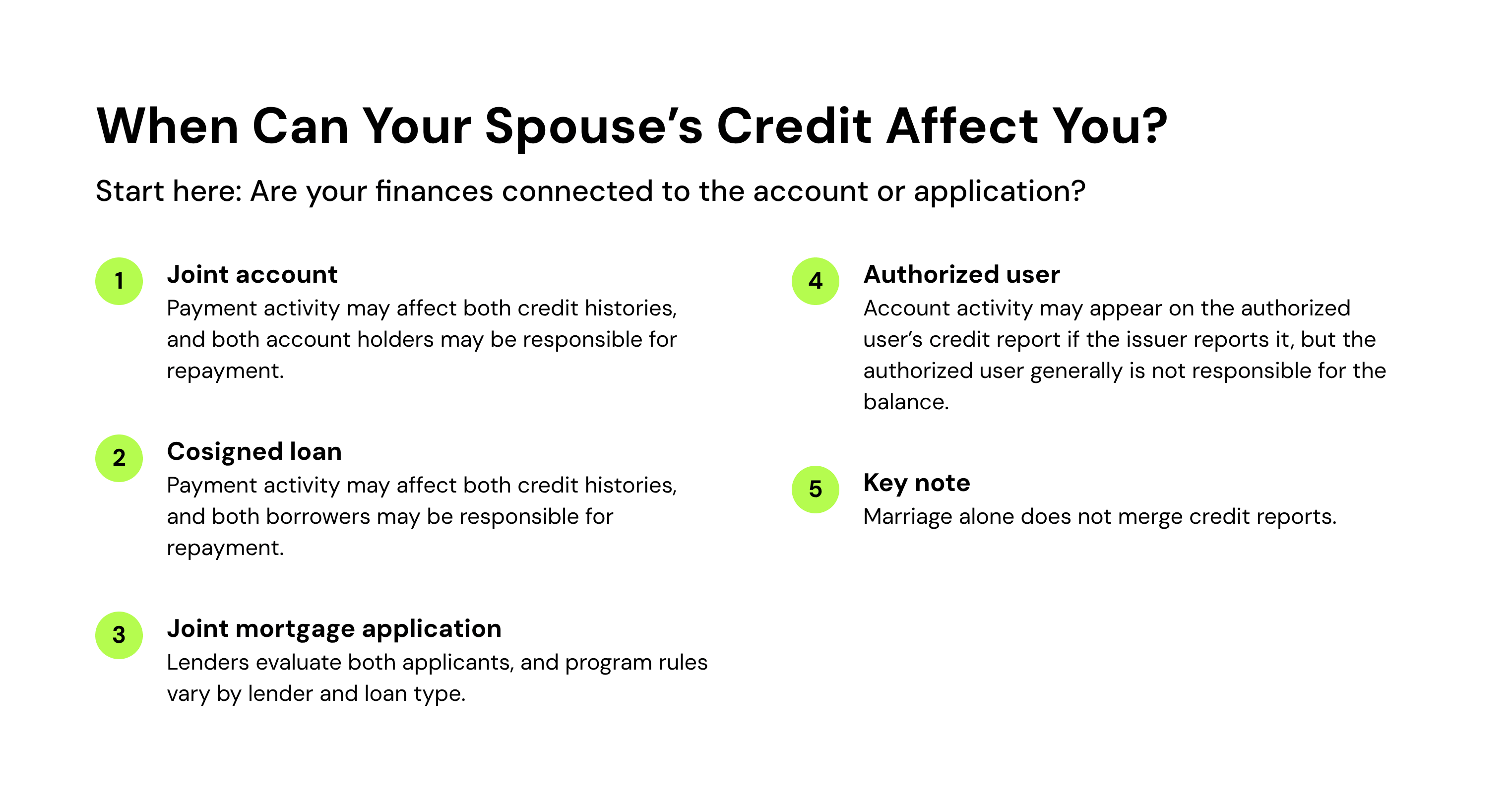
Joint accounts and cosigned loans
When you open a joint account, the account may appear on both credit reports. Its payment history and balance can therefore affect both spouses’ credit scores.
The Consumer Financial Protection Bureau confirms that joint credit card accounts affect both account holders’ credit scores. Each joint account holder may also be responsible for the full balance, even if only one person made the purchases.
Cosigning creates a similar responsibility. If you cosign a loan for your spouse, you agree to repay it if they don’t. Late or missed payments may appear on both credit reports, and the lender may pursue either signer for the amount owed.
Before opening a joint account or cosigning, make sure you understand:
- The required monthly payment
- Who will make each payment
- Whether both people can add new debt
- How the account will affect your household budget
- What happens if one person can’t pay
Applying for a mortgage together
If you apply for a mortgage together, the lender considers information from both applicants. Your spouse’s credit may affect whether the application qualifies, the interest rate offered and other loan terms.
The exact scoring method depends on the mortgage program and underwriting process. For many Fannie Mae loans with multiple borrowers, the lender selects an applicable score for each person and then uses the lower score as the loan’s representative credit score. Certain manually underwritten loans instead use an average of the borrowers’ median scores for minimum-score eligibility, according to Fannie Mae’s current guidance.
Credit scores aren’t the only consideration. Mortgage lenders may also evaluate income, debt, assets, down payment and employment history.
You may be able to apply in your name alone if you qualify based on your own finances. The CFPB explains that a lender generally can’t require your spouse to cosign a mortgage, although community-property laws and rights to the property may still require the lender to collect information or obtain certain signatures.
Read more >> How to buy a house with bad credit
FHA and conventional mortgage requirements
Fannie Mae’s automated underwriting system doesn’t impose a single universal minimum credit score for every conventional mortgage. Eligibility depends on the loan type, underwriting method and the rest of the application. Individual lenders may also have their own requirements.
For FHA-insured mortgages, HUD’s current handbook permits maximum financing for eligible borrowers with a qualifying score of at least 580. Borrowers with scores from 500 through 579 are generally limited to 90% loan-to-value financing, which typically means a down payment of at least 10%.
Meeting an agency threshold doesn’t guarantee approval. Lenders can apply additional requirements and evaluate the complete application.
Community-property laws
Nine states use community-property systems:
- Arizona
- California
- Idaho
- Louisiana
- Nevada
- New Mexico
- Texas
- Washington
- Wisconsin
Alaska, South Dakota and Tennessee also allow some couples to opt into forms of community property. The IRS notes that community-property rules differ significantly among states.
Living in a community-property state doesn’t mean every debt automatically appears on both spouses’ credit reports. It may mean that certain income, property or debts acquired during the marriage are treated as belonging to the marital community.
Responsibility depends on state law, when and why the debt was incurred, the account agreement and whether the debt benefited the household. Consider speaking with a licensed attorney for advice about your specific rights and obligations.
How to protect your credit after marriage
You don’t have to keep every part of your financial life separate. However, discussing your credit histories and setting expectations before opening joint accounts can reduce surprises.
Keep some credit in your own name
Maintaining at least one account in your own name can help you continue building an independent credit history. Separate accounts may also limit the effect of one spouse’s spending on the other person’s credit.
Keeping an account separate doesn’t necessarily make funds or debts separate property under state law. That is a legal question rather than a credit-reporting question.
Create a plan for shared accounts
Before combining accounts, agree on:
- Which expenses will be paid jointly
- Who will make and monitor payments
- How much either spouse can charge
- When you’ll review balances
- What you’ll do if income changes
Account alerts and autopay may help prevent missed payments, but both spouses should continue monitoring jointly held accounts.
Review both credit reports
You and your spouse should review your credit reports individually. You can request reports from Equifax, Experian and TransUnion as often as weekly through AnnualCreditReport.com.
Look for unfamiliar accounts, incorrect balances, inaccurate payment information and accounts you thought had been closed. Each spouse must access and manage their own reports.
Understand the risks of authorized-user status
Adding your spouse as an authorized user may help add an established account to their credit report if the issuer reports authorized users. However, not every card issuer reports authorized-user activity to every bureau.
The strategy can also backfire if the account develops a high balance or missed payment. Before adding your spouse, ask the card issuer how it reports authorized users and decide whether the authorized user will receive a card.
Read more >> How credit piggybacking works
Help your spouse build credit in their own name
Authorized-user status relies on someone else’s account. Over time, your spouse may benefit from building payment history through an account in their own name.
They can start by checking their reports for errors, paying existing accounts on time and keeping revolving balances manageable. The right approach depends on their current credit history and budget.
Bottom line
Marrying someone with bad credit doesn’t lower your credit score or combine your credit report with theirs. Your spouse’s credit becomes relevant when you apply jointly, cosign, share an account or live in a state where community-property laws affect the transaction.
Talk openly about existing debts and payment habits before combining accounts. If you have questions about responsibility for a spouse’s debt, consider speaking with a licensed attorney or nonprofit credit counselor familiar with your state’s laws.
Building credit in your own name can help you maintain financial independence. Kikoff’s Credit Account reports on-time payments to all three credit bureaus, with no hard credit check to sign up.
Frequently Asked Questions
Article Sources
Disclaimer: The information provided in this blog post is meant for informational purposes only and does not constitute financial advice.