



Buying a home is one of life's biggest milestones and investments - but if you don't have perfect credit or tens of thousands saved for a down payment, the dream of homeownership can feel just out of reach.
That's where FHA loans come in.
Backed by the Federal Housing Administration, these mortgages were designed to open the door to homeownership for more people, especially first-time buyers.
Are FHA loans worth it?
FHA loans are powerful tools, especially if your credit isn't perfect or you don't have a large down payment.
But if you already have strong credit, it's worth comparing FHA with conventional loans to see which option makes the most financial sense for you.
Compare the full cost. Look at interest rates, mortgage insurance, and fees. Check conventional loan options - with higher credit, conventional may edge out FHA on cost.
Think about timing: if you'll sell in a few years, FHA's lower entry costs might make sense; if you'll stay longer, conventional might save you more in the long run. Look for down payment assistance programs (DPA), which can stack with FHA or conventional depending on where you live.
What is an FHA loan?
An FHA loan is a mortgage insured by the Federal Housing Administration, a branch of HUD (the U.S. Department of Housing and Urban Development). Since the 1930s, FHA loans have helped millions of Americans buy homes when conventional mortgages weren't an option.
FHA loans come with more flexible requirements - lower down payments and more forgiving credit standards, making it possible to buy sooner, even if you're still working on your financial foundation.
Benefits of FHA loans
Lower down payments: you can buy a home with as little as 3.5% down if your credit score is 580 or higher, making homeownership far more accessible without having to save for years.
Flexible credit requirements: FHA loans allow buyers with credit scores starting at 500 to qualify (with a higher down payment). This flexibility helps more people enter the housing market, even if they've had setbacks in the past.
Competitive interest rates: because FHA loans are government-backed, lenders are often able to offer lower interest rates and fees, more flexibility with things like debt-to-income ratios or savings requirements, and easier access to the 3.5% down payment option.
Assumable loans: an FHA loan is "assumable," which means if you sell your home later, the buyer may be able to take over your loan with its existing terms - a major selling point if interest rates rise.
Options for different income levels: FHA loans aren't just for low-income borrowers. They're available across a range of incomes, making them a versatile option for many first-time buyers.
Support for first-time buyers: FHA loans are widely paired with down payment assistance programs and state-level first-time homebuyer initiatives, multiplying the benefits.
What FHA requires: credit scores and down payments
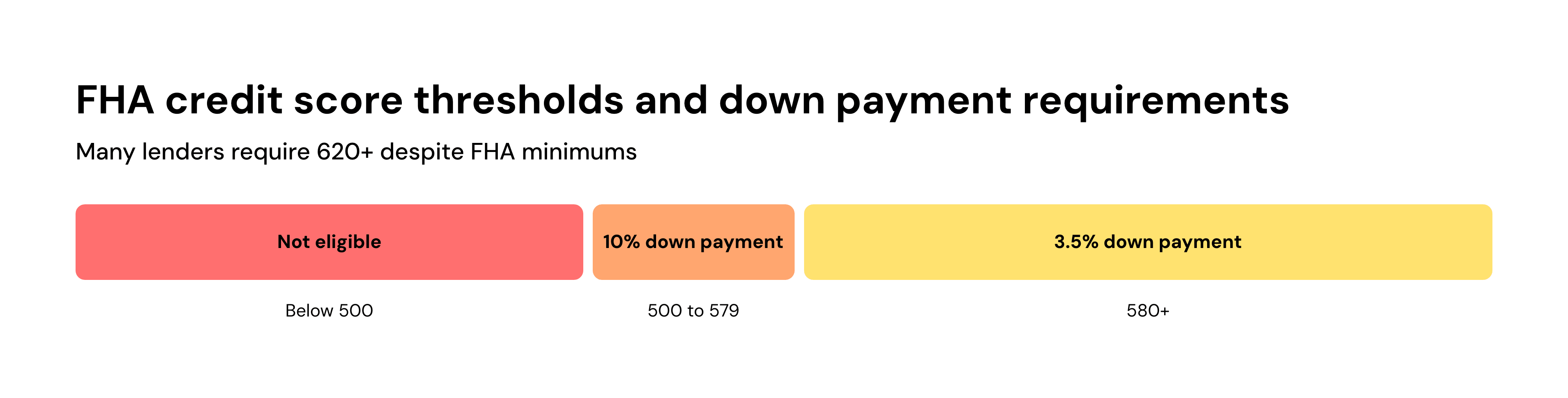
Also worth knowing: FHA itself allows borrowers with scores as low as 500, but many FHA-approved lenders require higher minimums - often 620 or more.
Debt-to-income ratio (DTI) matters too. Even with a lower credit score, strong compensating factors such as steady income or savings may help. Lenders might allow DTI up to ~50% depending on the rest of your financial picture.
Who qualifies for an FHA loan
Eligibility for FHA financing is broad, but not unlimited.
The FHA's guidelines make it easier for many borrowers to get approved, but there are specific rules every applicant must meet encompassing credit, income, employment, and legal status.
Income and employment: steady employment history is key. Lenders often want at least two years of verifiable income, either from salaried employment, self-employment, or documented benefits. There's no hard-and-fast minimum income, but you need to show enough steady income to cover mortgage payments, insurance, and other living costs.
Debt-to-income ratios: FHA typically expects your debts, including your projected mortgage payment, not to exceed 43% of your gross monthly income. In some cases, lenders may allow up to 50% DTI if you show compensating factors, such as substantial savings or a strong job history.
Legal residency: applicants must be U.S. citizens, lawful permanent residents, or eligible non-citizens. Documentation is required during the loan process.
Financial history: while FHA is forgiving of imperfect credit, recent major financial events, like bankruptcy or foreclosure, may trigger a waiting period, typically two or three years.
How good credit changes things
If your credit score is already solid (660–700+), an FHA loan might still be appealing, but there are trade-offs.
Where you might not get as much value from FHA: mortgage insurance premiums (MIP).
FHA loans require both an upfront premium and ongoing monthly premiums, which can add up over time. Conventional loans may be cheaper if you qualify, especially since private mortgage insurance (PMI) can eventually fall off, unlike FHA's MIP in many cases.
Tips if your credit isn't perfect but you want FHA
Raise your score even a little by paying down credit cards or keeping balances low. Keep debt-to-income in check, since FHA pays close attention to that. Ask lenders if they'll consider alternative credit histories, like rent or utility payments. Shop around — every lender has their own take on FHA requirements.
Common misconceptions
FHA isn't just for first-time buyers. While it's widely used by newcomers to homeownership, repeat buyers can also qualify, especially if credit or down payment constraints have changed since their last purchase.
FHA isn't a "bad credit" program. It's designed to expand access, not subsidize reckless borrowing. Responsible credit-building puts the power back in your hands.
Conclusion
FHA loans are powerful tools, especially if your credit isn't perfect or you don't have a large down payment. But if you already have strong credit, it's worth comparing FHA with conventional loans to see which makes the most financial sense for you.
And if your credit isn't where you'd like it to be yet, there are ways to get there. That's where Kikoff can help. With tools designed to build and strengthen your credit, Kikoff makes it easier to reach the scores that open more doors, whether that's qualifying for FHA, lowering your costs, or eventually moving into a conventional loan.
Frequently Asked Questions
About the editor

Disclaimer: The information provided in this blog post is meant for informational purposes only and does not constitute financial advice.