






The common retirement target is around 12% to 15% of your income, counting any employer match. Your starting point can be much lower: 3%, 5%, or whatever fits your budget.
The important part is finding an amount you can invest consistently without leaving yourself unable to pay your bills or cover an emergency.
How much of your income should you invest?
For retirement, the common target is 12% to 15% of your pay each year, and that includes money your employer puts in. Vanguard suggests 12% to 15%, while Fidelity suggests at least 15% of pretax income. Both count employer contributions, like a 401(k) match.
That match can cover a big share of the target. In Fidelity’s example, a worker whose employer matches 5% dollar for dollar needs to save 10% of their income each year to meet 15%.
It also helps to know what the number is built on. Fidelity’s 15% assumes you start saving at 25 and retire at 67. Fidelity also notes that its guideline may not fit well if you earn less than $50,000 or more than $300,000. And it’s a retirement figure only: It doesn’t tell you how much to put in a brokerage account for a home or another financial goal.
Where to start if 15% isn’t in your budget yet
A target tells you where you’re headed, not where to begin. Investor.gov suggests investing regularly over time. It gives 5% or 10% of your income as examples, or a fixed amount you can afford each pay period, and suggests raising your contributions as your income goes up or your expenses come down.
That fixed-amount option is what to focus on when a percentage feels out of reach. A set dollar amount every paycheck still builds the savings habit, and you can switch to a percentage later.
When you lose a job or an emergency medical bill comes due, it might not be possible to hit that target every year. The goal is to keep contributing and raise the amount when you can.
What 5%, 10%, and 15% of your pay looks like each month
Why the “right” percentage depends on your situation
Someone with no high-interest debt and a fully funded emergency account may be able to invest 15% or more. Someone juggling credit card balances, rent, and an unpredictable income could decide to start much lower.
Rather than asking what percentage to invest, consider the percentage you can invest consistently while taking care of other financial priorities.
Read more >> How to Save for Retirement
Free advice may already be included. Before you pay for investment advice, check your 401(k) plan. Many plans include access to advice at no extra cost.
If you do hire someone, first look them up on Investor.gov. It’s free and lets you confirm they’re licensed and registered.
Factors that affect how much you should invest
Your investing rate must fit alongside everything else your paycheck covers.
Your income and expenses
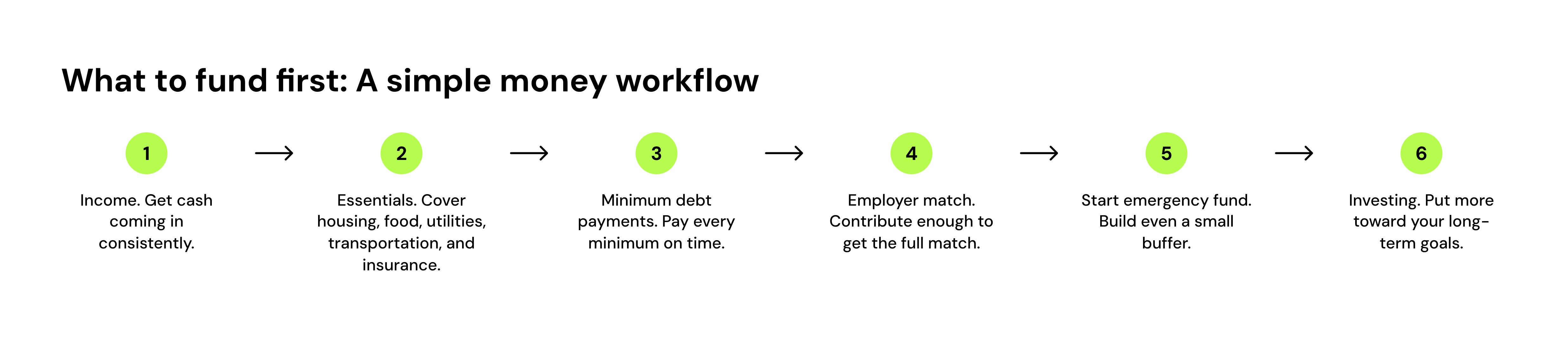
Start with your cash flow. Look at how much comes in each month and what you need for housing, food, utilities, transportation, minimum debt payments, and other essentials.
Divide the rest between investing, emergency savings, extra debt payments, and other goals. If your budget is tight, even a small recurring investment gives you somewhere to start.
Existing debt
High-interest debt can change the calculation. No investment offers guaranteed returns that beat the interest on a credit card. That makes paying down high-interest debt (Investor.gov puts the line at about 8% or above) one of the surest returns available.
If you have more than one balance, make the minimum payment on each and put any extra money toward the one with the highest interest rate. Once that debt is gone, you can redirect some or all of that payment toward investing.
A common exception is an employer match. Many people contribute just enough to get it, then put extra money toward expensive debt. It’s often called free money, but think of it instead as a part of your employer benefits package worth taking advantage of.
Emergency savings
Investing is generally for longer-term goals. An emergency fund is money you can access when your car breaks down, you lose income, or another unexpected expense arises.
Even a small emergency fund can help you recover from financial shocks without relying as heavily on high-interest credit cards or loans.
Short on cash before payday? For a gap of a few hundred dollars, Grant Cash Advance offers $25 to $500 to eligible customers, with no interest, no credit check, and no late fees. Instant delivery starts at $5, and repayment is automatic on your next payday, so plan for less to spend that pay period.
Your age and timeline
Time matters because investment earnings can generate additional earnings over the years.
Starting earlier may allow you to contribute a smaller amount over a longer period. If you’re starting later, you may need to contribute more to reach the same goal.
Financial goals
Retirement probably isn’t your only goal. You could be investing for a future home, education, or financial independence.
Give each goal a timeline and approximate cost. Money you expect to need relatively soon may belong in savings rather than investments that can fluctuate in value.
Read more >> Debt Repayment Strategies: Snowball vs. Avalanche
If the balance keeps outrunning your payments
A nonprofit credit counselor can work out what to tackle first, and may get your creditors to lower rates through a debt management plan with your creditors. The National Foundation for Credit Counseling can connect you with free or low-cost help at 800-388-2227.
How to start investing if you’re behind
If you’re not investing 15% right now, you haven’t failed some financial test. The percentage is a benchmark, not a deadline.
Start small and increase over time
Choose a percentage that fits your current budget, even if that’s 2% or 3%. Try to reach any employer match first, since that’s money you’d otherwise leave behind.
Even a one-point increase helps, and raising your rate a little each year adds up.
Automate your contributions
Automatic investing turns your goal into part of your routine.
Your workplace retirement plan may deduct contributions directly from your paycheck. You can also schedule recurring transfers to an individual retirement account (IRA) or brokerage account.
Automation doesn’t make an investment safer or guarantee returns. It just means you don’t have to remember to make each contribution.
Read more >> How to Build an Emergency Fund
How your credit fits into your financial plan
Credit and investing serve different purposes, but they compete for the same dollars.
Carrying expensive credit card debt can make investing harder because interest charges eat into your cash flow. Missed payments can also hurt your credit history, potentially making future borrowing more expensive.
A few things support both goals at once: on-time payments, manageable balances, some emergency savings, and investing what you can. As your financial foundation gets stronger, you may have more room to increase your investment percentage.
Read more >> The Importance of On-Time Payments in Building Credit
Bottom line
Start with a percentage you can keep up, get any employer match, and raise it as your budget allows.
Credit card interest comes out of the same paycheck as your investment contributions. Your credit doesn’t only decide whether you’re approved for the next card or loan. It also sets the rate, and that rate applies to the whole balance. Kikoff’s Credit Account reports your on-time payments to Equifax, Experian, and TransUnion, with no credit check to sign up. Plans start at $5 a month.
Frequently Asked Questions
Article Sources
Disclaimer: The information provided in this blog post is meant for informational purposes only and does not constitute financial advice.