




Cashing in a savings bond depends on how the bond was issued. Electronic bonds cash out online in your TreasuryDirect account. Paper bonds go to a bank or credit union that cashes them, or by mail to the Treasury. Most bonds can be cashed once they’re a year old.
If you find an old bond in a drawer, you haven’t missed your chance. Savings bonds don’t expire, and there’s no deadline to redeem them. Just check how much interest it’s still earning before you cash it.
How to cash in savings bonds
If you’re holding a printed certificate, your bond is paper. If you bought it online or got it as a gift through TreasuryDirect, it’s found in a TreasuryDirect account.
Cashing paper savings bonds
At a bank or credit union. Some banks and credit unions cash EE and I bonds, and each sets its own limits. Call first and ask whether they cash bonds, whether you need to be a customer, and how much they’ll cash in a day.
By mail to the Treasury. Fill out FS Form 1522 with each bond’s issue date and serial number, plus the bank account for your deposit:
- If your bonds total $1,000 or less, sign the form and include a copy of your driver’s license, passport, state ID, or military ID.
- If they total more than $1,000, sign in front of a notary or a certifying officer, available at most banks and credit unions.
- Mail the form and the bonds to the address on the form.
Take a photo of each bond and list the serial numbers before you mail them. The Treasury doesn’t send documents back.
Cashing electronic savings bonds through TreasuryDirect
Log in to TreasuryDirect, go to ManageDirect, and choose the bond. You can cash all of it or part, as long as you take at least $25 and leave at least $25. The money should land in your linked bank account within a few business days, so double-check your bank details before you submit.
If you don’t have a bank account, set one up first. TreasuryDirect and the Treasury’s mail-in process both pay by direct deposit.
Read more >> How to Gift a Savings Bond
When can you cash in savings bonds?
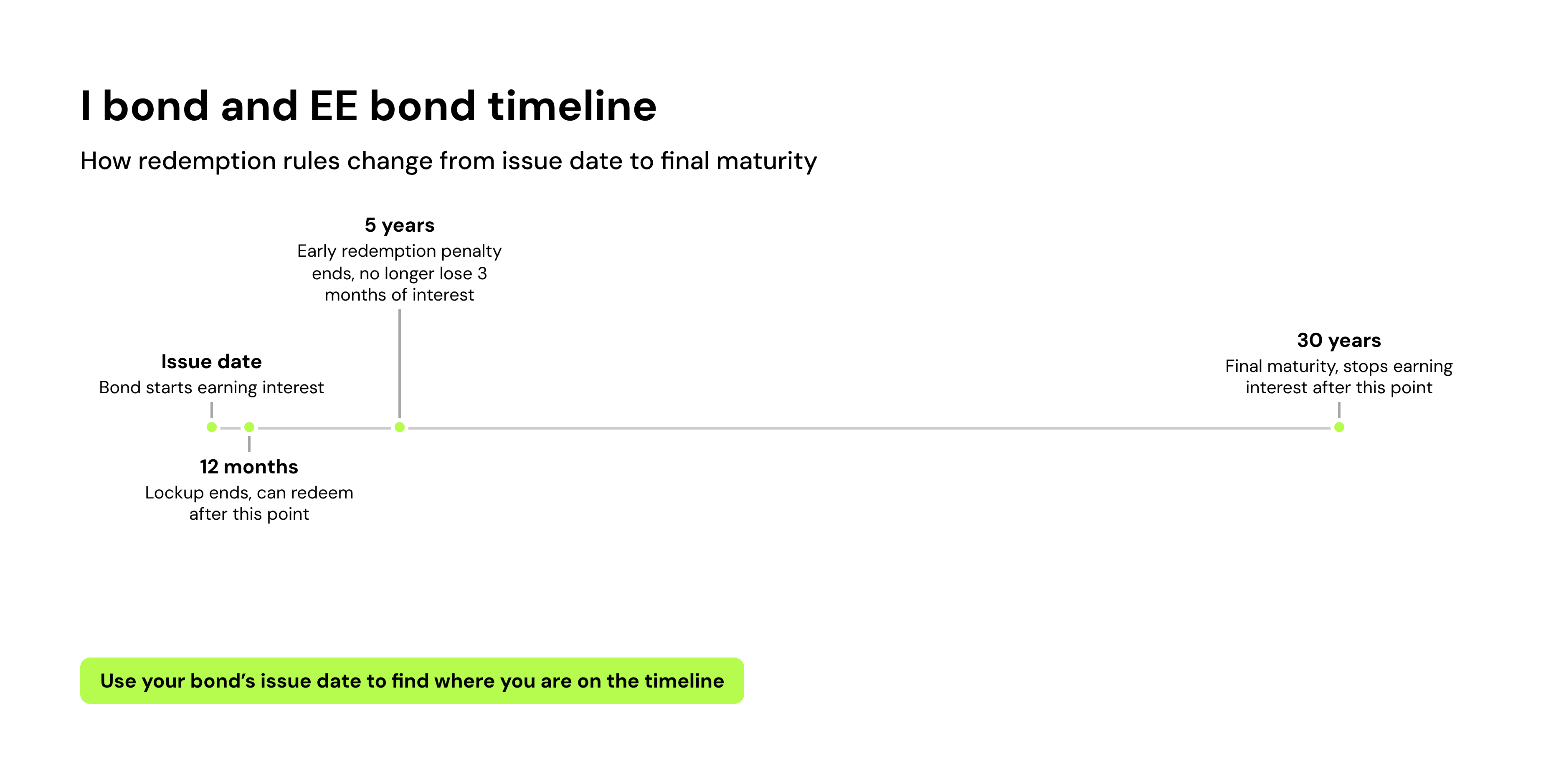
You can cash an EE or I bond any time after you’ve owned it for a year, according to the U.S. Treasury.
Cash it before year five and you’ll give up the last three months of interest. Hold it past 30 years and it stops earning altogether.
Minimum holding period
You can’t cash an EE or I bond during its first 12 months.
The one main exception is a federally declared disaster. In that case, the Treasury may let you cash it sooner.
Early redemption penalties
If you cash a bond before it’s five years old, you lose the last three months of interest. You keep all the money you paid for it.
For example, if you cash a bond at 18 months, you’d get 15 months of interest. Once the bond is five years old, there’s no penalty.
When savings bonds stop earning interest
EE and I bonds earn interest for 30 years. HH bonds earned interest for 20 years, and all of them have now stopped earning. So have all Series E bonds and savings notes.
As of November 2026, any EE bond issued in or before November 1996 has stopped earning. No I bond has reached 30 years yet. The first ones, issued in September 1998, stop earning in September 2028.
Read more >> Are Government Bonds Risk-Free?
How much is your savings bond worth?
Electronic bonds show their current value in your TreasuryDirect account. For paper bonds, use the Treasury’s Savings Bond Calculator with the series, denomination, and issue date printed on the bond.
The amount printed on a paper EE bond, called its face value, may not be what it’s worth. Paper EE bonds were sold for half their face value, so a $100 bond cost $50. Paper I bonds were sold at face value. What it’s worth now depends on when it was issued.
<<callout box: Can’t find your bonds? The Treasury Hunt search tool was retired on September 30, 2025. To search for matured bonds, contact your state’s unclaimed property office through unclaimed.org. For lost, stolen, or destroyed bonds, file a claim using TreasuryDirect’s savings bond forms.>>
Do you have to pay taxes when you cash in savings bonds?
Yes, but only on the interest you’ve earned. It’s subject to federal income tax but not state or local income tax, according to TreasuryDirect.
The IRS says you generally report the interest when the bond matures or when you cash it, whichever comes first. You can choose to report it yearly instead. So if a bond matured years ago and you never reported the interest, it may have been taxable back then, not this year. Your 1099-INT will still show it in the year you cash. Before you file, a CPA or enrolled agent can tell you whether to report it now or amend the earlier return.
Keep an eye out for your 1099-INT. TreasuryDirect posts it to your account in January of the next year, and the Treasury mails one if it cashes your paper bonds. If a bank cashes them, ask how you’ll get yours.
College costs may lower your tax bill. If you cash EE or I bonds issued after 1989 and pay qualified higher education costs that year, you may be able to exclude some or all of the interest with IRS Form 8815. Income limits and other rules apply, including that the owner was at least 24 when the bond was issued.
The IRS’s free Volunteer Income Tax Assistance program can help if you qualify. For inherited bonds or the education exclusion, consider talking with a CPA or enrolled agent for guidance specific to your situation.
What to do with savings bond money
Give the money a job before it slips into everyday spending:
- Build an emergency fund in an insured savings account, so a surprise bill doesn’t land on a card.
- Pay down high-interest debt. Credit card interest usually costs far more than a savings bond earns.
- Buy a new bond. New EE and I bonds are electronic only, from $25 up to $10,000 per series each calendar year.
- Save for a bigger goal. For retirement or investing, a financial advisor can give guidance specific to your situation.
Savings bonds don’t appear on your credit report, so cashing a savings bond won’t affect your credit at all.
Bottom line
Cash electronic bonds in TreasuryDirect and paper bonds at a bank or by mail with FS Form 1522. Wait five years if you can, and don’t let a bond sit idle past 30.
A savings bond quietly grows your money, but it’s invisible to lenders. Your credit report is built from how you pay your bills. Kikoff’s Credit Account reports your on-time payments to all three credit bureaus, with no credit check to sign up. Plans start at $5 a month.
Frequently Asked Questions
Article Sources
Disclaimer: The information provided in this blog post is meant for informational purposes only and does not constitute financial advice.