






Retirement might feel like a distant milestone, but the earlier you start saving, the easier it becomes to reach a comfortable number by the time you get there.
Every individual who wants financial security later in life needs a plan for how they'll get there, and that plan starts with understanding the tools available to you.
In this post, we'll take you through the accounts, strategies, and benchmarks that make up a solid retirement savings plan, so you can start building yours today.
How to start saving for retirement
Saving for retirement effectively comes down to a handful of core steps, and getting these right early makes everything else easier.
Let's jump in.
Figure out your retirement number
Your retirement number is generally the total amount you'll need saved to cover your expenses once you stop working.
A common starting point is to aim for 10 to 12 times your final annual salary by the time you retire.
This isn't a one-size-fits-all figure, since your number will depend on your desired lifestyle, expected retirement age, and other income sources like Social Security.
Still, having even a rough target gives you something concrete to work toward, rather than saving blindly and hoping it's enough.
Take advantage of employer matching
If your employer offers a 401(k) match, this is basically free money, and skipping it means leaving part of your compensation on the table.
A typical match might be 50% of your contributions up to 6% of your salary, though the exact structure varies by employer.
Just make sure you're contributing at least enough to get the full match before directing extra savings elsewhere.
Missing out on a match is one of the most common, and most avoidable, retirement savings mistakes people make.
Choose the right retirement accounts
Different accounts offer different tax advantages, and choosing the right mix can meaningfully affect how much you keep in retirement.
We'll cover the main account types in more detail below, but the short version is that most people benefit from combining an employer-sponsored plan with an individual account like an IRA.
This said, the "right" combination depends on your income, your employer's offerings, and your expectations for your tax bracket in retirement.
Automate your contributions
Setting up automatic contributions, either through payroll deduction or a recurring transfer, removes the temptation to skip a month.
This is a super simple habit that compounds into a big difference over decades, since consistency generally matters more than trying to time perfect contributions.
Luckily, most employers and brokerages make automation easy to set up once and forget about.
Understanding retirement account types
Before you can build a strategy, it helps to understand the accounts available to you and how each one works.
Here's a breakdown of the main retirement account types you're likely to encounter.
401(k) plans
A 401(k) is an employer-sponsored retirement account that lets you contribute a portion of your paycheck before taxes are taken out.
Contributions grow tax-deferred, meaning you won't pay taxes on the growth until you withdraw the funds in retirement.
Many employers offer a match, which is why a 401(k) is usually the first place people should direct their retirement savings.
Withdrawals before age 59 and a half generally come with a 10% penalty in addition to regular income tax, so this account is best treated as untouchable until retirement.
Traditional IRA
A traditional IRA is an individual retirement account that anyone with earned income can open, regardless of whether their employer offers a 401(k).
Like a 401(k), contributions may be tax-deductible, and the funds grow tax-deferred until withdrawal.
Traditional IRAs generally have lower contribution limits than 401(k)s, but they offer more flexibility in terms of investment choices since you're not limited to what your employer's plan offers.
Roth IRA
A Roth IRA works a bit differently, since contributions are made with after-tax dollars rather than pre-tax dollars.
The trade-off is that qualified withdrawals in retirement are completely tax-free, including all the growth your investments have generated over the years.
This can be a fantastic option if you expect to be in a higher tax bracket in retirement than you are now, since you're locking in today's tax rate on your contributions.
Roth IRAs also have income limits, so higher earners may need to explore a backdoor Roth conversion to take advantage of this account.
HSA as a retirement tool
A Health Savings Account isn't technically a retirement account, but it can function as one if used strategically.
HSAs offer a rare triple tax advantage, which is primarily why some savers treat them as a stealth retirement account: contributions are tax-deductible, growth is tax-free, and withdrawals for qualified medical expenses are also tax-free.
After age 65, you can withdraw HSA funds for any purpose without penalty, though non-medical withdrawals are taxed as ordinary income.
How much should you save for retirement?
There's no single right answer for how much to save, since it depends heavily on your income, expenses, and retirement goals.
That said, a few general benchmarks can help you gauge whether you're on track.
The 15% rule
A widely cited guideline is to save 15% of your gross income for retirement each year, including any employer match.
This isn't a strict requirement, but it's a useful default for people who don't have a more personalized target in mind.
If 15% feels out of reach right now, starting smaller and increasing your contribution rate by 1% each year is a manageable way to work up to it.
Savings benchmarks by age
Some financial professionals suggest having a multiple of your salary saved by certain ages, such as having your salary saved by 30, three times your salary by 40, and six times your salary by 50.
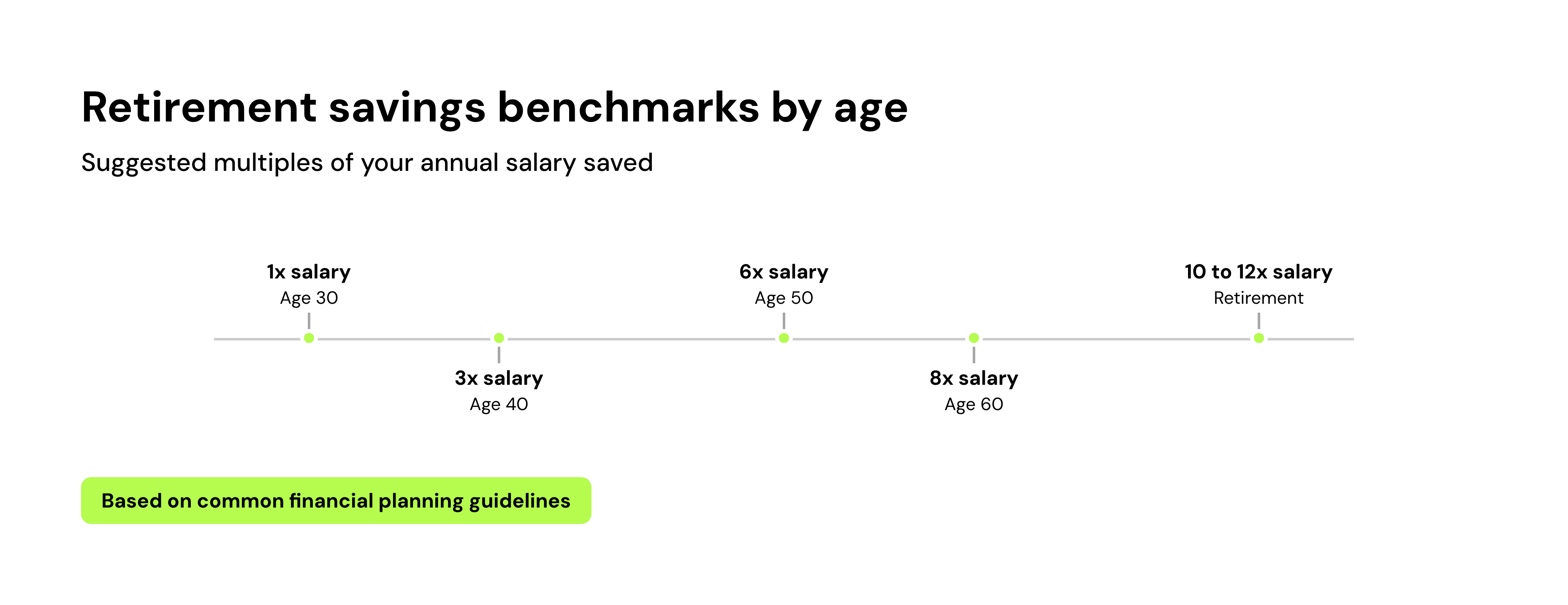
These benchmarks are generally rough guides rather than hard rules, since factors like starting income, debt levels, and regional cost of living can shift them significantly.
Falling behind a benchmark isn't a reason to panic, but it can be a useful signal to revisit your contribution rate or explore ways to free up more money each month.
The power of compound interest
Compound interest is basically what makes long-term retirement saving so powerful, since your money earns returns not just on your original contributions, but on the returns those contributions have already generated.
The formula for compound interest is written out as:
Future Value = Principal x (1 + interest rate / number of compounding periods) ^ (number of compounding periods x number of years)
This means that a dollar saved in your 20s is worth significantly more by retirement than a dollar saved in your 40s, simply because it has more time to compound.
For example, $5,000 invested at a 7% average annual return will grow to roughly $38,000 over 30 years, even without a single additional contribution.
That same $5,000 invested for only 10 years would grow to just under $10,000, which paints a picture of just how much time matters in this equation.
Retirement saving strategies by age
Your retirement strategy should generally shift as your income, obligations, and time horizon change.
In your 20s and 30s
This is generally the best time to prioritize starting the habit of saving, even if the dollar amounts are small at first.
Time is your single most valuable asset at this stage, since even modest contributions have decades to compound.
Focus on capturing your full employer match, opening a Roth IRA if you're eligible, and gradually increasing your contribution rate as your income grows.
In your 40s and 50s
By this stage, your income is usually higher, which makes it a good time to increase your savings rate meaningfully.
This is also when many people juggle competing priorities, be it a mortgage, college savings for kids, or supporting aging parents, so budgeting becomes more important than ever.
Catch-up contributions become available starting at age 50, allowing you to contribute more to your 401(k) and IRA than younger savers can.
Approaching retirement (60+)
As retirement gets closer, it's generally wise to start shifting your portfolio toward more conservative investments to protect what you've already saved.
This is also the time to firm up your withdrawal strategy, factor in Social Security timing, and estimate your healthcare costs in retirement.
Just make sure you have a clear picture of your expected expenses before you actually stop working, since adjusting a budget after the fact is much harder than planning ahead.
Common retirement saving mistakes to avoid
A few missteps can quietly derail even a well-intentioned retirement plan.
Cashing out a 401(k) when changing jobs
Cashing out your 401(k) instead of rolling it over into a new account or an IRA can trigger taxes and penalties, and it also erases years of compounding growth.
Rolling the funds over is generally a simple process that preserves your progress without adding much effort.
Not increasing contributions as income grows
It's a common trap to keep your contribution rate flat even as raises and promotions increase your take-home pay.
Increasing your contribution percentage alongside your income is a no-brainer way to accelerate your savings without feeling a pinch in your day-to-day budget.
Carrying high-interest debt while trying to save
Trying to save aggressively for retirement while also carrying high-interest credit card debt can work against you, since the interest on that debt often outpaces what your investments will earn.
Generally, it makes sense to knock out high-interest debt first, or at least in parallel, before ramping up retirement contributions beyond your employer match.
How building credit supports your retirement plan
Retirement savings and credit might seem like separate topics, but a strong credit profile actually plays a supporting role in your ability to save consistently.
Better credit generally means better interest rates on things like auto loans, mortgages, and any financing you take on along the way, which frees up more of your monthly budget for retirement contributions.
This means every dollar you're not paying toward high interest is a dollar that could instead be going toward your 401(k) or IRA.
Kikoff is a credit builder that reports to all three credit bureaus, and it can be a useful piece of the puzzle if you're working on strengthening your credit profile while you focus on your broader savings goals.
Building credit with a tool like this doesn't replace a retirement plan, but it can make the rest of your financial picture more efficient, which ultimately supports your ability to save more consistently over time.
Conclusion
Saving for retirement doesn't require a perfect plan from day one, it just requires starting and staying consistent.
Take advantage of employer matches, choose the accounts that make sense for your situation, and let compound interest do the heavy lifting over time.
This said, your broader financial health, including your credit profile, plays a role in how much you're able to save each month.
If you're looking to build stronger credit alongside your retirement goals, check out Kikoff to see how it fits into your plan.
Frequently Asked Questions
About the editor

Disclaimer: The information provided in this blog post is meant for informational purposes only and does not constitute financial advice.