

Errors on your credit report are more common than most people realize, and if left uncorrected, they can silently drag your credit score down for months or even years.
Filing a credit report dispute is effectively your formal request to a credit bureau to investigate and correct inaccurate, outdated, or fraudulent information on your report.
The good news is that disputing errors is one of the most direct ways to improve your credit score, especially when incorrect negative items are removed as a result.
In this post, we'll break down exactly how the dispute process works, what it actually does to your credit score, how long it takes, and how to protect yourself from common pitfalls.
Let's jump in.
How credit report disputes affect your credit score
Filing a credit report dispute does not directly hurt your credit score.
The act of submitting a dispute is not a credit inquiry, and it does not generate any kind of negative mark on your report.
What actually impacts your score is the outcome of the dispute, and that outcome can be significantly positive if an error is successfully removed.
Here's a breakdown of how the process can affect your score in practice:
If a dispute results in the removal of a negative item, such as a collection account, a late payment, or a fraudulent hard inquiry, your score will generally improve.
If a dispute results in no change, because the information was verified as accurate, your score remains the same.
If a dispute results in updated information that is still negative, such as a corrected balance that is still high, the score impact depends on what the updated data looks like to scoring models.
The single most important thing to understand is that disputing valid, accurate information will not remove it from your credit report, so it's worth focusing your energy on items that are genuinely incorrect.
What information can you actually dispute?
Every individual who has a credit report has the legal right to dispute any information they believe to be inaccurate or incomplete.
Under the Fair Credit Reporting Act (FCRA), credit bureaus are required to investigate disputes and correct or remove information that cannot be verified within a reasonable timeframe, usually 30 to 45 days.
Here are the most common types of errors worth disputing:
- Accounts that don't belong to you, which may indicate identity theft or a mixed file
- Incorrect late payment records when you paid on time
- Accounts showing as open that you've already closed
- Duplicate accounts, where the same debt appears more than once
- Incorrect balances or credit limits
- Outdated negative items that should have aged off the report after 7 to 10 years
- Hard inquiries you didn't authorize
This said, not everything on your report is worth disputing.
Accurate negative information, be it a missed payment you actually made late or a collection that legitimately belongs to you, cannot be removed through a dispute.
Disputing accurate items may result in the bureau verifying the item and leaving it as-is, which doesn't hurt your score, but it won't help either.
The dispute process, step by step
Filing a dispute is generally straightforward, though the exact steps vary depending on whether you're going directly to a bureau or using a tool like Kikoff.
Here's a breakdown of how the process typically works:
Step 1: Pull your credit reports
Before disputing anything, you need to know what's actually on your reports.
You can access your credit reports from all three major bureaus (Equifax, Experian, and TransUnion) for free at annualcreditreport.com.
Review each report carefully, because an error may appear on one bureau's report but not another's, which means you'll need to file a separate dispute with each bureau where the error appears.
Step 2: Identify the error
Once you have your reports, document exactly what is inaccurate and gather any supporting evidence you have.
Supporting evidence can include payment confirmations, account statements, or any correspondence with the creditor that contradicts what appears on your report.
The stronger your documentation, the more likely the bureau is to resolve the dispute in your favor.
Step 3: File the dispute
You can dispute directly with the bureau online, by phone, or by mail.
Each bureau has its own online dispute portal, and filing online is usually the fastest route.
Alternatively, tools like Kikoff can help you generate dispute letters and submit them electronically to TransUnion or by mail to Equifax and Experian, making the process much simpler.
Step 4: Wait for the investigation
Once a dispute is filed, the bureau has 30 days to investigate, though this can extend to 45 days in certain circumstances.
During this period, the bureau contacts the data furnisher, meaning the lender, collection agency, or other company that reported the information, to verify whether the data is accurate.
If the furnisher cannot verify the information or fails to respond within the timeframe, the bureau is required to correct or remove it.
Step 5: Review the outcome
After the investigation, the bureau will notify you of the results.
If the dispute was successful, the corrected information will be updated on your report and your score will reflect the change on its next update cycle.
If the dispute was not resolved in your favor, you have the option to add a consumer statement to your report, escalate with the Consumer Financial Protection Bureau (CFPB), or consult a consumer law attorney if the FCRA was violated.
How long does it take to see a score change?
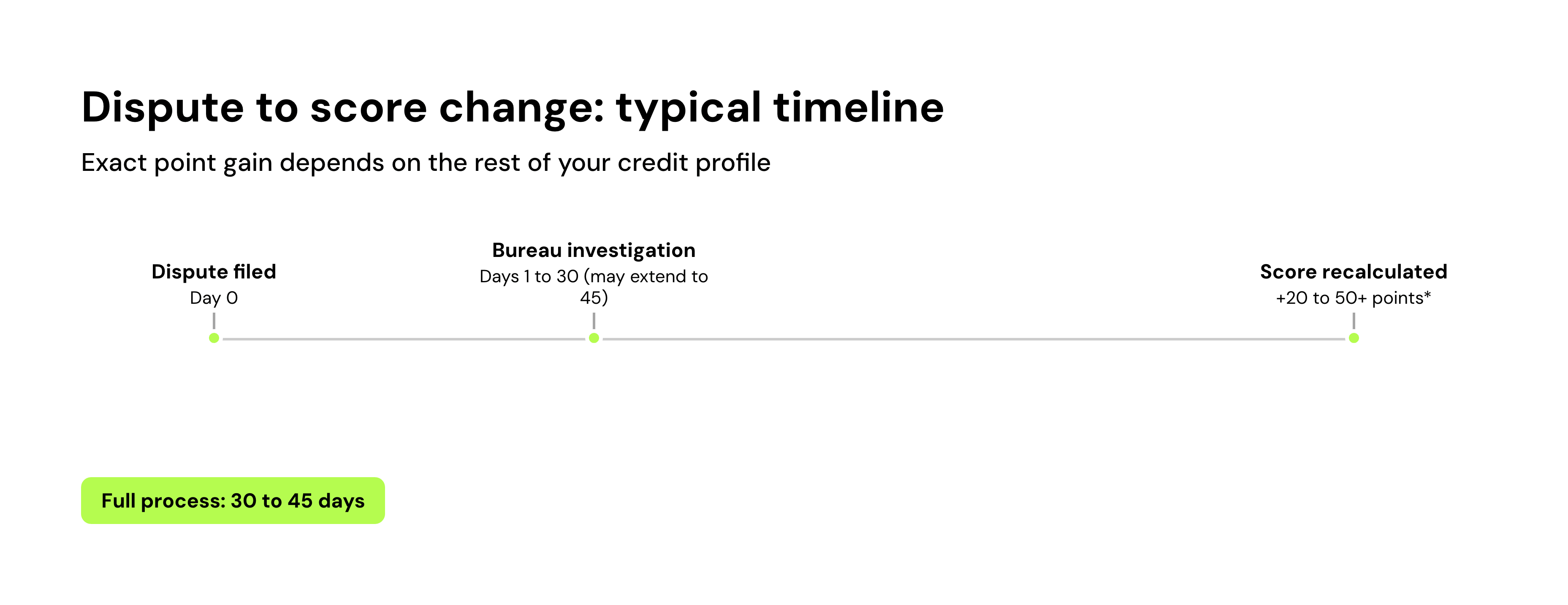
The investigation window is generally 30 to 45 days, but the score impact can take slightly longer to show up.
This is because credit scores are not updated in real time.
Your score is recalculated each time a lender or scoring model pulls your report, and most bureaus refresh score data on a monthly cycle aligned with when your creditors report.
This means that even if a negative item is removed promptly, you may not see the full benefit in your score for another few weeks depending on where you are in that reporting cycle.
Luckily, the wait is generally worth it.
Removing a single significant negative item, such as a collection account or a fraudulent hard inquiry, can result in a meaningful score jump, sometimes 20 to 50 points or more depending on the rest of your credit profile.
Disputing errors vs. "credit repair" tactics
It's worth drawing a clear line between legitimate dispute filing and some of the misleading tactics that show up in the "credit repair" space.
Disputing genuine errors is your legal right and it works because the underlying claim is valid.
What doesn't work, and can actually cause problems, is disputing accurate negative information with the goal of overwhelming bureaus into removing it, or paying a so-called credit repair company to do this on your behalf.
The FCRA explicitly states that accurate information cannot be removed before its natural expiration, be it a late payment after 7 years or a bankruptcy after 10 years.
Any company promising to "erase" legitimate negative items from your report is generally misleading you, and the FTC has taken action against numerous credit repair scams for exactly this type of fraud.
The right approach is to focus disputes on genuinely incorrect information, build positive credit habits to dilute the weight of older negatives over time, and use tools that actually help you understand your credit profile.
Kikoff offers free dispute tooling for all users, with no purchase required, and helps you file disputes with the bureaus without the confusion of going it alone.
How disputes interact with each credit bureau
Because your credit file is maintained separately at each of the three major bureaus, Equifax, Experian, and TransUnion, a dispute filed with one bureau does not automatically apply to the others.
This is one of the most common sources of confusion in the dispute process.
If an error appears on all three reports, you'll need to file three separate disputes.
The data furnisher, meaning the creditor or collector who reported the error, is supposed to correct their reporting across all bureaus if an error is confirmed, but in practice this doesn't always happen automatically or quickly.
This said, it's a no-brainer to check all three reports before and after a dispute so you can confirm the correction took effect everywhere it should have.
Kikoff reports to all three major credit bureaus as a data furnisher, so users building credit through the platform have payment history reflected across Equifax, Experian, and TransUnion.
When disputes can indirectly hurt you
While the dispute itself won't hurt your credit, there are a few indirect situations worth knowing about.
If you're in the middle of a mortgage application or another major credit decision, some lenders may view an "under dispute" flag on an account as a reason to pause or complicate the approval process.
This is because disputed accounts are sometimes temporarily excluded from scoring models while the investigation is active, which can actually inflate your score temporarily, and lenders may discount that number.
Just make sure you understand the timing before filing disputes immediately before a major credit application.
It's generally better to resolve disputes well in advance of applying for significant credit, giving your score time to reflect the corrected data before a lender pulls your report.
Conclusion
Disputing errors on your credit report is one of the most direct, legitimate ways to protect and improve your credit score.
The process doesn't hurt your credit, it's protected by federal law, and when it works, the score benefit can be substantial.
The key is to focus on genuinely inaccurate information, document your case well, and follow up across all three bureaus to make sure corrections take hold everywhere they need to.
If you want a simple way to handle disputes and build positive credit history at the same time, Kikoff offers free dispute tools alongside credit-building products that report to all three major bureaus, with no hard credit check to get started.
Frequently Asked Questions
If a bureau fails to complete its investigation within 30 days, or 45 days in some circumstances, it is legally required under the FCRA to delete the disputed item from your report. This doesn't happen automatically, though, so following up with the bureau directly is worth doing if you haven't received a resolution after the allotted window.
Filing a dispute itself does not lower your credit score. The only scenario where your score could be negatively affected is if the dispute reveals that a previously reported item was actually more favorable than the corrected version, which is uncommon but possible if, for example, a balance or limit was being reported incorrectly in your favor.
There's no legal limit to how many disputes you can file simultaneously. That said, filing a large number of disputes at once without clear supporting documentation can slow down the investigation process, and bureaus are not required to investigate disputes they consider "frivolous." Focusing on your most impactful, well-documented errors is generally the most effective approach.
No, the three bureaus do not automatically share dispute outcomes. Each bureau runs its own investigation independently, and a correction made at one bureau will not automatically be reflected at the others. If an error appears on more than one report, you'll need to file separate disputes with each bureau where it shows up.
Sources
Disclaimer: The information provided in this blog post is meant for informational purposes only and does not constitute financial advice.