




Debt restructuring means asking a creditor you already owe to change your terms, such as a lower rate, a longer repayment period, or smaller payments for a while. You don’t take out a new loan, and you don’t have to be behind on payments to ask. But the creditor has to agree, and a lower monthly payment can cost you more over time.
What is debt restructuring?
Debt restructuring changes the terms of a debt you already have, usually because the current payment has become hard to keep up with. Instead of borrowing to pay it off, you work with your current creditor to change how you repay it. The creditor still collects some or all of what you owe, just on terms you can manage.
For example, the payment on a $10,000 personal loan at 12% over three years is about $332 a month. If your lender extends the loan to five years, the payment drops to about $222. But you’d pay about $1,390 more in interest.
Restructuring isn’t automatic. Your creditor has to agree to the changes, and not every type of debt can be restructured this way.
How does debt restructuring work?
Debt restructuring typically starts when you contact your creditor and explain that you’re experiencing financial difficulties. You might need to provide information about your income, expenses, and outstanding debts.
Negotiating new terms with creditors
The restructuring process follows five general steps:
- Review your finances. Determine how much you owe, what you’re currently paying, and what you can realistically afford.
- Contact your creditors. Explain your financial situation and ask about hardship programs or restructuring options.
- Provide documentation. Your creditor could request pay stubs, bank statements, or other proof of financial hardship.
- Review proposed terms. Compare the new monthly payment, interest costs, and repayment timeline with your existing agreement.
- Get the agreement in writing. Make sure you understand the new terms before making payments under the arrangement.
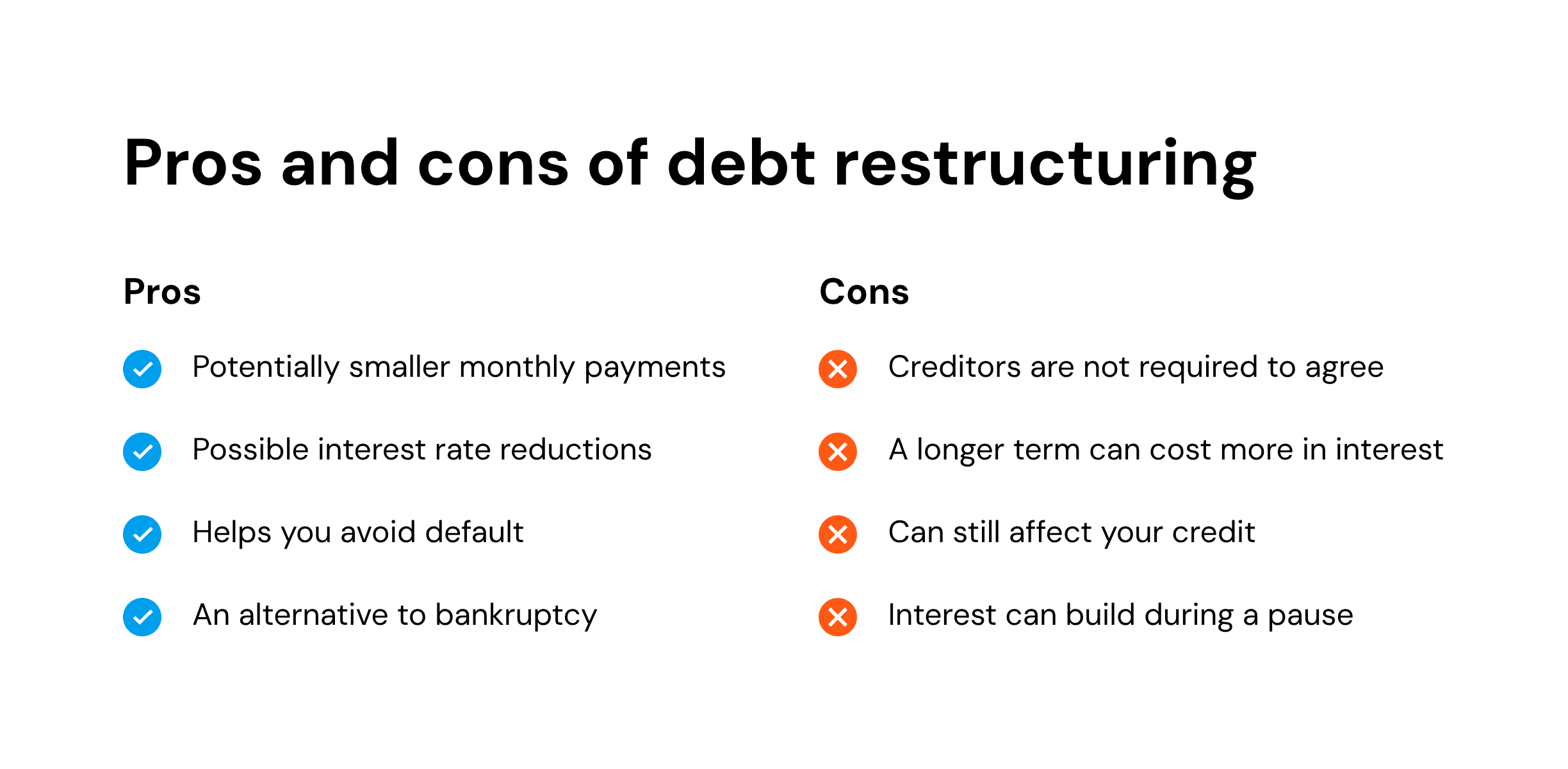
Creditors aren’t required to accept your proposal. However, some prefer to modify your repayment terms rather than risk missed payments or default.
Common changes made during restructuring
Depending on the creditor and type of debt, restructuring might involve:
- Lower interest rates. Reducing the interest charged on your outstanding balance.
- Extended repayment terms. Giving you more time to pay, resulting in smaller monthly payments.
- Temporary payment reductions. Allowing smaller payments during a financial hardship.
- Payment pauses. Temporarily suspending payments through an approved hardship arrangement. Ask whether interest keeps building during the pause, and whether it gets added to what you owe.
- Balance reductions. In some situations, creditors forgive part of the balance, although this overlaps with debt settlement.
Keep in mind that extending your repayment term could mean paying more interest overall, even if your monthly payment decreases.
Read more >> How to Negotiate Credit Card Debt
Debt restructuring by type of debt
Most personal debt can be restructured in some form, but what you can ask for depends on the kind of debt. (Businesses restructure debt too, sometimes through bankruptcy, but this guide covers personal debt.)
Credit cards
Many card issuers offer hardship programs that temporarily lower your interest rate or set up a fixed repayment schedule. Call the number on the back of your card and ask for the hardship department.
You can also work with a nonprofit credit counseling agency, which may recommend a debt management plan. You make one monthly payment to the agency, and creditors may agree to lower your rates. The agency will generally close the cards in the plan, and most charge a setup fee and a monthly fee.
Mortgages
Your mortgage servicer may offer a loan modification, which permanently changes your rate, term, or payment, or forbearance, which pauses or reduces payments for a set time. Ask whether skipped payments will be due in a lump sum later. If you’re behind, foreclosure is the risk, so contact your servicer as early as you can. A HUD-approved housing counselor can typically help for free at 800-569-4287. If foreclosure has already started, talk with an attorney.
Auto loans
Lenders may agree to defer a payment or extend your loan term. Ask before you miss a payment. In most states, a lender can repossess your car as soon as you’re in default, with no legal waiting period.
Medical bills
Many hospitals and providers offer payment plans, and nonprofit hospitals are required to have a financial assistance policy. Ask the billing office for the policy and a payment plan before the bill goes to collections.
Federal student loans
Federal student loans aren’t negotiated. Instead, your servicer can move you to a different repayment plan, or pause payments through deferment or forbearance. See your options at StudentAid.gov, and learn more about getting help with student loans.
Read more >> Which Debt Should I Pay Off First?
Debt restructuring vs. debt consolidation
Debt restructuring changes the terms of existing debt, while debt consolidation typically combines multiple debts into one new loan or credit account.
For example, you could consolidate several credit card balances using a personal loan. You’d then make one monthly payment instead of several.
Consolidation can simplify repayment and potentially reduce interest costs, but qualifying for favorable terms often depends on your credit and income.
Restructuring, meanwhile, may be more appropriate when you’re struggling to afford existing payments and need your creditors to change your terms.
Read more >> What Is Debt Consolidation? How It Works and When It Pays
Debt restructuring vs. debt settlement
Debt settlement involves negotiating with creditors to pay less than you owe, usually through a lump-sum payment or a negotiated repayment arrangement.
Restructuring generally focuses on making debt easier to repay, although some restructuring agreements also reduce principal balances.
Debt settlement can carry significant risks. Debt settlement companies typically encourage you to stop making payments while saving money for a settlement. This can lead to additional fees, collection activity, lawsuits, and credit damage.
Forgiven debt generally counts as taxable income unless an exception (such as insolvency) applies.
Read more >> What Is Debt Forgiveness? Who Qualifies and What It Costs
How debt restructuring affects your credit
Debt restructuring doesn’t automatically hurt your credit. The impact depends on your payment history, the agreement, and how your creditor reports the account.
For example, if your lender modifies your loan while your account stays current, the impact may be limited. However, missed payments before restructuring can remain on your credit reports for up to seven years.
Other potential credit consequences include:
- Late payments. Payments reported as late can negatively affect your credit.
- Account closures. A creditor could close a credit card account as part of a hardship arrangement, potentially affecting your credit utilization.
- Settlement reporting. If your creditor accepts less than the full balance, it may report the account as settled rather than paid in full.
- Bankruptcy. Formal restructuring through bankruptcy can stay on your credit report for up to 10 years.
Ask your creditor how it reports the arrangement to the credit bureaus before agreeing to new terms.
After the new terms start, check that your account shows up the way your creditor said it would. Your reports are free every week at AnnualCreditReport.com. If the account shows a late payment after you paid as agreed, that’s an error you can dispute for free with the credit bureau, or Kikoff's AI Credit Disputes can help handle it for you.
Read more >> Best Debt Negotiation Services
Not sure which path fits?
To compare your options, a nonprofit credit counselor can weigh restructuring, settlement, and bankruptcy against your budget for free or at low cost. Call the National Foundation for Credit Counseling (NFCC) at 800-388-2227.
If you’re considering bankruptcy, talk with a bankruptcy attorney before you file. LawHelp.org lists free legal aid by state.
Bottom line
Debt restructuring works best when you can still make payments under new terms and ask your creditor before the account falls further behind. Call the number on your statement and ask about hardship options. A nonprofit credit counselor can help you compare what your creditors offer.
If your hardship arrangement closes a card, that’s one fewer account adding on-time payments to your credit report. When your budget has room, the Kikoff Credit Account reports your on-time payments to Equifax, Experian, and TransUnion. There’s no credit check to sign up, and plans start at $5 a month.
Frequently Asked Questions
Article Sources
Disclaimer: The information provided in this blog post is meant for informational purposes only and does not constitute financial advice.