


Account re-aging means changing an account’s delinquency status or dates, and it covers two very different things. A lender can agree to bring a past-due account back to current after you make a few payments. Or a debt collector can report a later date for when you first fell behind, which keeps a negative item on your credit reports longer than federal law allows.
If you’re worried that paying an old collection will keep it on your credit reports longer, it won’t. How long it stays depends on when you first fell behind with the original lender. A payment can affect something else, though: the time a collector has to sue you.
Two kinds of re-aging
How a lender re-ages a past-due account
For a bank, re-aging means returning a past-due credit card or other revolving account to current without collecting everything you owe first. Under federal banking guidance on re-aging last updated in 2000, a bank typically re-ages an account only when:
- The account has been open at least nine months.
- You’ve made at least three consecutive minimum monthly payments, or the same amount in total.
- It hasn’t re-aged the account more than once in 12 months or twice in five years. A workout program, meaning a formal repayment plan, can add one more re-age every five years.
Lenders have a reason to say yes. Under the same guidance, a revolving account that reaches 180 days past due is generally charged off, or written off as a loss. A charge-off is one of the more serious marks a credit report can show.
Re-aging changes how the account is reported from then on. Late payments already reported typically stay. Before you agree, ask your lender what you’d need to pay and whether those late payments would stay on your reports.
If you’re behind on several accounts, a nonprofit credit counselor may ask your lenders to re-age them as part of a debt management plan. The National Foundation for Credit Counseling (NFCC) can connect you with free or low-cost debt counseling at 800-388-2227.
Read more >> Can a Collection Agency Change the Open Date on Your Account?
Asking your lender to re-age an account. You can call the number on your statement and ask:
“Can you re-age my account if I make the required payments? How many payments, and how much each? Will the late payments already reported stay on my credit reports? Can you confirm the terms in writing?”
Get the answer in writing before you pay, so you have a record if the account isn’t brought current as promised.
When re-aging is illegal
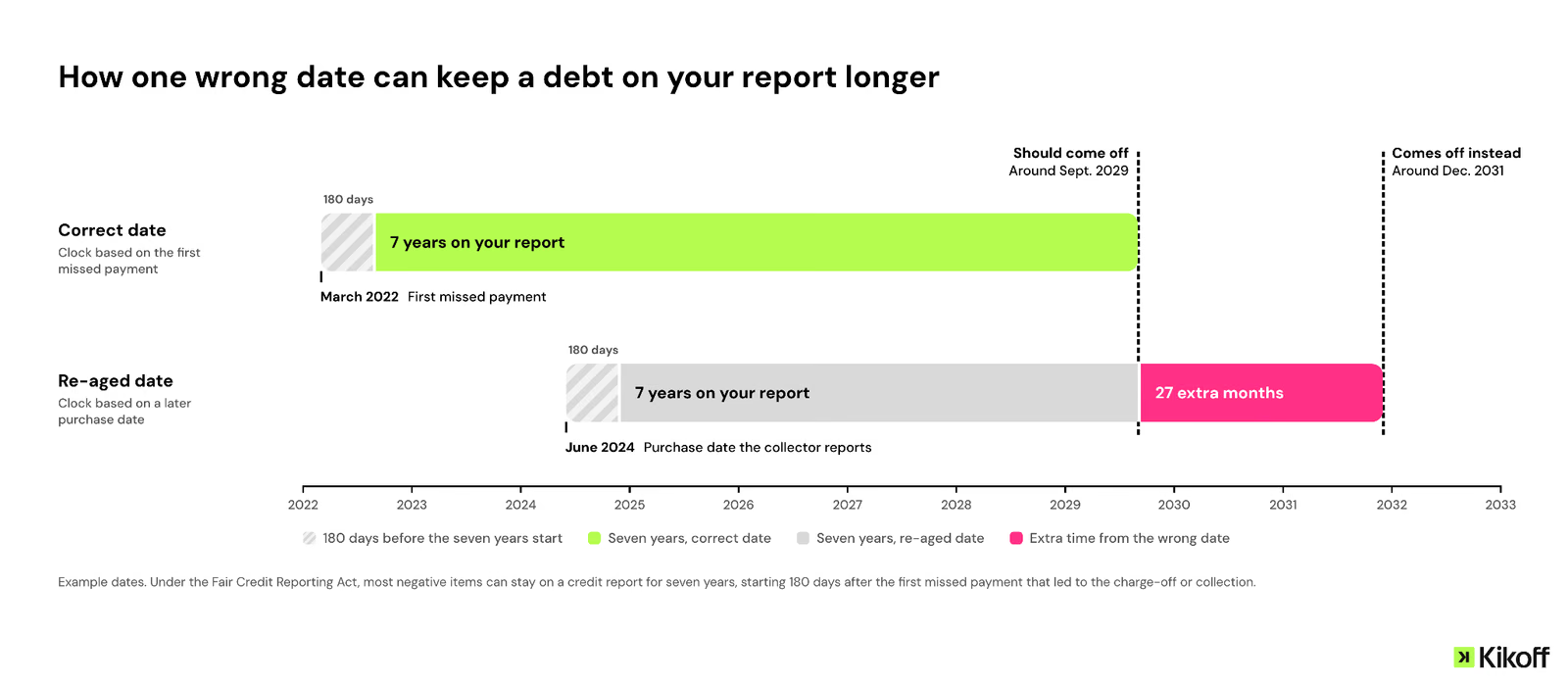
Most collections and charged-off accounts can stay on your credit reports for seven years. Under the Fair Credit Reporting Act, those seven years start 180 days after the missed payments that led to the collection or charge-off. Companies that report these accounts must tell the credit bureaus the month and year that you first fell behind.
Illegal re-aging is reporting a later date than the real one, such as the day a debt buyer bought the debt. In 2004, collector NCO Group agreed to pay a $1.5 million civil penalty to settle Federal Trade Commission (FTC) charges that it reported dates of delinquency that were later than the real ones.
Here’s an example: Say you first fall behind on a card in March 2022, and it’s later charged off. The seven years start around September 2022, so the item should come off around September 2029. If a collector reports its June 2024 purchase date instead, the end date moves to around December 2031, more than two years later.
How to spot and dispute a re-aged debt
Disputing an error on your credit report is free.
- Start by getting your free credit reports from AnnualCreditReport.com. You can check each of the three bureaus once a week for free, and checking your own reports doesn’t affect your credit.
- Next, find each collection or charged-off account and the date you first fell behind. Labels vary by bureau, such as “date of first delinquency” or the date the item is scheduled to come off. Compare it with old statements or bank records showing your last payment.
- If the date is later than when you actually fell behind, dispute it with the bureau and with the company that reported it. Send copies of your proof, not originals, and write down what you sent and when so you can follow up.
- The bureau generally has 30 days from receiving your dispute to investigate and respond. If the date still isn’t corrected, submit a complaint to the CFPB.
A collection account may list the date the collector opened its own account, usually when it bought the debt. That date can be later than when you fell behind and still be correct. What controls when the item comes off is when you first fell behind with the original lender.
Disputes correct inaccurate information only. If the date is right, the item stays on your report until its legal end date. If it’s wrong, you can dispute it yourself for free, or Kikoff’s AI Credit Disputes can help you prepare and track the dispute.
Paying an old debt: Two different time limits
The lawsuit time limit is the statute of limitations, and your state’s law sets it. A partial payment or acknowledging that you owe an old debt may restart it, according to the CFPB, even after it has run out.
Read more >> When Does a Debt Become Delinquent?
Before you pay an old debt. Find out your state’s time limit to sue before you pay or promise to pay anything. A legal aid office or a licensed consumer attorney can tell you whether the debt is too old for a lawsuit. If you’re sued, respond by the deadline on the court papers, even if you think the debt is too old.
Bottom line
Re-aging is either a lender agreeing to bring a past-due account current or a collector illegally reporting a later delinquency date. Ask your lender about the first, and dispute the second for free. Either way, a correct date only stops an old item from staying too long. It doesn’t add anything new to your file. Kikoff’s Credit Account reports your on-time payments to Equifax, Experian, and TransUnion, with no credit check to sign up. Plans start at $5 a month.
Frequently Asked Questions
Article Sources
Disclaimer: The information provided in this blog post is meant for informational purposes only and does not constitute financial advice.