
An insurance claim is a formal request for your insurance company to pay for a loss your policy covers, like a fender bender, a burst pipe, or a stolen laptop. Filing one starts a review, not a payout. Your insurer checks the loss against your policy, subtracts your deductible, and pays up to your coverage limit, under rules your state sets.
If you’re worried a claim will follow you, it won’t land on your credit reports. Insurers track claims in a separate claims history that other insurers can check when you apply or renew.
How an insurance claim works
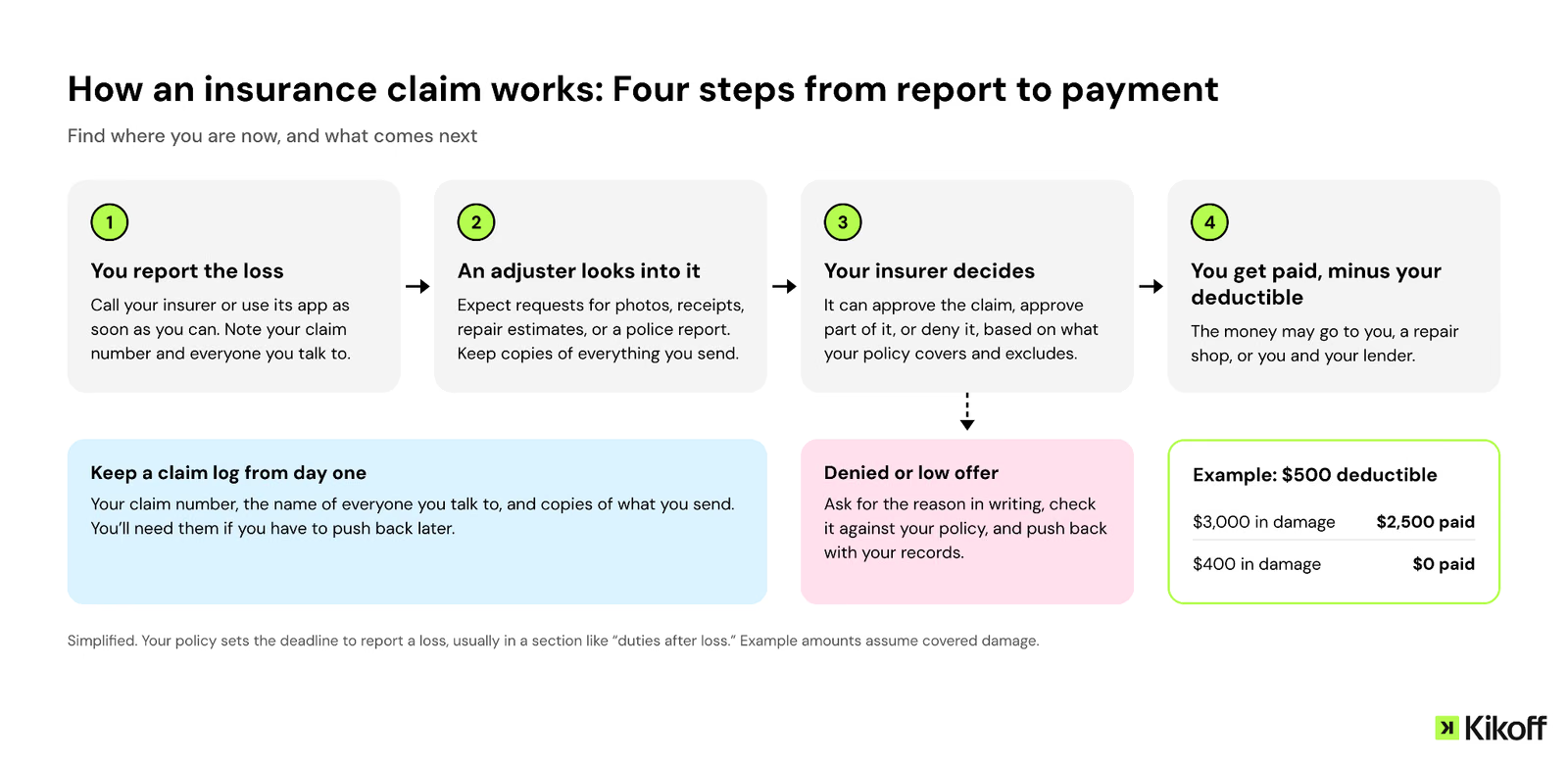
- You report the loss. Call your insurance company or use its app as soon as you can. Your policy sets the deadline, usually in a section like “duties after loss.” Write down your claim number and the name of everyone you talk to. You’ll need them if you have to push back later.
- An adjuster looks into it. An adjuster is the person your insurer assigns to investigate. Expect requests for photos, receipts, repair estimates, or a police report. Keep copies of everything you send.
- Your insurer decides. It can approve the claim, approve part of it, or deny it, based on what your policy covers and excludes.
- You get paid, minus your deductible. The money may go to you, to a repair shop, or to you and your lender together if you have a car loan or mortgage.
For example, say a storm causes $3,000 in covered damage and your deductible is $500. Your insurer pays $2,500. If the damage were $400, you’d get nothing.
Words you’ll see on your claim
What can change what you get paid
Having a policy doesn’t mean every loss is covered. Two people with the same damage can get different results because their policies, deductibles, and states differ. Your policy sets your filing deadlines, and your state sets rules like how quickly an insurer must respond and pay, so they aren’t the same everywhere.
Before you file, pull up your policy or call your agent and ask:
- Does my policy cover this kind of loss, or is it excluded?
- What’s my deductible for this claim? Some policies have separate ones for wind or hail.
- Will you pay actual cash value or replacement cost?
- How long do I have to file and send proof of the loss?
- Will you pay me, the repair shop, or my lender?
Should you file or pay out of pocket?
When the loss is close to your deductible, filing may add to your claims history without paying you much. A database called C.L.U.E., run by LexisNexis, collects up to seven years of auto and home insurance claims. Insurers can check it when you apply or renew. Whether one claim changes your premium depends on your insurer, the type of claim, and your state.
You can see your own record. LexisNexis provides one free report every 12 months if you ask, at consumer.risk.lexisnexis.com or 866-897-8126. If it lists a claim you didn’t file or the wrong amount paid, contact LexisNexis to dispute it.
Read more >> How to File a Home Insurance Claim
If your claim is denied or the offer seems low
A denial or a low offer isn’t always the final word. Work through these steps in order:
- Ask for the reason in writing, including the exact policy language your insurer relied on.
- Compare that language with what happened. Sometimes a denial rests on a missing document or a misunderstanding about the loss.
- Send more proof, like repair estimates, photos, and receipts. Ask whether your insurer has an internal appeal and what its deadline is.
- Contact your state insurance department. It’s free, and it oversees how insurers handle claims. Find your state’s department through the National Association of Insurance Commissioners (NAIC). Most let you file a complaint online, by mail, or by phone.
You don’t have to accept a payment you think is unfair. If the loss is large or the dispute is heading toward a lawsuit, consider talking with a licensed attorney for personalized guidance.
Before you accept a settlement. Get the offer in writing, ask how it was calculated, and compare it with your own repair estimates. If the numbers don’t line up, your state insurance department can review the claim for free.
How claims connect to your credit
Filing a claim doesn’t put anything on your credit reports. Your credit can still affect your insurance, though. A credit-based insurance score is based partly or entirely on your credit history. Insurers use it to estimate how likely you are to file a claim, not how likely you are to repay a loan.
Most states let insurers use these scores to help set premiums. In most states, though, insurers can’t use them as the only reason to raise your rate or to deny, cancel, or refuse to renew your policy, and some states limit them further. After you get an insurance quote, you can ask whether one was used and which risk category you landed in. Many insurers will reconsider a premium change after a job loss, serious illness, or similar life event, so ask if that applies to you.
Bottom line
An insurance claim is how you ask your insurer to pay for a covered loss, and your policy and state rules decide what you get. A claim records what happened to your car or home. It doesn’t add anything to your credit history, and in most states, that history is part of how insurers price your coverage. Kikoff’s Credit Account reports your payment history to Equifax, Experian, and TransUnion, so paying on time each month can help build your credit. Plans start at $5 a month.
Frequently Asked Questions
Article Sources
Disclaimer: The information provided in this blog post is meant for informational purposes only and does not constitute financial advice.