







A subprime mortgage is a home loan for someone a lender sees as a higher credit risk, usually because of a lower credit score. To make up for that risk, it costs more. That can mean a higher interest rate, higher fees, or a bigger down payment. No federal law defines “subprime,” and there’s no single score that triggers it. What federal rules do define is a higher-priced mortgage, and that label comes with extra protections for you.
If you’re worried a subprime loan is your only way into a home, it may not be. FHA rules allow scores as low as 500 with 10% down, though some lenders set higher minimums.
What makes a mortgage subprime
Lenders price loans by risk. A lower score, a recent bankruptcy or foreclosure, or a high debt-to-income ratio can push a loan into subprime pricing. Debt-to-income is the share of your monthly income that goes to debt payments. Income that’s hard to document, like freelance or cash work, can do the same.
You may not see the word “subprime” on an offer. Some lenders say “nonprime” instead, and some subprime loans are sold as non-QM loans. Non-QM means the loan doesn’t meet the federal standards for a qualified mortgage. (The label also covers loans for borrowers with strong credit and hard-to-document income, so non-QM doesn’t automatically mean subprime.)
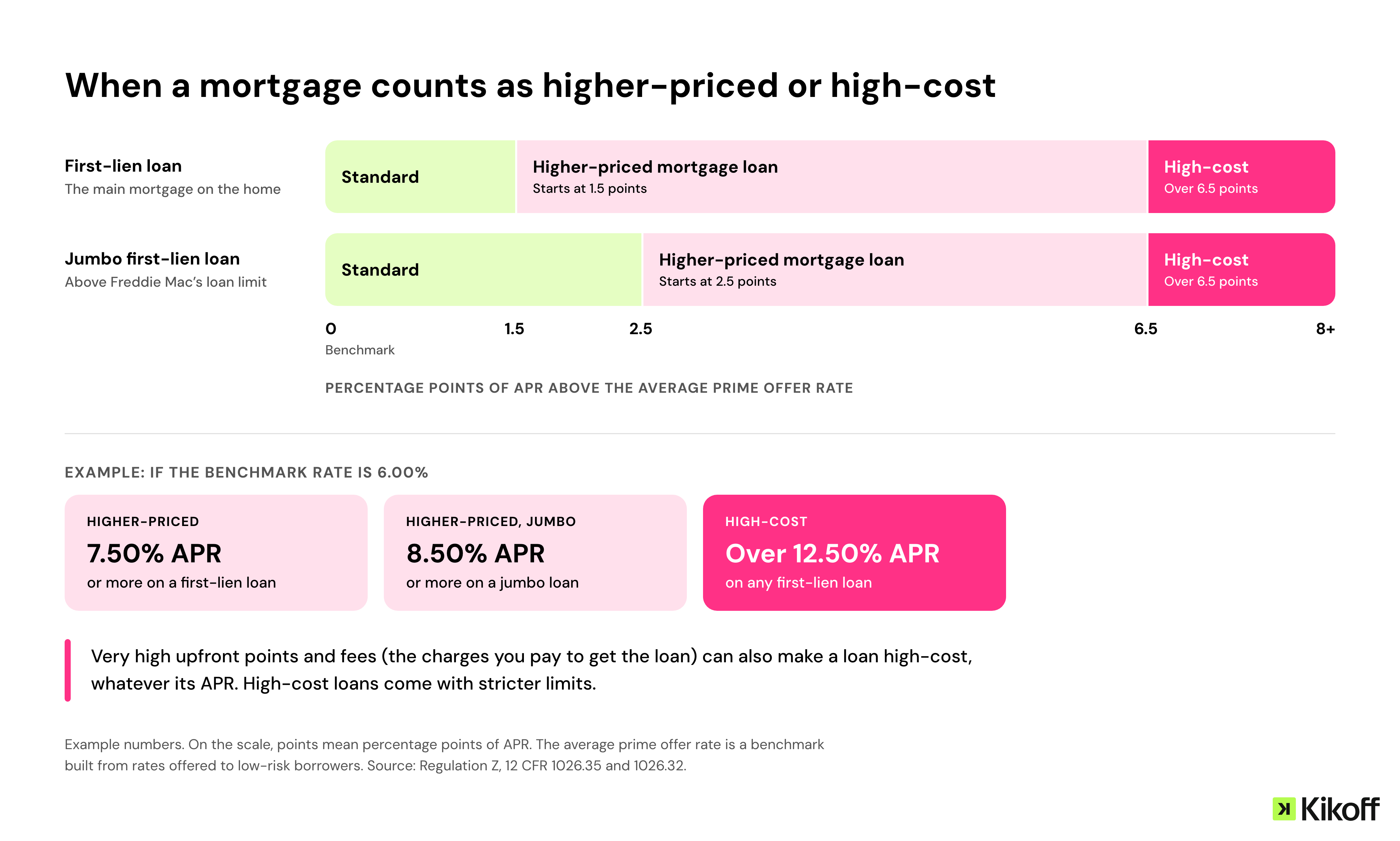
Federal rules measure the price instead of the label. Under Regulation Z, a first-lien home loan (the main mortgage on the home) is a higher-priced mortgage loan when its APR is 1.5 or more percentage points above the average prime offer rate. That’s a benchmark built from the rates lenders offer low-risk borrowers. For jumbo loans, which are larger than Freddie Mac’s loan limit, the line is 2.5 points. A first-lien loan more than 6.5 points above that benchmark counts as a high-cost mortgage. Very high points and fees can also trigger that label, which comes with stricter limits.
Read more >> How to Buy a House With Bad Credit
What credit score counts as subprime?
That’s up to whoever draws the line, and they don’t all use the same scoring model.
The CFPB’s tiers come from its mortgage borrower research, and VantageScore publishes its own four tiers. Neither is a lending rule.
Mortgage lenders don’t all pull the same score either. As of November 2026, lenders selling loans to Fannie Mae and Freddie Mac can choose Classic FICO or VantageScore 4.0. Loans underwritten manually still use Classic FICO.
So the score in your free credit app may not be the one a lender sees. When you apply, ask the lender which scoring model it used and what score it pulled.
Your mortgage score is usually the middle of three
Mortgage lenders pull a score from each bureau and generally use the middle one, or the lower one if only two come back. So an error on one report can change the score that prices your loan. Before you apply, check all three reports free every week at AnnualCreditReport.com. Disputing errors is free with each bureau, or Kikoff’s AI Credit Disputes can help you challenge inaccurate information.
Read more >> What Is a Subprime Credit Score?
What a higher rate can cost
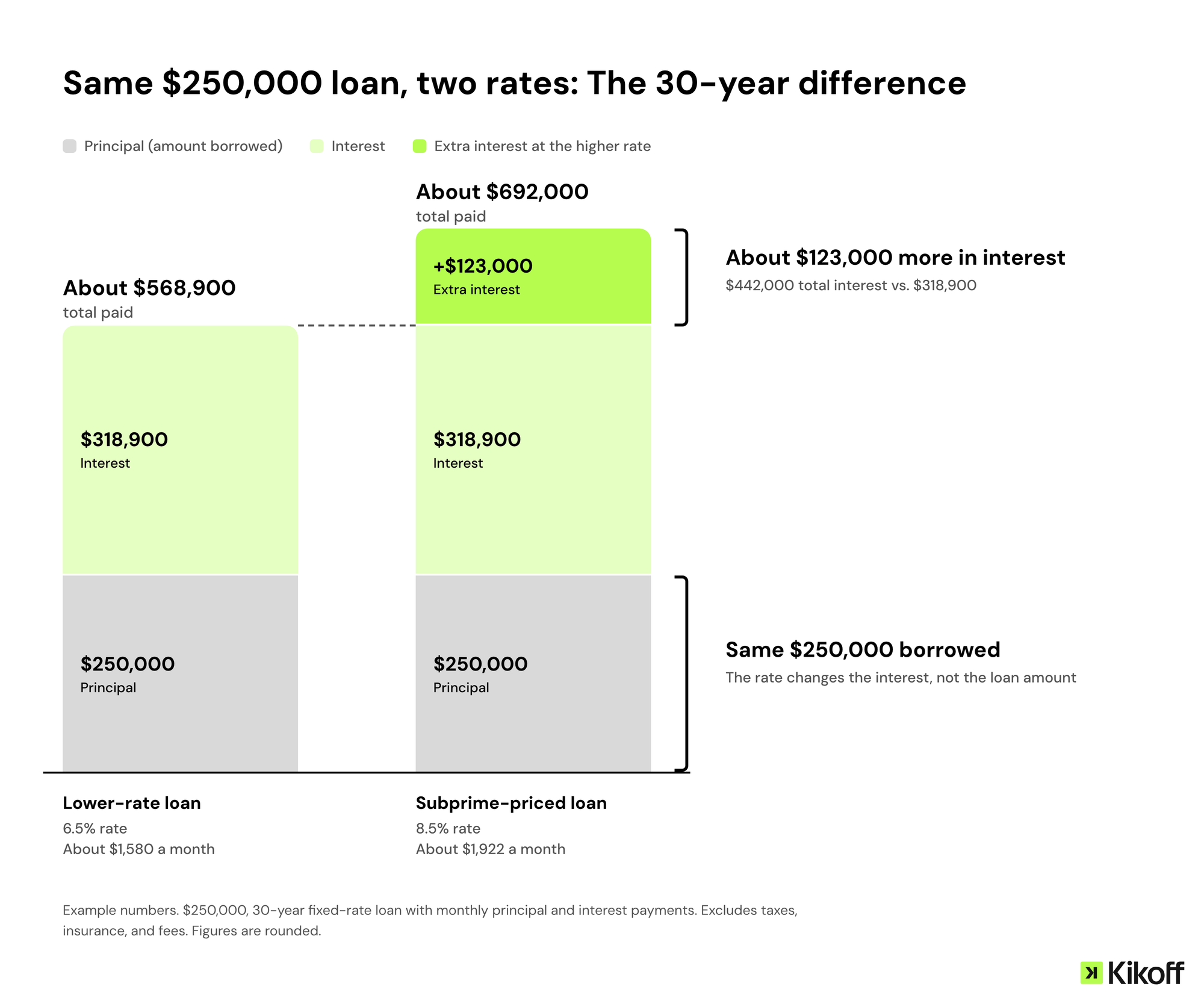
A few percentage points add up fast on a 30-year loan. Take the same $250,000, 30-year loan at two rates, 6.5% and 8.5%.
The higher rate costs about $342 more a month, or about $123,000 more over the life of the loan if you keep it for all 30 years. Taxes, insurance, and fees would come on top of both.
Protections that apply to you
Most home loans, subprime or not, come with federal protections from Regulation Z:
- Ability to repay. Before closing, your lender must make a “reasonable and good faith determination” that you can repay the loan. It has to look at your income, debts, and credit history.
- Escrow on higher-priced loans. If your first-lien loan on your home is higher-priced, the lender must set up an escrow account for property taxes and insurance. That folds those bills into your monthly payment, so a big tax bill doesn’t catch you off guard.
- Fewer risky features on qualified mortgages. A qualified mortgage can’t have an interest-only period, negative amortization (where the balance grows), or a term longer than 30 years. A non-QM loan can. Before you sign, check the Loan Estimate, the three-page form a lender must give you within three business days of applying.
Red flags before you sign. Be wary of a lender that promises approval no matter your credit, rushes you to sign before you’ve compared offers, or pitches a low payment that turns out to be interest-only. Look up any lender or loan officer on NMLS Consumer Access to confirm they’re licensed. If something went wrong with a lender, file a complaint with the CFPB.
Options to check first
Subprime pricing isn’t the only path for a lower score. Compare these first.
FHA rules come from HUD’s FHA handbook, and conventional rules from Fannie Mae’s Selling Guide. If you’ve served in the military or are buying in a rural area, ask lenders about VA or USDA loans too.
If you’re weighing a subprime offer against waiting a year, a HUD-approved housing counselor can walk through the numbers with you. Search for one near you or call HUD at 800-569-4287.
Read more >> First-Time Homebuyer Programs: What’s Available in All 50 States
Bottom line
A subprime mortgage can get you into a home with a lower credit score, but the higher rate stays on the loan unless you refinance. Check FHA and conventional options first, and compare every offer’s APR before you sign.
Your credit affects both whether you’re approved and what you pay. A lender prices your mortgage from the history already on your credit reports, so the time to add on-time payments is before you apply. Kikoff’s Credit Account reports your on-time payments to Equifax, Experian, and TransUnion, with no credit check to sign up. Plans start at $5 a month.
Frequently Asked Questions
Article Sources
Disclaimer: The information provided in this blog post is meant for informational purposes only and does not constitute financial advice.