







You found a home, made an offer, and the seller said yes. Before your lender hands over the money, though, someone has to confirm the home is actually worth what you agreed to pay. That’s the appraisal.
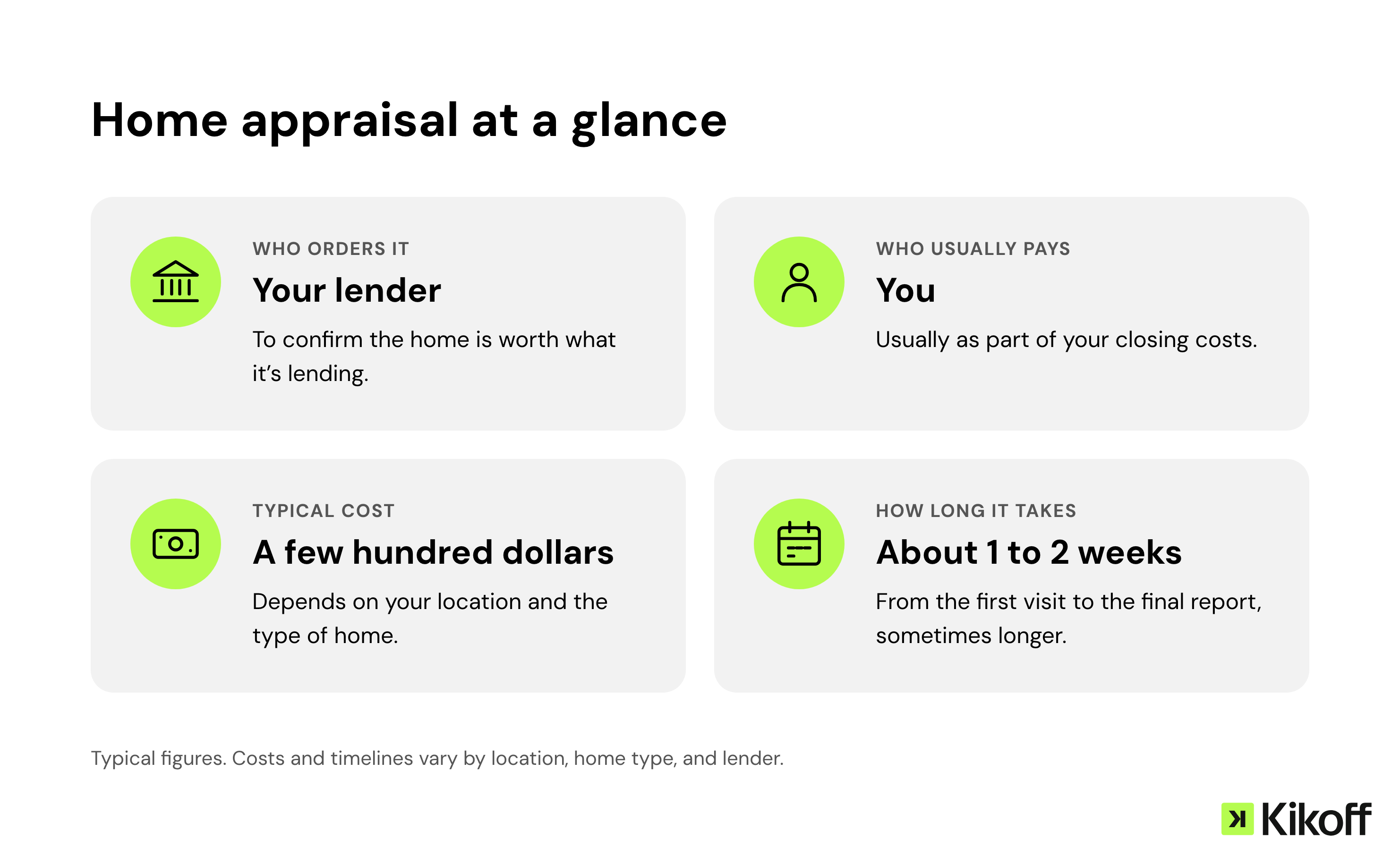
It usually takes one to two weeks and costs a few hundred dollars, and it protects you as much as the lender. If the number comes in below your offer, you’ll know before you overpay, and you still have options.
What is a home appraisal?
A home appraisal is a licensed appraiser’s opinion of what a home would sell for today. The appraiser doesn’t gain or lose anything based on whether your sale goes through, which helps keep the number fair.
A fair appraisal matters to your lender because the home backs your loan, and if the payments stop, the lender can take the house. But it helps you, too. If the appraisal comes in below your offer, that’s a signal that you may be overpaying.
How does a home appraisal work?
Once you’re under contract, your lender hires an independent appraiser. The appraiser visits the home, compares it to similar nearby sales, and writes up a report with an estimated value. Your lender uses that number to decide how much it will lend you.
Who orders the appraisal
Your lender orders the appraisal, but the bill usually lands on you, and you'll pay for it at closing. You don’t usually get to pick your own appraiser.
What the appraiser evaluates
Think of it as a check on the home’s value, not a deep dive into repairs. That’s what a home inspection is for. According to Freddie Mac, an appraiser looks at things like:
- How old it is and what shape it’s in
- How big the home is and how many rooms it has
- Improvements, like a newer kitchen or a finished basement
- The neighborhood and what homes there are selling for
- The lot it sits on
How the appraiser determines value
Most appraisals rely on recent sales of similar homes nearby, called comparables or “comps.” Every home is a little different, so the appraiser nudges each comp’s price up or down to account for what it has (or doesn’t have) compared to yours.
For instance, if a comp has a garage and your home doesn’t, its price gets adjusted down. Then the appraiser looks at all the adjusted prices to determine your home’s value.
[Image generation failed for: Callout: For a first-lien mortgage (the primary loan on your home), your lender has to give you a free copy of the home appraisal as soon as it’s done and no later than three days before closing, according to the CFPB. — spawn ETXTBSY]
How long does a home appraisal take?
Freddie Mac says to expect about one to two weeks between the visit and the final report, and sometimes longer when local appraisers are busy. The visit itself is usually the quickest part. Most of the time goes into researching comps and writing up the report.
Read more >> How Long Does It Take After Appraisal to Close?
How much does a home appraisal cost?
Expect to pay a few hundred dollars, though it depends a lot on where you live and the type of home. You’ll see the exact fee on your loan estimate, and you’ll usually pay it as part of your closing costs. The copy of your report, though, is free.
What happens if the appraisal comes in low?
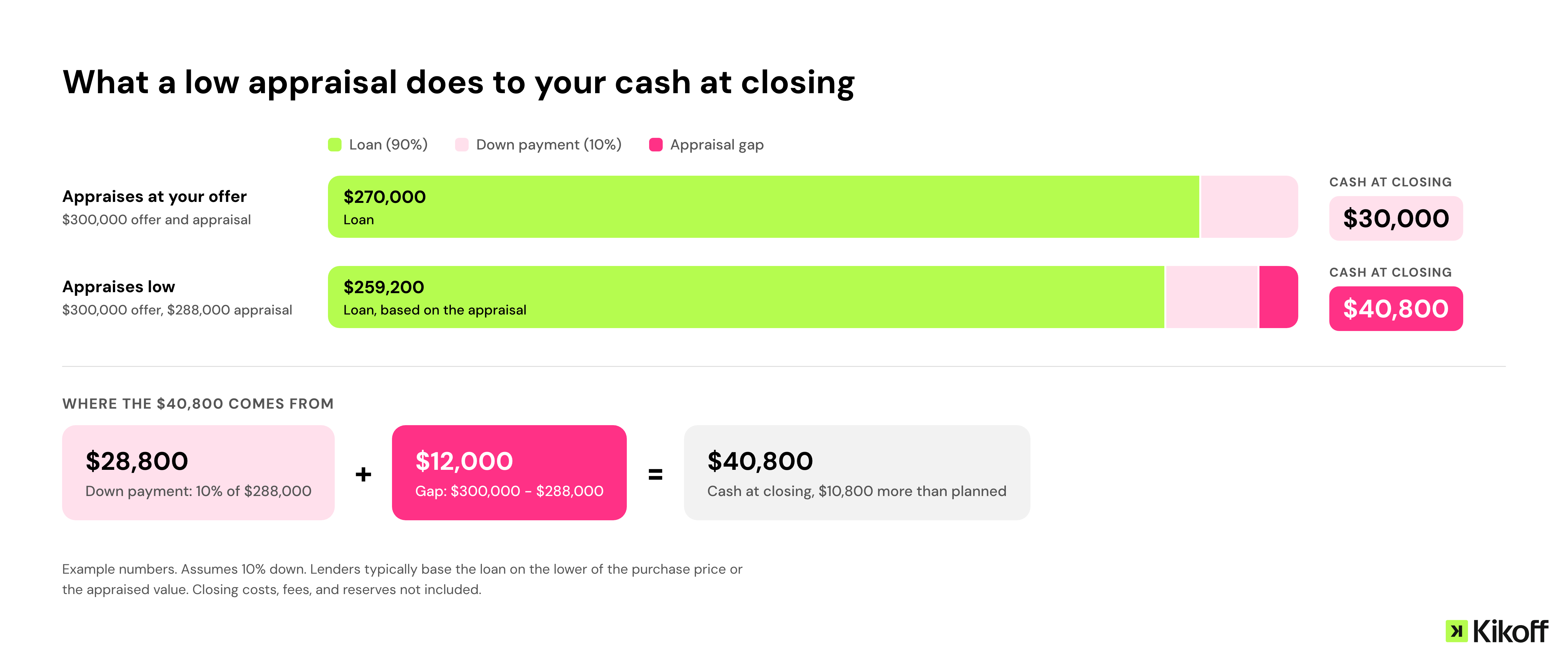
In plain terms, a low appraisal means the appraiser thinks the home is worth less than your offer. Your lender will likely lend based on the lower number, which leaves a gap someone has to cover.
Say you offer $300,000 and the home appraises at $288,000. Your loan is now based on the $288,000 appraisal. With 10% down, that’s a $259,200 loan instead of $270,000. You’d need $40,800 at closing instead of $30,000: your down payment on the appraised value plus the $12,000 gap.
While receiving a low appraisal can be disappointing, you still have options. Here’s what you can do.
Renegotiate the purchase price
Ask the seller to lower the price. Your appraisal lists recent sales of similar homes nearby, which can help show the price is too high. Share it with the seller, or have your real estate agent do it, and see if they’ll come down to the appraised value or meet you partway.
Make up the difference in cash
If the seller won’t budge, you could pay the gap yourself on top of your down payment. But think hard before you do: Draining your savings to close leaves you with no cushion for the repairs and surprises that come with owning a home.
Challenge the appraisal
Read the report closely, and look for mistakes like the wrong square footage, a missing bedroom, or comps that don’t really compare to your home. If you find issues, ask your lender for a reconsideration of value (ROV), which is a request for the appraiser to take another look. Send along any recent nearby sales you think the appraiser missed.
Walk away from the deal
If your purchase contract has an appraisal contingency, you may be able to cancel the contract if the home appraises low. Without that protection, walking away could mean giving up your earnest money, the good-faith deposit you put down when your offer was accepted.
Run the numbers >> Use Kikoff’s mortgage calculator to see what your payment looks like at the appraised value instead of the asking price.
Before you decide. A HUD-approved housing counselor can go through the numbers with you for free or at low cost. Use HUD’s search tool to find one near you. Whether you can cancel without losing your earnest money depends on your contract, so check with your real estate agent or a real estate attorney first.
Home appraisal vs. home inspection
An appraisal tells you, and your lender, whether the price is fair. An inspection tells you what you might be on the hook to fix once the keys are yours.
While an inspection is often optional, it’s generally not a good idea to skip it. An inspection can catch expensive problems, like a leaky roof or bad plumbing. And if the inspector finds something, you may be able to use that report to ask for repairs or a lower price.
Pick your own home inspector. An inspector you hire yourself works only for you, with nothing riding on whether the sale goes through.
Bottom line
The appraisal tells your lender what the house is worth. Your credit history tells it what rate to offer you, and that rate applies to every dollar of the loan for as long as you have it.
If you’re planning to buy, it pays to start building your credit now. Kikoff’s Credit Account reports your on-time payments to all three credit bureaus, with no credit check to sign up. Plans start at $5 a month.
Frequently Asked Questions
Article Sources
Disclaimer: The information provided in this blog post is meant for informational purposes only and does not constitute financial advice.