






You’ve found a great fixer-upper with potential. Now you just need the money to buy it and fix it up, and for many folks, that means borrowing.
Lenders that fund flips care most about two numbers: what the home will sell for once it’s fixed, and how much of your own cash is going in. You don’t need flipping experience to get approved, but you do need to walk a lender through both.
What is a house flipping loan?
A house flipping loan is typically short-term financing that helps you buy a property, fix it up, and then sell it for a profit. Some loans cover only the purchase price, while others cover both the purchase and the repairs, with the repair money often paid out in stages.
Flips tend to move fast. The typical flip took about five months from purchase to resale in the second quarter of 2026, according to ATTOM. Some loans are made for that kind of timeline, and others aren’t, so it’s important to know the difference before you borrow.
Flips can lose money too. ATTOM’s typical gross profit of about $60,500 in Q2 2026 counts only the sale price minus the purchase price. It leaves out repairs and other costs, which experienced flippers estimate at 20% to 33% of the value after repairs.
Read more >> How to Invest in Real Estate With Poor Credit
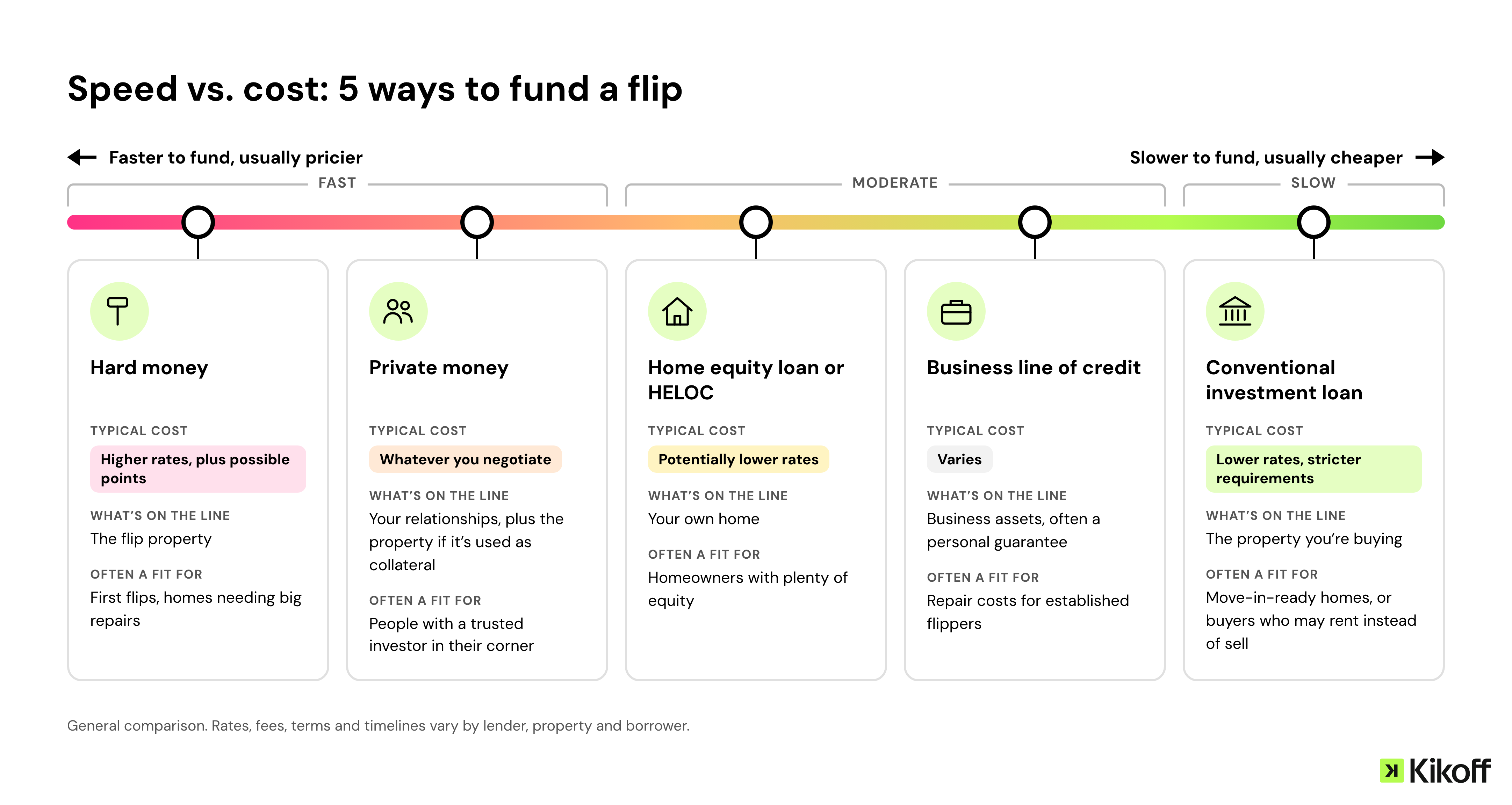
5 types of loans for flipping houses
1. Hard money loans
Hard money lenders are typically private companies that focus on real estate investors, so you probably won’t find one at your local bank. They lend mainly based on the property's value, and approval can come quickly, sometimes within days.
However, this speed tends to cost you. Expect higher interest rates on hard money loans than on a traditional mortgage, and some may charge upfront fees called points (one point equals 1% of the loan amount).
2. Home equity loans or HELOCs
If you own your home, you may be able to borrow against your equity, which is the difference between what your home is worth and what you still owe on it. There are two main ways to do it:
- Home equity loan. Also called a second mortgage, a home equity loan pays out a lump sum, usually with a fixed interest rate. You typically pay it back in equal monthly payments over a set term.
- Home equity line of credit (HELOC). A HELOC lets you borrow as needed during a set draw period, then you pay it back over a repayment period. The rate is often variable, so your payment can go up or down with the market.
Rates on both types are often lower than on a hard money loan, but the trade-off is serious: your home is the collateral. If you fall behind on payments, you risk losing your home to foreclosure.
Borrowing against your home? If the flip runs over budget or doesn’t sell, the payments on a home equity loan or HELOC are still due, and your home is the collateral. Before you borrow, a licensed attorney or nonprofit credit counselor can walk you through what you’d risk and how to plan for it. The National Foundation for Credit Counseling can connect you to free or low-cost counseling at 800-388-2227.
3. Business lines of credit
If you own a business, a business line of credit lets you borrow as home renovation bills roll in. Like a credit card, you typically pay interest only on what you use.
To qualify, you typically need steady revenue and some time in business, and many lenders check your personal credit too. You may also need to back the line with business assets or a personal guarantee, meaning you’d pay it yourself if the business can’t.
No business? A personal line of credit works similarly, but you’ll typically need solid credit since there’s usually no collateral.
4. Private money loans
With private money, your lender is a person, not a business: maybe a family member, a friend, or an investor you met through a local real estate group.
The two of you decide the terms together, so there’s often more flexibility. Even so, it’s important to put everything in writing. And keep in mind that a loan from someone you know can strain the relationship if something goes wrong.
5. Conventional investment property loans
A conventional investment property loan is a standard mortgage for a home you won’t live in, usually one you plan to rent out. It typically costs less than hard money, but you’ll likely need stronger credit and a bigger down payment than for a primary home.
The home also generally needs to be safe and livable, and most of these loans won’t pay for repairs. That rules out a lot of true fixer-uppers.
Requirements for getting a house-flipping loan
Flip lenders look at two things: you and the real estate deal. Requirements vary by lender, but most check the same four areas.
Credit score
While hard money lenders tend to care more about the property than your score, a stronger credit history may help you qualify for a lower rate.
Down payment and reserves
When flipping, plan on putting your own money in. Just over 60% of flipped homes were bought with all cash in early 2026, according to ATTOM. If you do borrow, hard money lenders usually cap the loan at 75% to 80% of the home’s current value. That means you may need to cover 20% or more of the home’s value yourself, plus closing costs.
Experience and business plan
Lenders may weigh your flipping experience when deciding whether to lend to you, though some work with first-time flippers. If you’re new, having a clear plan showing the scope of work and enough cash on hand to cover repairs, holding costs (loan payments, taxes, insurance, and utilities while you own the home), and overruns can help bridge the gap.
Property details and ARV
Every flip starts with one number: what the home should sell for once the work is done. That’s called the ARV, or after-repair value. Many flip lenders use it to decide how much you can borrow.
Lenders typically cap the loan at a percentage of the ARV, usually no more than 65% to 70%, according to the Urban Institute.
Say a home costs $140,000, needs $40,000 of work, and will be worth $250,000 when it's done. Your lender might fund up to 80% of the purchase price plus all the repairs, but no more than 70% of the ARV.
- Purchase plus repairs: $112,000 + $40,000 = $152,000
- ARV cap: $250,000 × 0.70 = $175,000
- The lender funds the lower number: $152,000
- Your cash: $180,000 total cost − $152,000 = $28,000, plus closing costs, holding costs, and a cushion
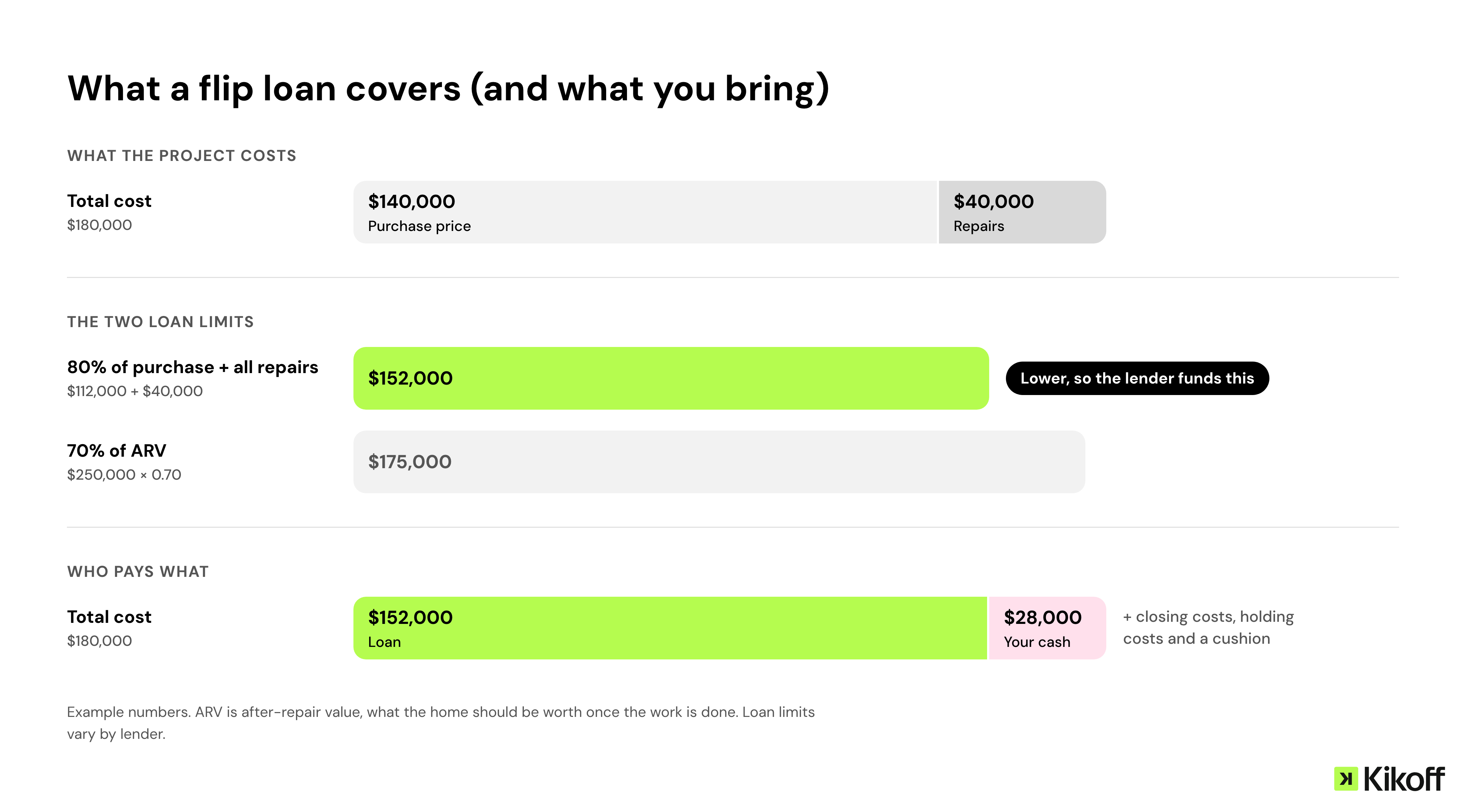
Lenders may also cap the loan based on other factors. So, whatever the loan doesn’t cover comes out of your own pocket.
Read more >> How to Make a Cash Offer on a House
How to get a loan to flip a house step by step
Step 1: Check your credit and finances
Even lenders who focus on the property are likely to check your credit. Ask each lender whose credit it checks. If you personally guarantee the loan, including one made to your LLC, expect it to be yours.
Pull your reports from all three bureaus for free weekly at AnnualCreditReport.com. Check them for mistakes, like an on-time payment marked late. If you find one, you can dispute it yourself for free with the bureau that’s reporting it. Kikoff’s AI Credit Disputes can help you draft the dispute letter if you’d rather not start from scratch.
Next, add up your total project cost: the purchase price, repairs, closing costs, and bills while you own the home. Subtract what you can put in yourself to see how much you’ll need to borrow. Then add a cushion in case the project runs long or over budget.
Renting while you save for your first flip? Your on-time rent payments often don’t show up on your credit report unless something reports them. Kikoff’s rent reporting sends them to Equifax and TransUnion, so the payments you already make can count toward the credit history lenders check.
Step 2: Research lenders that fund flips
Look for lenders who say they work with fix-and-flip investors. To find them, try searching terms like “fix and flip loans” or “hard money lenders near me.” You’ll likely find a mix of local and online lenders, so it’s a good idea to pick a few and compare their offers.
Look at their rates, points, how much of the repairs they’ll fund, and how they pay out that money. Local real estate agents and investor meetups can also help point you toward lenders with good reputations.
Step 3: Prepare your deal package
Your deal package is the case you make to a lender. The stronger it is, the easier it is for them to say yes.
Your package should answer four questions about the home, the work, you, and your plan:
- The home — the address, the purchase price, and your ARV estimate, backed by recent sales of similar homes nearby.
- The work — a line-by-line repair budget showing what you’ll fix, what each part costs, and how it adds value.
- You — proof of the cash you’re putting in, plus any past flips or renovation work, even small jobs.
- Your plan — your timeline and how you’ll pay the loan back.
Ask whether the lender issues a preapproval or proof-of-funds letter, which shows a seller you have the money to close.
Step 4: Apply and close quickly
You may be up against cash buyers. Fewer than 4 in 10 flipped homes were bought with financing in 2025, according to ATTOM, so a quick close can help a preapproved loan offer stand out.
Once you’re under contract, schedule the inspection and the appraisal, if your lender requires one, right away. Before you sign your loan docs, read the terms closely, especially prepayment penalties and what happens if the project runs long.
Tips for getting approved with less experience
Everyone starts with zero flips, and lenders know that. Here's how you can make yourself an easier yes.
- Start small. A cosmetic flip with paint, flooring, and fixtures is easier to budget and easier for a lender to believe in.
- Partner with someone who's done it. An experienced flipper on the deal can lend you credibility, and you'll learn a lot along the way.
- Lower the lender’s risk. A bigger down payment and a written bid from a licensed contractor both make your deal safer to fund, which can help make up for a thin track record.
Flipping puts real money at risk, especially if you borrow against your own home. Consider talking with a financial advisor, licensed attorney, or nonprofit credit counselor for personalized guidance.
Bottom line
Getting a loan to flip a house is less about looking perfect and more about showing up prepared, with solid numbers and cash of your own. Hard money will often lend on the property alone, but the lower-cost options in that table, like conventional investment loans and lines of credit, lean harder on your credit.
Kikoff’s Credit Account reports your on-time payments to Equifax, Experian, and TransUnion, with no credit check to sign up. Plans start at $5 a month.
Frequently Asked Questions
Article Sources
Disclaimer: The information provided in this blog post is meant for informational purposes only and does not constitute financial advice.