
A preferred credit card is a step up from a basic card. It usually earns more rewards, may charge an annual fee, and is typically aimed at applicants with strong credit. But “preferred” is just a name the card company picks, so two “preferred” cards can cost very different amounts. If you’re newer to credit, the real questions are whether you’d qualify and whether the fee would eat your rewards. You can check both before you apply.
What “preferred” means on a credit card
Card companies use names like Preferred, Gold, Platinum, and Premier to show where a card sits in their lineup. No federal rule defines any of them. Chase Sapphire Preferred is a travel card, Blue Cash Preferred from American Express is a cash back card, and Ink Business Preferred is for business owners. They share a pitch: more rewards for stronger credit and, often, a yearly fee.
Because the word isn’t standardized, one company’s platinum card can outrank its preferred card while another’s does the reverse. Judge the card by its terms instead of its name.
What a preferred card can cost
Two costs matter most: the APR, or the yearly interest rate on a balance you carry, and the annual fee.
In the CFPB’s survey of card terms from the first half of 2023, median purchase APRs ranged from about 15% to 28%, depending on the applicant’s credit tier and the size of the card company. Smaller banks and credit unions charged less in every tier than the 25 largest card companies. Across all accounts at reporting banks, the average card APR was about 21% in the third quarter of 2026, according to the Federal Reserve.
In the same CFPB survey, 27% of the largest companies’ cards charged an annual fee, compared with 9.5% at smaller ones. Those fees averaged $157 and $94.
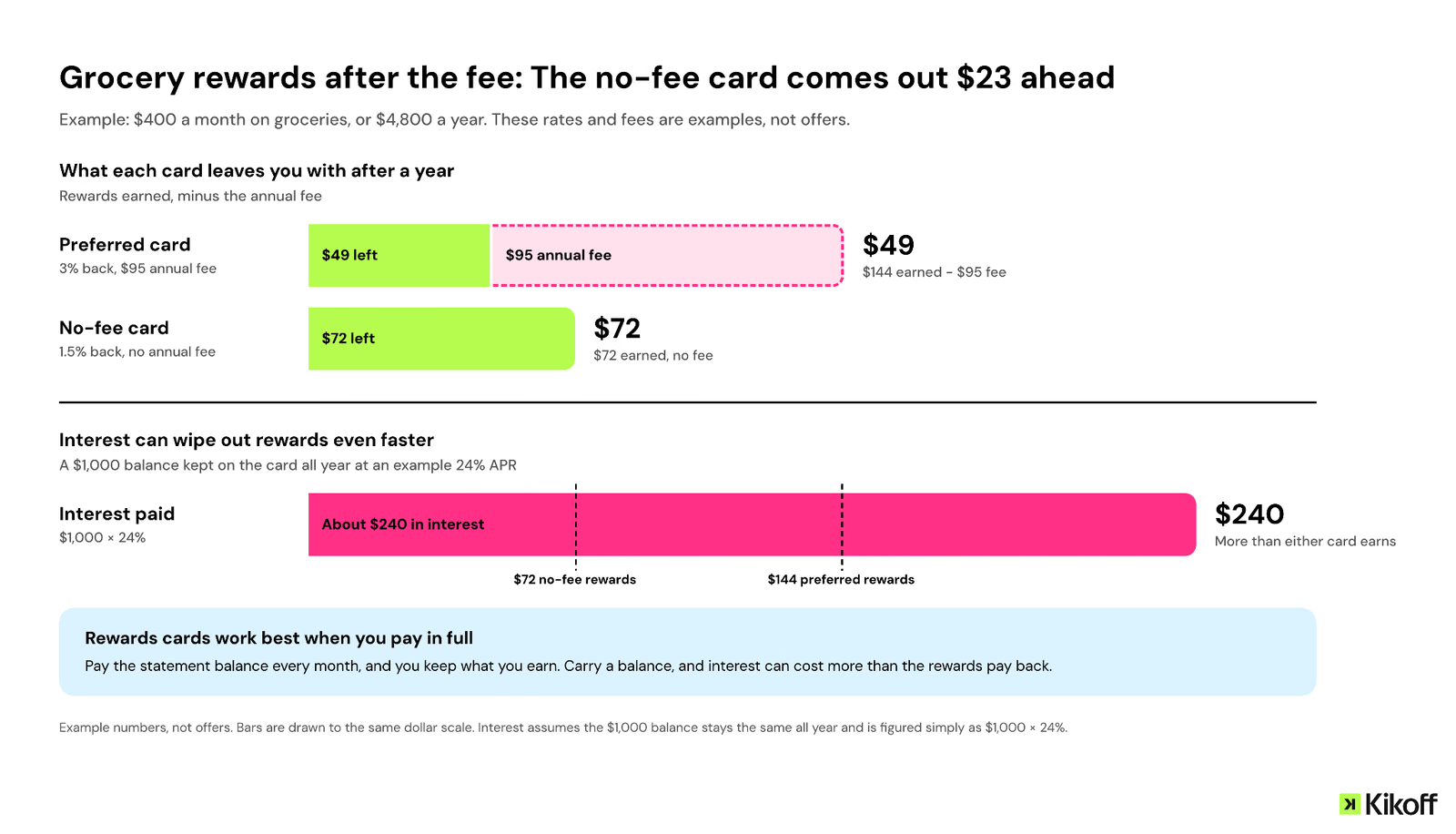
Check whether the fee pays for itself. Say a preferred card charges a $95 annual fee and earns 3% back on groceries, and a no-fee card earns 1.5%. These numbers are examples, not offers. If you spend $400 a month on groceries, that’s $4,800 a year. The preferred card earns $144, and the no-fee card earns $72. The $72 difference doesn’t cover the $95 fee, so you’d end up $23 behind.
Interest can cancel out rewards even faster. Keeping a $1,000 balance on a card all year at a 24% APR, another example, costs about $240 in interest. That’s more than either card pays back on a year of groceries, so rewards cards work best when you pay the statement balance in full.
Read more >> What Are the Fees and Costs of Using a Credit Card?
Federal rules that cover any card
The Credit CARD Act of 2009 added these protections to Regulation Z, the federal truth-in-lending rules. They apply to a preferred card the same as a basic one.
- You see the price before you apply. The application has to show the APRs and annual fee in a table, with the rates and fees in bold.
- First-year fees have a ceiling. Fees you must pay in year one, including an annual fee, can’t add up to more than 25% of your starting credit limit. Late fees and returned-payment fees don’t count toward it. On a $1,000 limit, that’s $250 at most.
- Your rate is set for the first year, with exceptions. A card company generally can’t raise your APR in year one. Exceptions include a promotional rate ending, a variable rate following its index, and a payment more than 60 days late.
- You get warning before big changes. After that, it has to give you 45 days’ written notice before raising your rate or making other significant changes, such as a higher annual fee. For many changes, you can reject them before they take effect.
- You get time to pay. Your statement has to reach you at least 21 days before the due date.
- Extra payments go to the costliest balance. Anything above the minimum goes to the balance with the highest APR first.
- Under 21, you need your own means. That’s your own income or assets, or a cosigner who’s at least 21.
If you ever miss a due date, pay at least the minimum as soon as you can. A payment about 30 days late can show up on your credit reports. Past 60 days late, the card company can also apply a higher penalty rate to the balance you already carry.
Before you apply, find the rates-and-fees table on the application. Check the purchase APR, the annual fee, and whether a $0 first-year fee rises in year two.
Can you get a preferred card with limited credit?
Maybe not yet, and that’s not a reflection of you. Card companies set approval and APR from your credit reports, and a short history gives them less to go on.
Start by checking for prequalification on the card company’s website. It usually uses a soft inquiry, which doesn’t affect your credit scores. Prequalification isn’t an approval, so read the terms before you apply.
If a preferred card is out of reach for now, a no-annual-fee card, a student card, or a secured card can get you started. A secured card asks for a deposit that usually becomes your credit limit. Each on-time payment adds to the history a card company reviews next time. To see what it will see, get your free credit reports every week at AnnualCreditReport.com.
Read more >> Secured Credit Cards vs. Unsecured Credit Cards
Bottom line
A preferred credit card trades a higher bar for approval, and sometimes a yearly fee, for bigger rewards. The rates-and-fees table tells you the price. What sets your odds and your APR is your credit history, and if you’re starting out, there may not be much on it yet. Kikoff’s Credit Account reports your on-time payments to Equifax, Experian, and TransUnion, with no credit check to sign up. Plans start at $5 a month.
Frequently Asked Questions
Article Sources
Disclaimer: The information provided in this blog post is meant for informational purposes only and does not constitute financial advice.