






Your debt-to-credit ratio compares what you owe on credit cards and other revolving accounts with your total credit limits. It’s the same thing as credit utilization, or how much of your available credit you’re using. With $500 in card balances and $5,000 in total limits, your ratio is 10%.
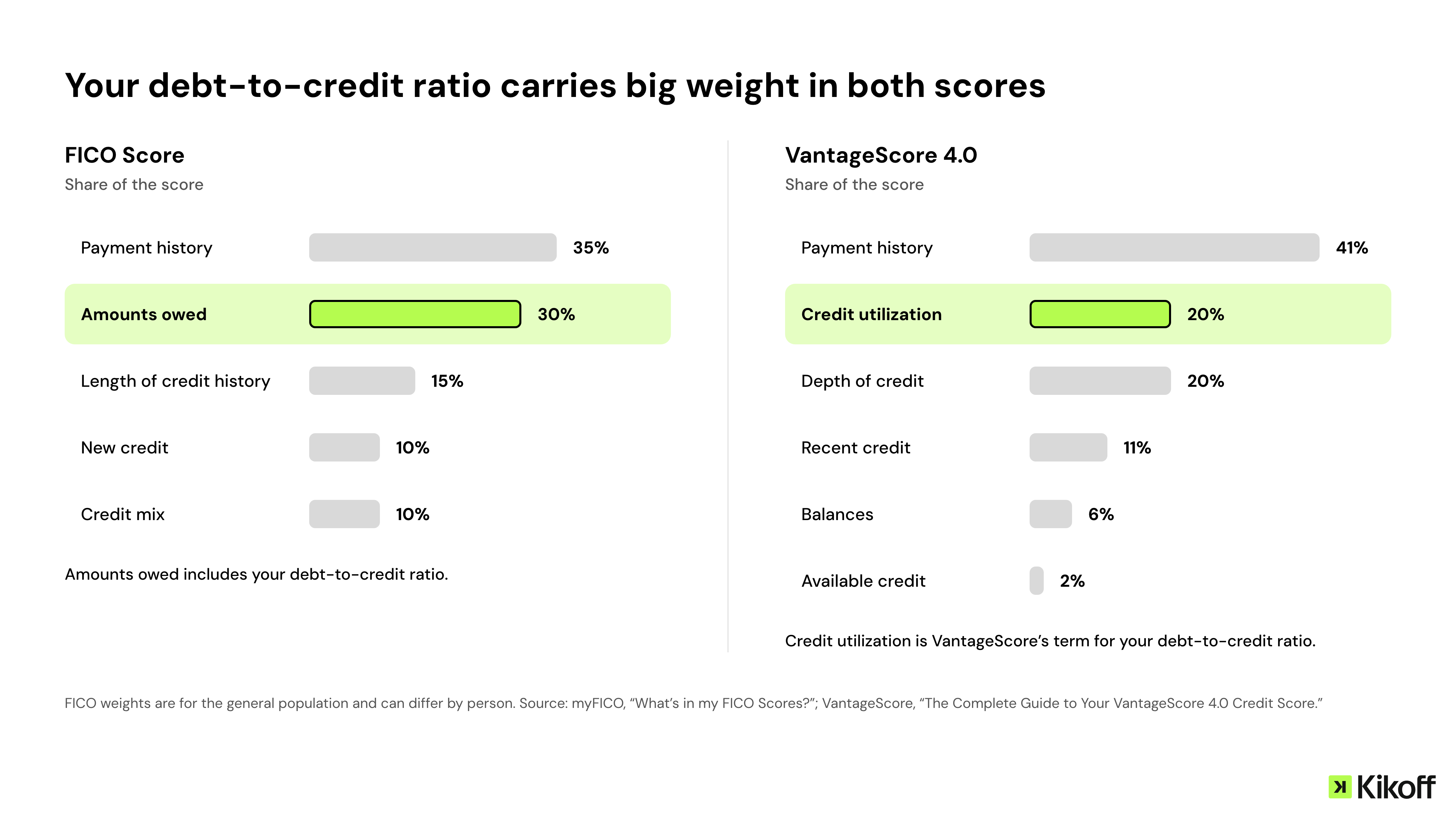
This ratio can explain a score dip that shows up even when you’ve paid every bill on time. FICO puts “amounts owed,” the category that includes it, at 30% of its scores. Only payment history, at 35%, counts for more. And unlike a late payment, your ratio can change as soon as a lower balance gets reported.
How to calculate your debt-to-credit ratio
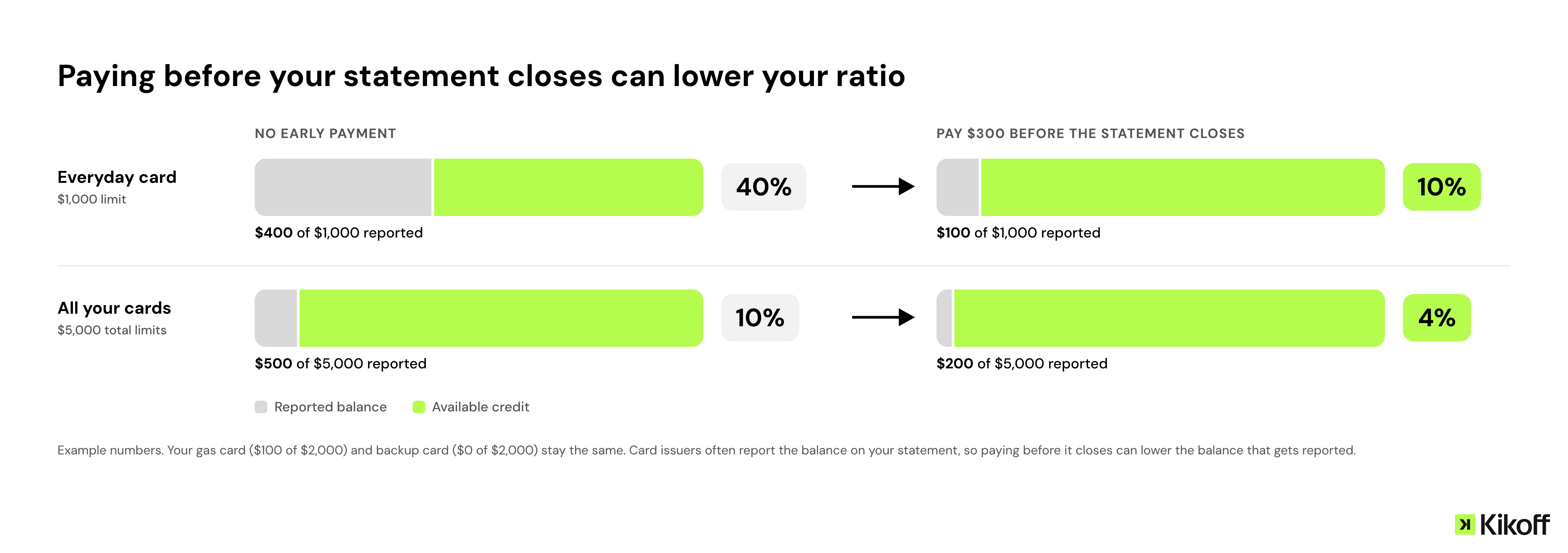
Start by adding up the balances on your credit cards and any other revolving lines of credit. Next, add up their limits. Divide the balances by the limits, then multiply by 100. Do the same math for each card too, because one card near its limit can stand out even when your total looks low.
Here’s an example of what that might look like:
Installment loans, such as car loans, student loans, and mortgages, aren’t part of this ratio. FICO looks at them separately, comparing what’s still owed with the original loan amount.
To find your numbers, check your card statements or get your free credit reports weekly from AnnualCreditReport.com. Checking your own reports doesn’t hurt your scores. To keep an eye on your ratio over time, Kikoff’s Credit Monitoring tracks your utilization for you.
Why your debt-to-credit ratio is important
Credit scores weigh this ratio heavily, and VantageScore ranks it among its most influential factors. The common guidance is to keep it at 30% or less of your total limits, and lower tends to be better. You also don’t need to carry a balance from month to month to get a good score. Paying your statement balance in full by the due date is the best way to use a card: you owe no interest, and your ratio stays low.
Lenders typically read a high ratio as a sign that your budget may be stretched. A lower one suggests you have room to spare. That’s how risk-based lending works. It isn’t a judgment of you, and a high balance often traces to a car repair or a medical bill.
When your balance gets reported
According to FICO, the balance on your credit report is usually the one from your most recent statement, not what you owe today. So even if you pay your card in full by the due date, your report can still show the balance from that statement.
Find your statement closing date on your card statement or in your card’s app. It’s often a different day from your payment due date.
Read more >> How Often Do Credit Reports Update?
Paid in full, but your ratio still looks high? Your report likely shows your last statement balance, not today’s. If you’re in a position to, pay a few days before the statement closes. Either way, pay at least the minimum by the due date. A payment 30 days late can show up on your credit reports, and payment history is FICO’s biggest factor.
Debt-to-credit vs. debt-to-income
These two ratios sound alike, but they measure different things. Your debt-to-income ratio (DTI) compares your monthly debt payments with your gross monthly income. Credit reports don’t include your income, so DTI isn’t part of your credit scores. Lenders typically look at both when you apply for a loan, especially a mortgage.
Read more >> What is a good debt-to-income ratio?
How to lower your debt-to-credit ratio
When you’re ready to work on it, these steps can help:
- Pay before the statement closes. This can lower the balance that gets reported, even when you can’t pay more overall.
- Pay down the card closest to its limit first. Using our example, moving your everyday card from 40% to 10% helps both that card and your total.
- Don’t rush to close a card. Closing an account in good standing doesn’t erase its history, but its limit stops counting. Close your backup card in the example, and the same $500 balance goes from 10% to about 17% of $3,000.
- Ask about a higher limit. A bigger limit lowers the ratio if your balance stays the same. Before you request one, ask the card company whether the request involves a hard inquiry.
No credit card yet? That’s common when you’re starting out, and you don’t need several cards. One account you can pay on time gives scoring models something to read.
Read more >> How to Lower Your Credit Utilization
Bottom line
Your debt-to-credit ratio is a snapshot of your card balances against your limits, and it can change as soon as a new balance is reported. A snapshot doesn’t build a track record, though, and with no revolving account there’s no ratio at all. Kikoff’s Credit Account is a revolving line that reports your on-time payments to Equifax, Experian, and TransUnion, with no credit check to sign up. Plans start at $5 a month.
Frequently Asked Questions
Article Sources
Disclaimer: The information provided in this blog post is meant for informational purposes only and does not constitute financial advice.