
A credit card issuer is the bank, credit union, or other company that lends you the money every time you use a credit card. It decides whether you’re approved and sets your credit limit, APR, and fees. It also sends your bill and reports how you pay to the credit bureaus.
The name in big letters on the card isn’t always that company. A store card or a card from an app is often run by a bank you’ve never heard of. That bank is who you’ll deal with if a payment is late, a charge looks wrong, or an application gets turned down.
What a credit card issuer does
Your card issuer, or the bank or company that gives you the card, runs your account from application to payoff. Your card company handles five jobs:
- Approving you. Before it opens an account or raises your limit, federal rules require it to consider whether you can make the minimum payments, based on your income or assets and your current debts.
- Setting your price. It picks your APR, fees, and credit limit, usually based on your credit reports and income. Average card APRs at commercial banks ran about 21% to 23% from mid-2025 through the third quarter of 2026, according to the Federal Reserve. Your rate can land above or below that.
- Saying yes or no to each purchase. A network like Visa or Mastercard carries the request. Your card company checks your available credit and decides.
- Billing you. It sends your statement and takes your payments.
- Reporting to the credit bureaus. Each month, it can send your balance, limit, and payment history to Equifax, Experian, and TransUnion. Card companies choose which bureaus they report to, so ask before you apply. An account that doesn’t reach a bureau adds no history to that bureau’s report.
Read more >> What Are the Fees and Costs of Using a Credit Card?
How to find out who your card company is
On a store card, an airline card, or a card offered through an app, the brand on the front is usually a partner. A bank behind it approves you, lends the money, and holds your account. The lender’s name shows up in four places:
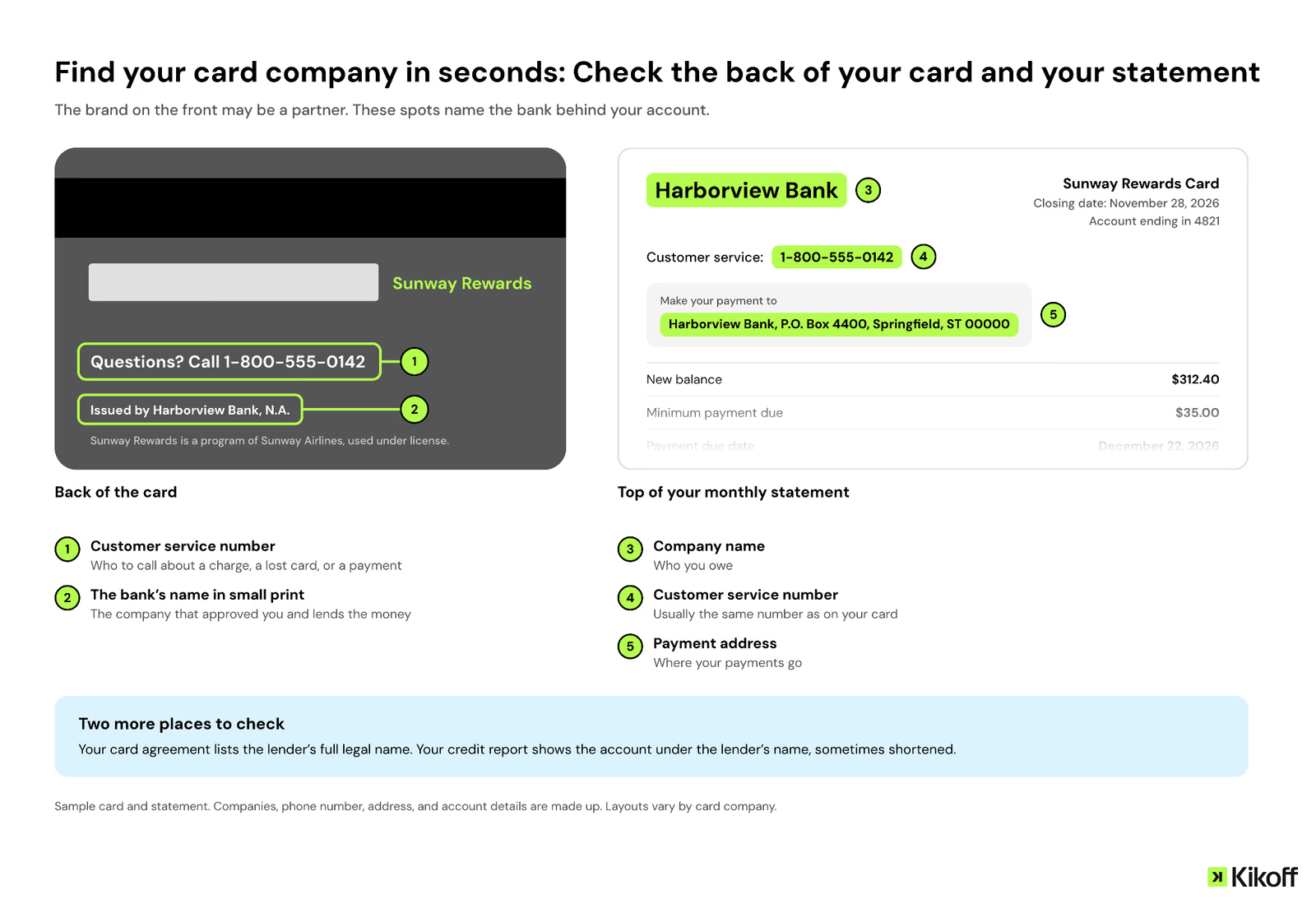
A store card may be listed under a bank name you don’t recognize. Before you dispute it as an account you didn’t open, compare the open date and the last digits of the account number with the store cards you have.
Lost your card agreement? Search the CFPB’s credit card agreement database by your card company’s name. Companies with fewer than 10,000 accounts don’t have to send theirs in, so if yours isn’t listed, call the number on the back of your card and ask for a copy.
What federal rules don’t let your card company do
The Credit CARD Act of 2009 set limits on card companies through a federal regulation called Regulation Z. These matter most when you pick your first card:
- Fees in year one are capped. In the first year, total fees can’t top 25% of your credit limit when the account opens. On a $300 limit, for example, that’s $75. Late fees, over-the-limit fees, and returned-payment fees don’t count toward the cap.
- Your APR generally holds for the first year. Federal rules generally bar a rate increase in the first year after you open the account. Exceptions include a promotional rate that ends after at least six months, a variable rate that moves with an index, and payments more than 60 days late.
- Big changes need notice. Your card company has to send written notice at least 45 days before a significant change to your terms, such as a higher APR.
- Your existing balance keeps its rate. A missed payment can show up on your credit reports once it’s about 30 days late. Your card company generally can’t raise the rate on the balance you already carry unless your payment is more than 60 days late. If you’ve missed one, pay at least the minimum as soon as you can.
Starter card check. Some cards for people new to credit stack an annual fee, a monthly fee, and a one-time program fee. Before you apply, add up every fee in the rates and fees table. If the total is close to a quarter of the credit limit, a secured card with no annual fee, backed by a refundable deposit, may cost you less.
If a card company turns you down
A denial comes with rights. After a card company has your complete application, it has 30 days to tell you its decision. If the answer is no, the notice has to list the specific reasons. It can instead tell you how to ask for them, and you’ll have 60 days to ask.
Ask for the reasons, such as too little credit history or a late payment. Then get your free credit reports from all three bureaus at AnnualCreditReport.com, where you can check them every week without affecting your scores. If something’s wrong, dispute it for free with the bureau and with the company that reported it.
Read more >> Secured Credit Cards vs. Unsecured Credit Cards
Bottom line
A credit card issuer is the company that lends you the money, sets your price, and reports how you pay. Your card company makes its yes-or-no call by reading your credit reports, and a short history is something no application can make up for. If yours is thin, Kikoff’s Credit Account reports your on-time payments to Equifax, Experian, and TransUnion, with no credit check to sign up, so there’s a record in your name before you apply. Plans start at $5 a month.
Frequently Asked Questions
Article Sources
Disclaimer: The information provided in this blog post is meant for informational purposes only and does not constitute financial advice.