
The easiest way to destroy a metal credit card is to send it back to your card company, which can destroy or recycle it for you at no cost. If you’d rather do it yourself, a pair of tin snips will get through most metal cards. Kitchen scissors and paper shredders usually won’t.
If you’re worried about what someone could pull off an old card, focus on three spots: the chip, the magnetic stripe, and the card number. Once those are cut apart, the card is very hard to use or read. Getting rid of the card doesn’t touch your account, either. Your balance, credit limit, and payment history stay where they were.
First, check why you’re getting rid of it
- You got a replacement card. Activate the new one first. If the number changed, update your autopay, saved cards, and phone wallet so repeat charges, like your phone bill, don’t get declined.
- You think the number was exposed. Destroying the card doesn’t protect a number someone already has. Ask your card company for a card with a new number, then destroy the old one.
- You’re closing the account. Call to close it first. Cutting up the card leaves the account open, along with any annual fee.
Federal rules don’t require your card company to collect your old card when it sends a new one, as long as the old card is voided in some way. That’s why some replacements arrive with only a note telling you to destroy the old one.
Your four options
Mailing it back takes the least effort. U.S. Bank, for example, says it includes a prepaid envelope for domestic mail when it sends a replacement metal card. Write down the date you mail it, in case a charge you don’t recognize shows up later.
How to cut up a metal card yourself
- Gear up. Put on work gloves and safety glasses. Cut metal has sharp edges, and small pieces can snap off.
- Use tin snips. They’re sold at hardware stores and handle both solid metal cards and cards with a metal core between plastic layers.
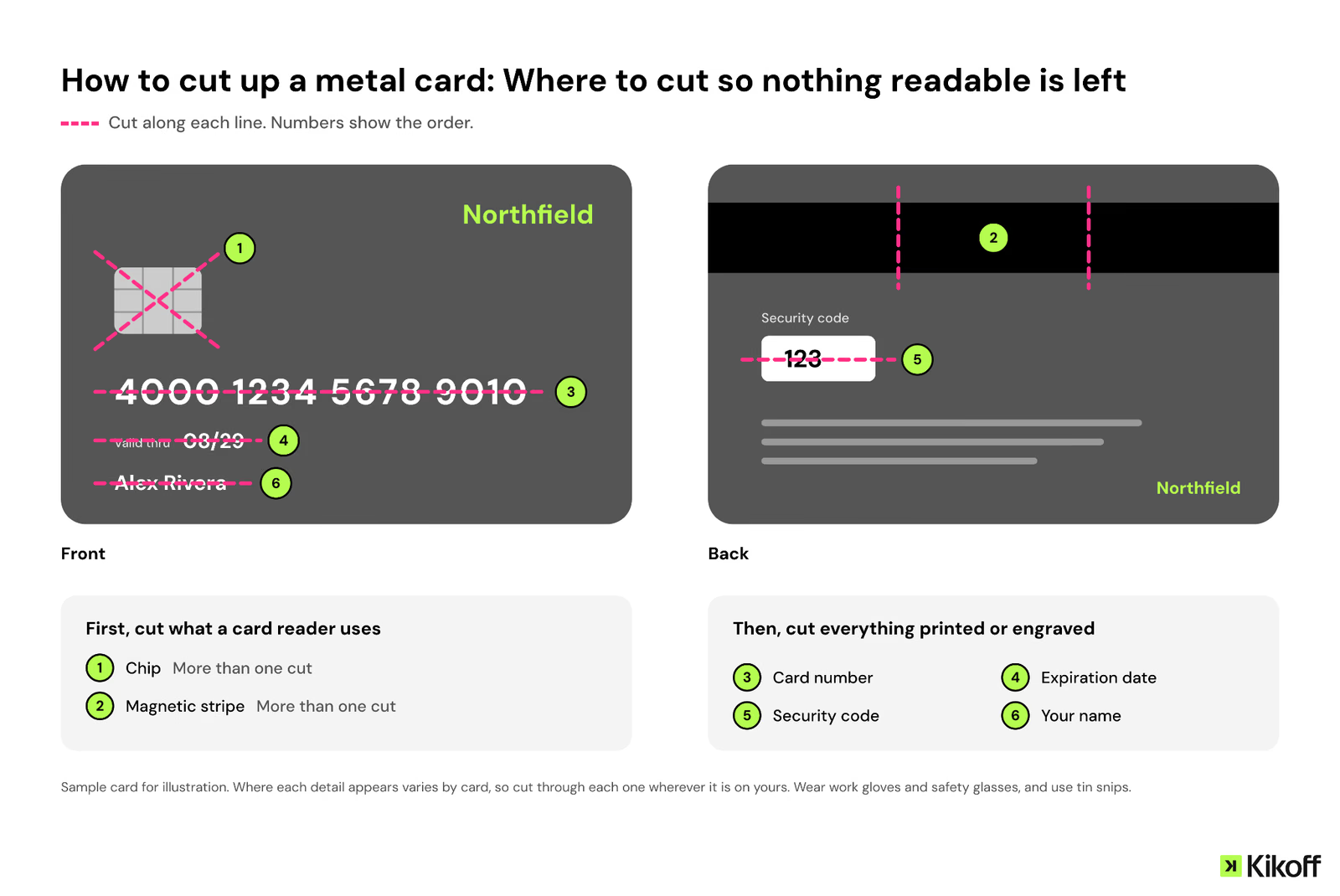
- Cut through the chip, then the magnetic stripe. Those hold the data a card reader uses. Make more than one cut through each.
- Cut through everything printed or engraved: the card number, expiration date, security code, and your name.
- Split up the pieces. Put them in separate bags and throw them out on different days. If you’d like to recycle them, ask your local recycling program whether it takes small metal scraps.
What to skip
- A paper shredder. Most can’t cut metal. You’re more likely to jam the motor than destroy the card.
- Burning it. Many metal cards are layered with plastic and adhesive, which can give off harmful fumes when heated.
- Bending it until it snaps. That can leave jagged shards and still leave the chip intact.
- Throwing it out whole. Anyone who finds it can read your name and number.
- Paying someone to destroy it. Your card company will take it back for free.
Red flag: a message asking you to mail your old card to a “disposal service” or share your card number so someone can “deactivate” it. Mail the card only in your card company’s own envelope, and check with the number on the back of the card if you’re unsure.
If you’re closing the account
Call your card company to close the account, and ask it to confirm the closure in writing.
- Your balance doesn’t go away. Keep paying at least the minimum by each due date. A late payment on a closed account can still bring a late fee and show up on your credit reports. Under Regulation Z rules that carry out the CARD Act, the limits on raising your rate and fees keep applying to a balance after the account closes. Your card company generally can’t start charging a new fee, such as a closed-account fee, based only on that balance.
- Your history stays, but your limit goes. A closed account in good standing stays on your credit reports and keeps counting toward your credit history. Its limit no longer counts toward your available credit, though. For example, say you have two cards with $1,500 limits each and a $600 total balance. You’re using 20% of your available credit. Close one card, and that same $600 is 40% of what’s left. If the card has no annual fee, keeping it open and using it for a small charge now and then may be simpler.
- If someone uses your old number anyway, federal law limits what you owe. According to the CFPB, if someone steals and uses only your card number, not the card itself, you generally aren’t responsible for unauthorized charges. If the physical card is lost or stolen, you owe nothing if you report it before it’s used, and at most $50 if it’s used before you report it.
Read more >> How Revolving Credit Accounts Affect Credit Utilization
Bottom line
To destroy a metal credit card, mail it back to your card company or cut through the chip, stripe, and number with tin snips. Destroying the card doesn’t close the account, and closing the account doesn’t erase its history.
Closing a card does remove one account’s limit, and if it was one of only a few accounts, your credit history now rests on fewer of them. Kikoff’s Credit Account gives you an account in your name that reports your on-time payments to all three credit bureaus, with no credit check to sign up. Plans start at $5 a month.
Frequently Asked Questions
Article Sources
Disclaimer: The information provided in this blog post is meant for informational purposes only and does not constitute financial advice.