
A co-branded credit card is a credit card from a bank that carries another company’s brand, like an airline, a hotel chain, or a store. The bank approves you, lends the money, and sets your rate. The brand supplies the rewards, which usually pay out best when you spend with that brand.
That split is easy to miss when you sign up at a checkout counter. The bank behind the brand is who you owe, and it reports your payments to the credit bureaus. Your credit still decides whether you’re approved and what rate you get.
How a co-branded credit card works
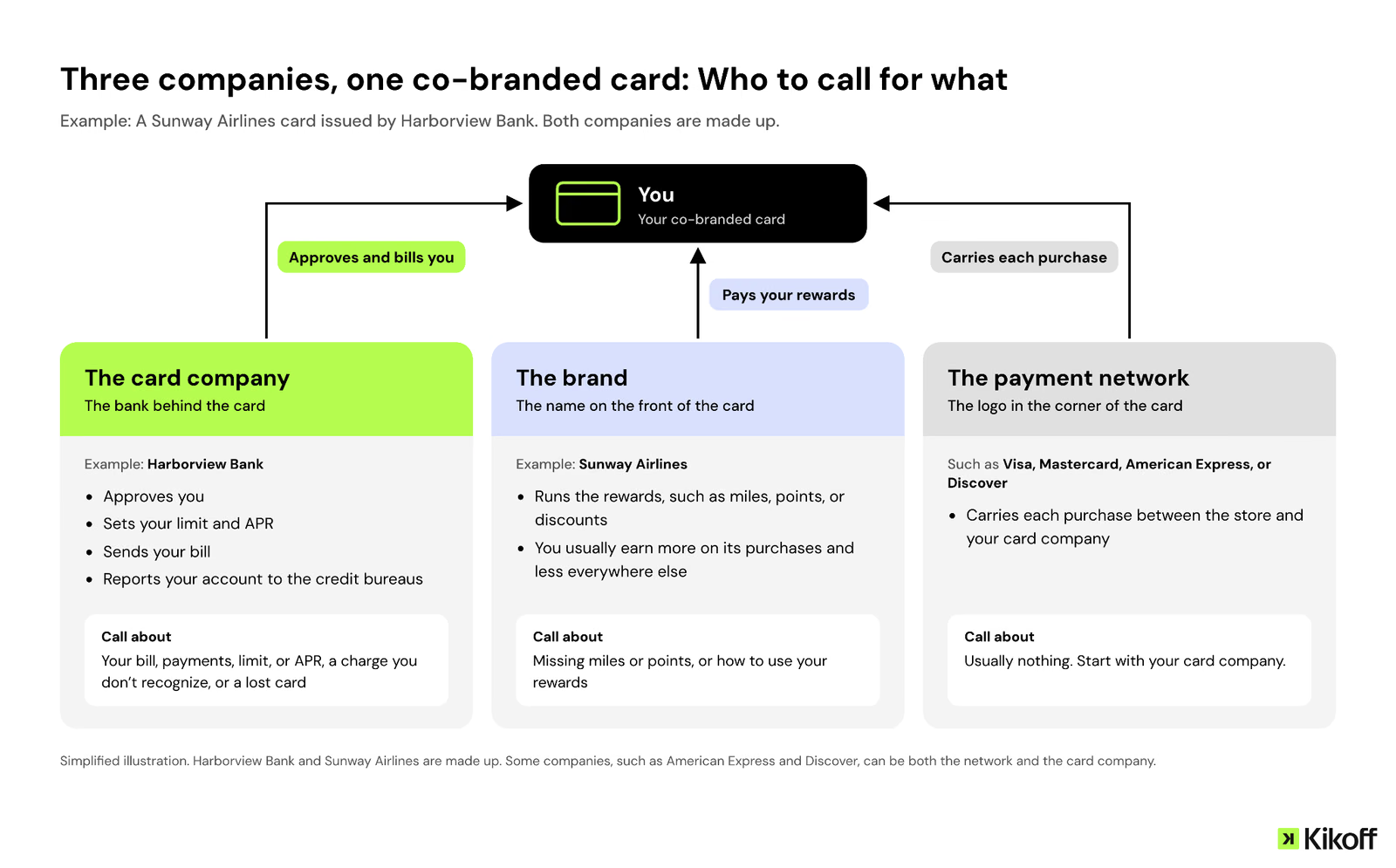
Up to three companies share the work on a co-branded card:
- The card company is the bank that approves you, sets your limit and APR, sends your bill, and reports your account to the credit bureaus.
- The brand runs the rewards, such as airline miles, hotel points, or store discounts. You usually earn more on purchases with the brand and less everywhere else.
- The payment network, such as Visa, Mastercard, American Express, or Discover, carries each purchase between the store and your card company.
With American Express and Discover cards, the card company and the network are often the same company.
Co-branded card vs. store card
Both can have a store’s name on the front, but they work differently:
Store cards of both kinds are generally easier to get with low or no credit scores, according to the Consumer Financial Protection Bureau (CFPB).
What co-branded cards cost
Average credit card APRs at commercial banks ran about 21% to 23% from mid-2025 through the third quarter of 2026, according to the Federal Reserve. Retail cards often run higher. In a 2024 report, the CFPB found that 90% of retail cards, counting co-branded and store-only cards, listed a maximum APR above 30%. Only 38% of other general-purpose cards did.
Some co-branded cards charge an annual fee, and some don’t. Both the fee and the APR are in the rates and fees table on the application.
To see whether a fee pays for itself, start with what you already spend with the brand. Take an example card with a $95 annual fee that earns 2 points per dollar with the brand, at 1 cent a point. You’d need to spend $4,750 a year there to earn back the fee.
Interest can erase rewards even faster. Earning 2% back on $1,000 of purchases gets you $20. Carrying that $1,000 for a year at an example APR of 30% costs about $300 in interest. If you might carry a balance, compare APRs before rewards.
Before you sign up at the register. Look up the card’s APR and annual fee on your phone first. Applying usually means a hard credit check, so you may want to skip the offer if you’re applying for a car loan or apartment soon.
Read more >> What Are the Fees and Costs of Using a Credit Card?
Federal rules that apply to every co-branded card
A brand’s name on the front doesn’t change your rights. Co-branded cards follow the same Credit CARD Act rules, carried out through a federal regulation called Regulation Z, as any credit card:
- Under 21 needs income or a cosigner. A card company can’t open an account for someone under 21 unless they can make the minimum payments on their own, or a cosigner 21 or older signs on and can pay.
- First-year fees are capped. Required fees in the first year can’t top 25% of your credit limit at opening. On a $500 limit, for example, that’s $125. Late, over-the-limit, and returned-payment fees don’t count.
- Extra payments go to the costliest balance. When you pay more than the minimum, the extra goes to the balance with the highest APR first.
- Changes come with notice. Your card company has to send written notice at least 45 days before a significant change, such as a higher APR.
- Your existing balance keeps its rate. A missed payment can show up on your credit reports once it’s about 30 days late. Your card company generally can’t raise the rate on the balance you already carry unless you’re more than 60 days late. If you’ve missed one, pay at least the minimum as soon as you can.
What happens if the partnership ends
Retail card deals often run seven years or longer, according to the CFPB. When one ends, the brand may move to a new bank, and existing accounts can be sold to it.
If that happens, you may get a new card, a new company name on your bill, or different rewards. Read every letter about the switch, and compare the new APR and fees with your old ones. A significant change in terms generally needs the 45-day notice above. Ask what happens to unused points, and redeem them first if they won’t carry over.
Then get your free credit reports at AnnualCreditReport.com, where you can check every week. If the old account shows as closed, its on-time history generally stays on your reports. If something’s wrong, dispute it for free with the bureau and the company that reported it.
Read more >> Secured Credit Cards vs. Unsecured Credit Cards
Bottom line
A co-branded credit card is a bank card with a brand’s rewards attached, and it’s worth it when you already spend with that brand and pay in full. Your credit reports decide which card you’re approved for and the APR you’re offered. If your history is short, Kikoff’s Credit Account reports your on-time payments to Equifax, Experian, and TransUnion, with no credit check to sign up, so there’s a record in your name before you apply. Plans start at $5 a month.
Frequently Asked Questions
Article Sources
Disclaimer: The information provided in this blog post is meant for informational purposes only and does not constitute financial advice.