



Let's jump in: your billing cycle quietly shapes your credit score, your payment schedule, and how lenders see you every single month. Most people pay their bills without ever thinking about the cycle behind them, which means they're missing an opportunity to be more strategic about their finances.
What is a billing cycle?
A billing cycle is the recurring period of time between one statement and the next on a credit card, utility, or subscription account. It basically marks the window during which your transactions, usage, or charges are tracked and then summarized into a statement.
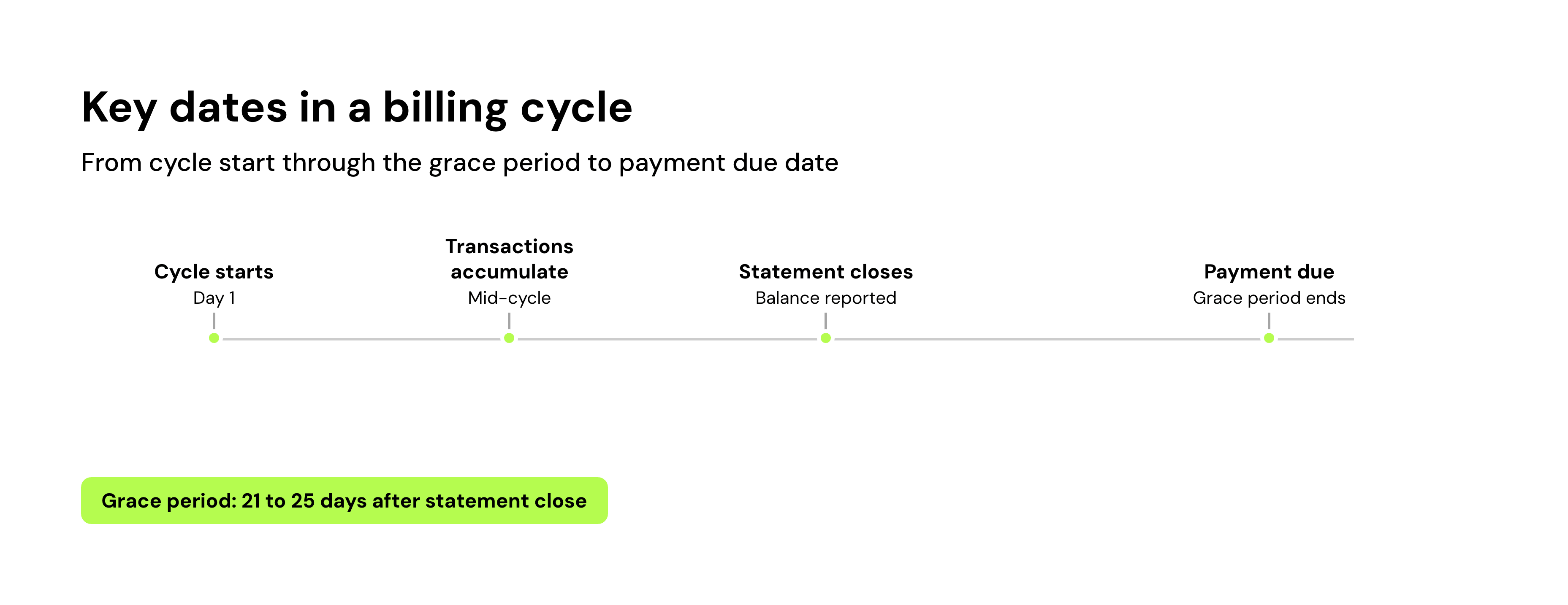
Most billing cycles run about 30 days, though they can range from 28 to 31 days depending on the creditor and the month. This means your cycle start and end dates don't always line up neatly with the calendar month.
Every individual who opens a credit card or signs up for a utility service gets assigned a billing cycle start date, usually tied to the account opening date. The specific dates can often be changed by contacting your provider, which is worth knowing if timing matters to you.
At the end of each cycle, the creditor tallies everything up and generates a statement, which is primarily a snapshot of what you owe, what you've spent, and what your minimum payment is. That statement date is also typically when your balance gets reported to the credit bureaus, which is why cycle timing paints a picture that goes well beyond just paying a bill.
Understanding this foundation is what makes every other part of personal finance easier to manage.
How billing cycles work for credit cards
A credit card billing cycle generally starts the day after your previous statement closed and runs until the next closing date. During that window, every purchase, payment, and fee gets recorded to your account.
When the cycle closes, your card issuer calculates your statement balance and sends you a summary of activity. You then have a grace period, usually around 21 to 25 days, before your payment is due.
If you pay your full statement balance by the due date, you usually avoid interest charges entirely. This said, if you only pay the minimum or carry a balance, interest begins accruing on the remaining amount.
Lots of people don't realize that the timing of your payments within a cycle can have just as much impact as the amount you pay. Paying down your balance before the statement closes, for example, can lower what gets reported to the credit bureaus.
The single most important habit you can build around billing cycles is knowing exactly when yours closes so you can plan accordingly.
Statement balance vs. current balance
Your statement balance is the amount owed at the moment your billing cycle closed, and it's the figure that appears on your official statement. Your current balance, on the other hand, is a live number that reflects all transactions up to right now, including any purchases or payments made after the cycle ended.
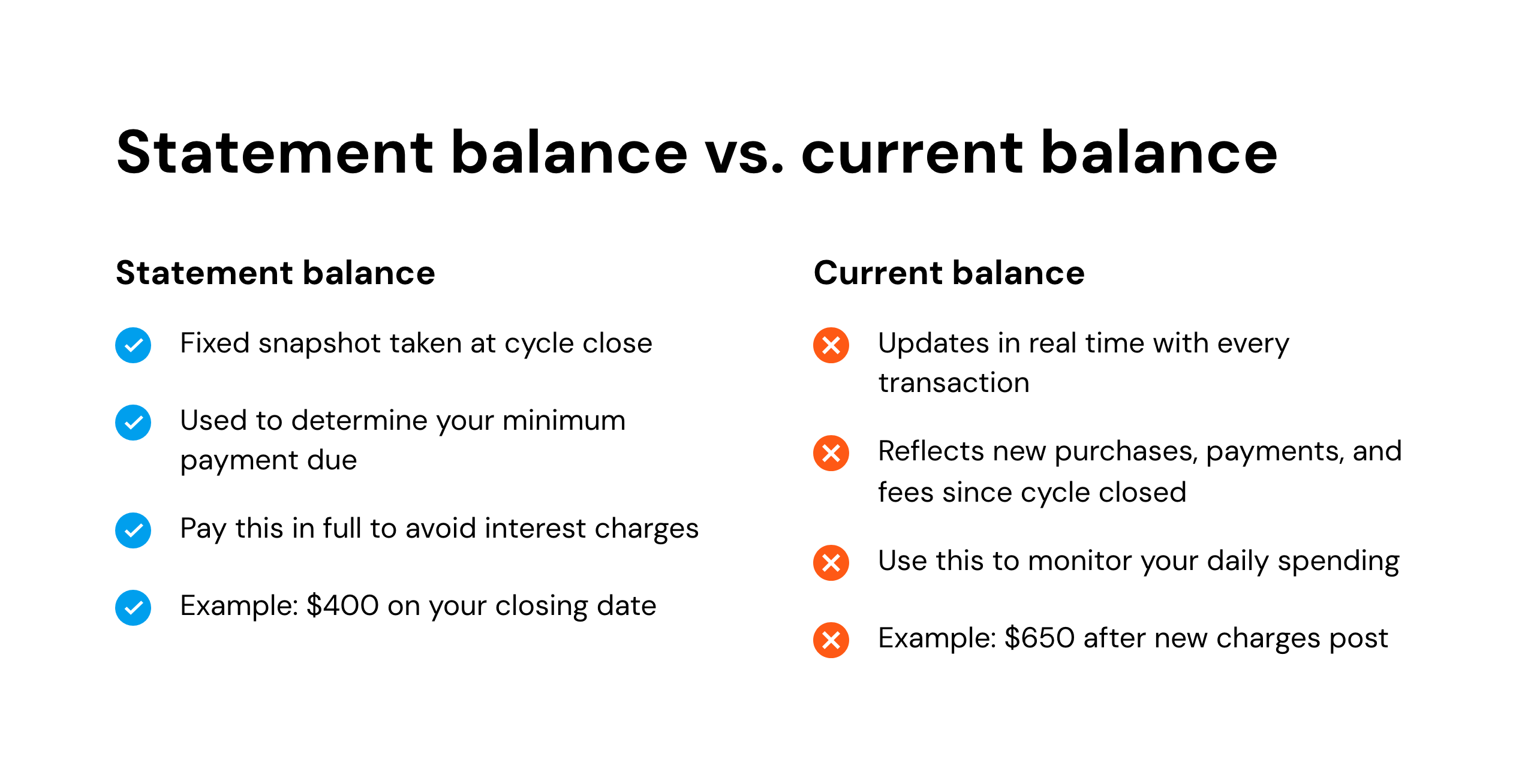
These two numbers can look very different if you've been active on your card since the last statement. This means you could have a statement balance of $400 but a current balance of $650 because you've already made more purchases in the new cycle.
For the purpose of paying off your card and avoiding interest, the statement balance is what you want to focus on. Paying that amount in full by your due date keeps you in good standing and generally preserves your grace period.
Every individual who regularly checks their current balance is in a better position to avoid surprises when the next statement drops. It's a super simple habit that can save you from scrambling when the due date arrives.
Billing cycle and credit utilization
Credit utilization is basically the percentage of your available credit that you're currently using, and it's one of the most heavily weighted factors in your credit score. Your billing cycle is directly tied to how that utilization is calculated and reported.
Here's a breakdown of how it works: when your statement closes, your card issuer typically reports your statement balance to the credit bureaus. That reported balance, divided by your credit limit, is what shows up as your utilization rate.
If your statement closes with a high balance, your utilization will look high to lenders, even if you paid everything off the following day. This is why timing matters, and why paying down your balance before your statement close date can effectively lower your reported utilization.
Luckily, you don't have to be perfect to see a positive impact. Even reducing your utilization from 80% to below 30% by the statement close date can make a meaningful difference in how your credit profile looks.
Every individual who wants to actively manage their credit score should know their statement close date as precisely as they know their due date. These are not the same day, and confusing them is a common mistake that quietly works against your credit goals.
Billing cycles for utilities, phone, and subscriptions
Billing cycles aren't just a credit card concept. Every individual who pays a phone bill, electric bill, or streaming subscription is also operating within a billing cycle, usually without thinking about it.
Utility billing cycles are typically based on actual usage during a measured period, be it a monthly meter read or a set number of days. At the end of that period, you receive a bill for what you consumed.
Phone plans and subscription services generally work on a fixed monthly cycle that starts on the date you first signed up. This means someone who signs up on the 15th will be billed on the 15th of each month, even if that falls on a weekend or holiday.
Understanding when each of your accounts bills you lets you plan your cash flow more effectively, especially if multiple bills cluster around the same date. Spreading out due dates, where possible, is a no-brainer move for avoiding cash flow crunches.
Most providers will adjust your billing date on request, which is mainly useful if you want to align payments with payday. Just make sure to confirm any changes in writing so you don't miss a payment during the transition.
Payment due dates and billing cycles
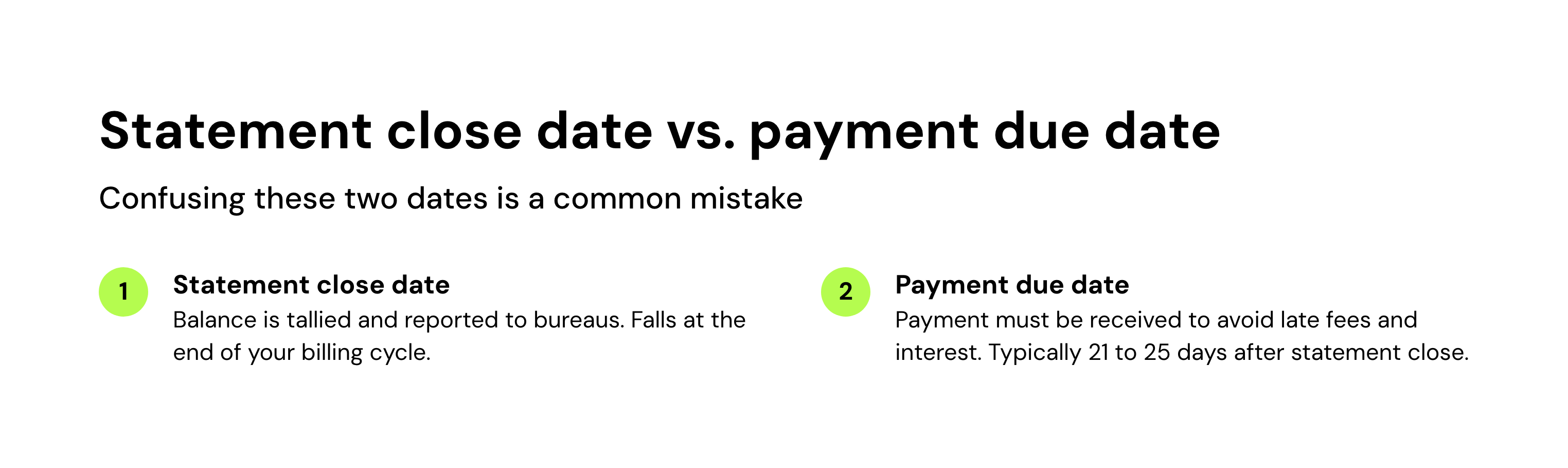
Your payment due date is not the same as your statement close date, and mixing them up is one of the most common billing mistakes people make. The due date usually falls about three weeks after the statement closes, giving you time to review your charges and arrange payment.
Missing a due date, even by a single day, can result in a late fee and potentially a penalty interest rate. More seriously, a payment that goes 30 days past due can be reported to the credit bureaus and damage your credit score.
Setting up autopay for at least the minimum payment is generally the easiest way to protect yourself from accidental late payments. This said, autopay for the minimum only prevents a missed payment, it doesn't prevent interest from accruing on any remaining balance.
If your due date falls at an inconvenient time in your budget cycle, contact your issuer and ask to move it. Lots of issuers will accommodate this request, usually within one or two billing cycles.
Every individual who treats their due date as a hard deadline, not a suggestion, puts themselves in a much stronger position for long-term credit health.
Conclusion
Understanding your billing cycle is one of the clearest, most actionable things you can do to take control of your credit and your finances. It affects when your balance is reported, how your utilization looks to lenders, and whether you pay interest or nothing at all.
Every individual who knows their statement close date and due date has the tools to manage utilization strategically and stay consistently on time with payments. These are two of the biggest drivers of credit score health, and billing cycles sit at the center of both.
Kikoff is a credit-building platform designed to help people establish and strengthen their credit in a straightforward, accessible way. If you're working on building your credit history, learn more at kikoff.com.
Frequently Asked Questions
About the editor

Disclaimer: The information provided in this blog post is meant for informational purposes only and does not constitute financial advice.