.jpg)
.jpg)



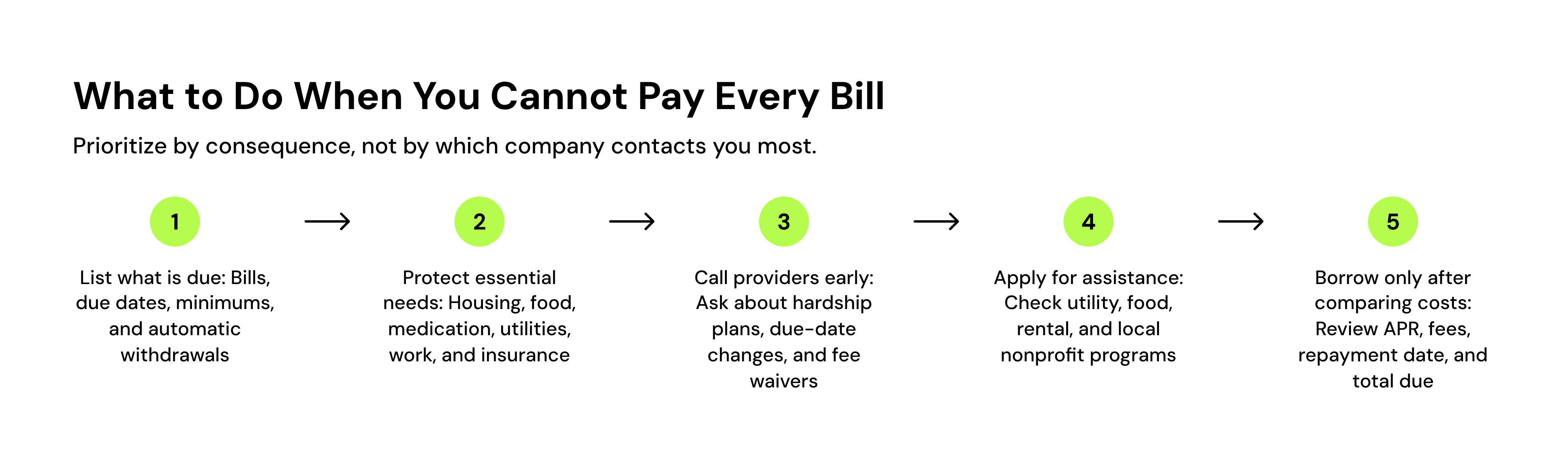
When bills are due and your bank account is empty, start by protecting the expenses that keep you housed, safe, and able to work. Then contact each provider before the payment is late, ask about hardship options, and apply for assistance. If there still is not enough money, weigh the consequence of missing each bill before deciding what to pay first.
You may not be able to solve everything today, but acting early can reduce fees, prevent avoidable service interruptions, and give you more options.
How to pay bills when you have no money
Start with a complete picture of what is due, what money is available, and what could happen if each payment is late. Do not simply pay the company that calls most often.
Read more >> How to Get Emergency Money
List your bills and available money
Write down every bill, its due date, the minimum amount due, and any notice you have received. Include upcoming automatic withdrawals so they do not create an unexpected overdraft.
Next, total the money you can safely use before your next paycheck or benefit payment. Do not count money already needed for food, medication, transportation, or another essential expense.
Prioritize bills by the consequence of not paying
There is no universal order that works for every household. The Consumer Financial Protection Bureau’s bill-prioritizing guidance recommends weighing what you could lose or disrupt if each bill goes unpaid.
Give immediate attention to:
- Food, medication, and urgent health or safety needs
- Rent or mortgage payments that protect your housing
- Electricity, heat, water, and other essential utilities
- Transportation, childcare, equipment, and insurance needed to keep working
- Secured debts, such as an auto loan, when missing a payment could put essential property at risk
- Court-ordered obligations or other payments with serious legal consequences
Credit cards, unsecured personal loans, and subscriptions may fall below immediate housing or safety needs, but ignoring them can still lead to fees, credit damage, collection activity, or a lawsuit. Prioritizing one bill does not erase your obligation to pay the others.
Contact each provider before the due date
Tell the provider that you are experiencing financial hardship, state how much you can pay, and ask what options are available. Depending on the provider and your account, those options may include:
- Moving the due date
- Splitting the payment
- Creating a short-term repayment plan
- Pausing or reducing a payment temporarily
- Waiving a late fee
- Enrolling in a hardship or income-based program
Ask how the arrangement affects interest, fees, service, and credit reporting. Get the terms in writing and do not agree to a payment you are unlikely to make.
Apply for government and nonprofit assistance
Assistance may free up money for other essential bills even if a program does not pay the exact bill you are worried about.
- LIHEAP may help eligible households with heating, cooling, or emergency energy costs. Rules and funding vary by state.
- SNAP may help eligible households pay for food, leaving more cash available for housing and utilities.
- State and local rental-assistance programs may help eligible renters. You can also call 211 to look for local services.
- Community action agencies, food banks, housing nonprofits, and faith-based organizations may offer direct help or referrals.
Apply as early as possible. Save confirmation numbers, emails, and copies of every document you submit.
Look for a safe way to bring in money quickly
Selling items you no longer need, picking up temporary work, or asking an employer whether it offers an earned-wage or paycheck-advance program may help close a small gap. Check the timing and full terms before relying on money that is not certain to arrive before the bill is due.
Be careful with pawning essential property. If you cannot repay the pawn loan on time, you may lose the item.
Treat borrowing as a last-resort bridge
A loan or cash advance may move the shortage into your next pay period instead of solving it. Before borrowing, compare the annual percentage rate, fees, repayment date, automatic-withdrawal terms, and total amount due. Cash-advance apps may also charge subscription fees, expedited-transfer fees, optional tips, or other costs.
Do not use short-term debt to cover a monthly shortage that is likely to continue. Repayment could leave you unable to cover the same bills next month.
What happens if you miss a bill payment?
The result depends on the type of bill, your agreement, how late the payment becomes, and state or local law. A missed payment may lead to fees, loss of service or property, collection activity, or negative credit reporting.
Read more >> What Happens If You Miss a Credit Card Payment?
Utilities
Utility late fees, notice requirements, shutoff rules, and medical or seasonal protections vary by provider and location. Contact the utility as soon as you know you cannot pay. Ask about a payment plan, budget billing, hardship assistance, and any protection that may apply to your household.
If you receive a shutoff notice, apply for help immediately and tell the assistance program about the deadline. USA.gov explains that each state has its own utility-disconnection policies.
Credit cards and unsecured personal loans
A late credit-card or unsecured-loan payment may trigger a fee or additional interest under your agreement. If the delinquency is reported to the credit bureaus, it can hurt your credit. The account may eventually be charged off, sent to a debt collector, or become the subject of a lawsuit.
Call the creditor before missing the payment and ask about hardship options. If a debt collector later contacts you, verify the debt before paying or sharing sensitive information. The Consumer Financial Protection Bureau explains that federal law prohibits debt collectors from using harassing, deceptive, unfair, or abusive practices.
Auto loans
An auto loan is secured by the vehicle. Missing a payment can put the car at risk, and the CFPB warns that repossession may occur without advance notice or a court order in some states.
Contact the lender or servicer immediately and ask about a due-date change, payment plan, or temporary payment pause. Get any agreement in writing and ask how it will affect your credit reporting and total loan cost.
Rent or mortgage
Late rent may lead to a fee, a demand for payment, or an eviction filing, depending on the lease and local law. The CFPB states that a landlord cannot force a tenant out by changing the locks without a court order, although eviction procedures and timelines vary by location.
If rent is the problem, review how to pay rent when you cannot afford it and contact the landlord before the due date if possible.
A missed mortgage payment can make the loan delinquent and may eventually lead to foreclosure. The CFPB explains that foreclosure procedures vary by state and recommends seeking help as soon as you expect difficulty making mortgage payments. Contact the mortgage servicer promptly and ask about available loss-mitigation options. A HUD-approved housing counselor can also help you understand your choices.
How to reduce the chance of falling behind again
Not every shortage comes from overspending. A job loss, medical bill, rent increase, or family emergency can overwhelm a careful budget. Once the immediate problem is under control, focus on changes that fit the reason you fell behind.
Read more >> How to Save Money Fast on a Low Income
Build a small bill buffer
You do not have to save a full month of expenses immediately. Start with a smaller target, such as one common late fee, one utility bill, or part of a paycheck. Keep the money separate from everyday spending if possible.
Align due dates with your income
Ask providers whether they will move a due date or split a large monthly payment. Matching bills more closely to paydays can reduce timing problems even when your total monthly income does not change.
Review the budget without blaming small purchases
Compare reliable take-home income with housing, utilities, food, transportation, insurance, minimum debt payments, and other necessities. Canceling an unused subscription may help, but small cuts will not solve a large, recurring income gap.
If essential expenses regularly exceed income, look into benefits, additional income, creditor hardship programs, nonprofit credit counseling, or longer-term changes to major expenses.
Bottom line
When you cannot pay every bill, list what is due, protect the expenses with the most serious consequences, and contact providers before you miss a payment. Apply for assistance early and keep written records of every agreement and application.
Borrowing may cover a small, one-time gap, but it can also reduce the money available for next month’s bills. Compare the full cost and repayment timing before accepting any loan or advance.
Getting through the immediate hardship comes first. When your budget is stable enough to look ahead, Kikoff’s free Credit Account reports on-time payments to Equifax, Experian, and TransUnion with no hard credit check to sign up. Payment behavior and other credit activity can affect your credit. Individual results vary.
Frequently Asked Questions
Article Sources
Disclaimer: The information provided in this blog post is meant for informational purposes only and does not constitute financial advice.