.jpg)




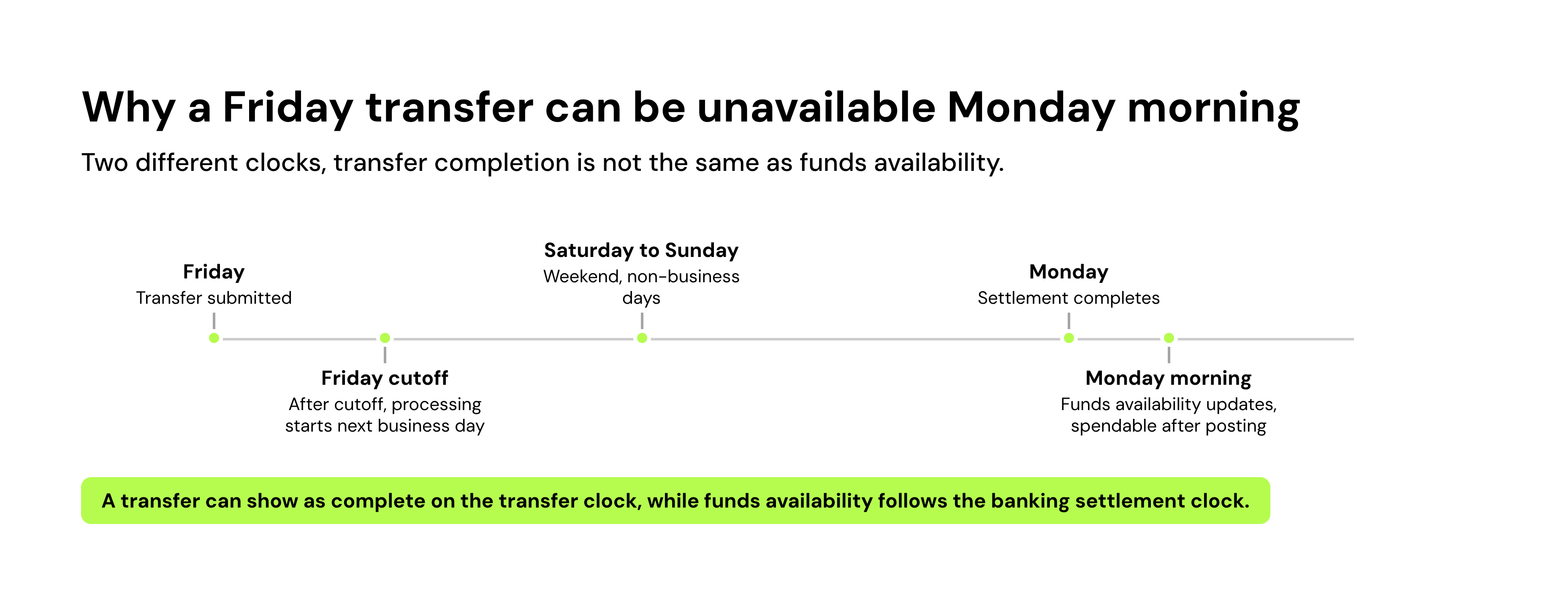
Most ACH transfers settle within one banking day, and once your bank has the money, federal rules give it until the next business day to make it available to you. Those are two different clocks, which is why a transfer that "went through" on Friday can still be unspendable Monday morning. The gap comes from batch cutoff times, weekends, and federal holidays
How long do ACH transfers take?
ACH transfer time depends on which direction the money is being pushed or pulled. Nacha, the nonprofit that writes the rules for the Automated Clearing House (ACH) network, sets a window for two main types of transactions.
Credits have a wider window, which is why it can take longer for payments you’re waiting for. Nacha's rules cap a credit's settlement date at two banking days out and a debit's at one, and within that range the sender picks. Across the network, about 80% of transactions settle within one day.
Only the U.S. Treasury, which disburses federal payments including tax refunds and Social Security, is allowed to initiate ACH credits that settle more than two banking days in the future.
Why ACH transfers aren't instant
To both the sender and the recipient, ACH transfers appear as numbers on the screen. There are two main reasons why transactions don't go through right away.
The ACH batch processing system
If a bank took the time to send every ACH request through the network as soon as it received it, it would be difficult to get anything else done. Instead, banks bundle multiple ACH requests into one transaction.
Each bundle is sent to one of two central ACH operators: the Federal Reserve (FedACH) or the Clearing House’s Electronic Payments Network. The ACH operator then routes the funds to the recipient.
Cutoff times and business days
Most banks will forward multiple batches of ACH requests per day. Each batch has a cutoff time, so the speed of your ACH transfer is influenced by the time the initial request was sent.
Think of it like a post office. If you drop off your package before 4 p.m., it typically reaches your recipient sooner. If you drop it off at 4:15, the package may sit until the next day’s pickup, taking longer to reach its final destination.
Banks don’t send batches of ACH requests every single day. They typically don’t operate on weekends or federal holidays. This means that if the sender initiates the ACH transfer on Friday, it might not even be sent until Monday.
ACH transfers vs. other payment methods
You might wonder: how long do ACH transfers take compared to other payment methods? Here’s a quick comparison of ACH transfer times against wire transfers and payment by check:
Wire transfer
Wire transfers are usually faster than ACH transfers. Money often reaches the recipient within minutes or hours. However, wire transfers cost more, often $15 to $30 for the sender, and they aren’t typically used for routine payments.
Payment by check
Some employers still pay by paper check. When you deposit one, you may not get the full amount right away. Under Regulation CC, the first $275 of a day's check deposits must be available the business day after you deposit, with the rest generally available the business day after that.
Bottom line
Most ACH transfers settle within one banking day, and your bank has until the next business day to make an incoming one available. If it's taking longer than that, ask.
Still, none of this reaches your credit report: Checking activity, like direct deposits, isn't reported to the bureaus. Only accounts that report are.
The Kikoff Credit Account reports to Equifax, Experian, and TransUnion, with no credit check to sign up and plans from $5 a month.
Frequently Asked Questions
Article Sources
Disclaimer: The information provided in this blog post is meant for informational purposes only and does not constitute financial advice.