







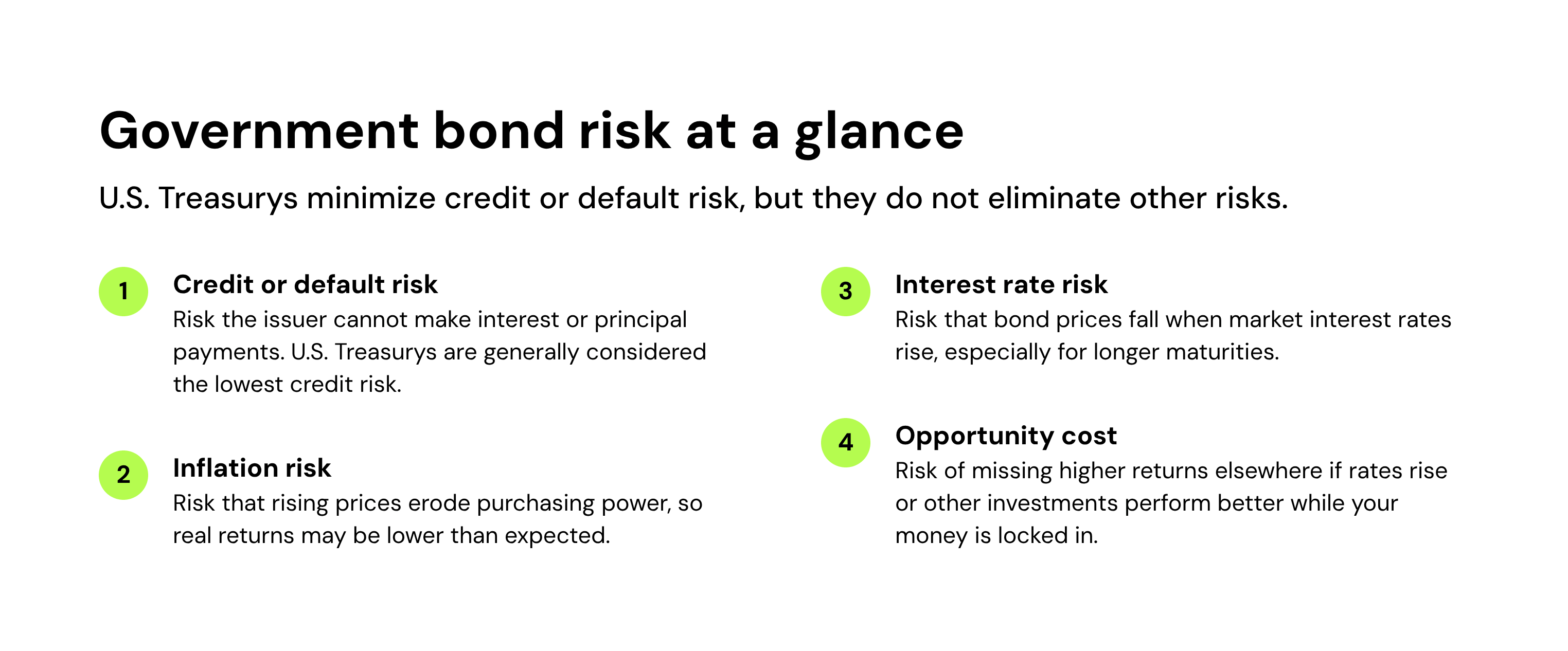
Government bonds take one risk almost entirely off the table: the chance the issuer doesn’t pay you back. But there are other risks. Inflation can outpace a fixed 3% return, rising rates can cut into what the bond sells for if you need out early, and money parked in Treasurys isn’t growing anywhere else.
That’s the difference between “low risk” from “risk-free,” and only one is a real category. The useful question is which risks you're accepting in exchange for the one you're removing.
Where the risk actually sits
No investment is completely risk-free. U.S. Treasury bills, notes, and bonds are generally considered among the lowest-risk investments available, but they still have risks.
The main distinction is credit risk, or the possibility that an issuer won’t make its promised payments. U.S. Treasury securities are backed by the full faith and credit of the federal government. That makes their credit risk different from that of bonds issued by corporations, municipalities, or foreign governments.
That doesn’t mean your Treasury investment can’t change in value, though. For example, if you sell a marketable Treasury security before maturity, its market price could be higher or lower than what you paid.
Why government bonds are considered low-risk
When you buy a bond, you’re basically lending money to the issuer. With a U.S. Treasury security, the borrower is the federal government.
Treasury bills are short-term securities that mature in four to 52 weeks. They’re generally sold at a discount or at face value, and you receive the face value at maturity. Treasury notes have terms of 2, 3, 5, 7, or 10 years and pay a fixed interest rate every six months. Treasury bonds mature in 20 or 30 years.
Because the federal government backs these obligations, investors commonly use Treasury securities when they want to reduce credit risk in an investment portfolio.
4 risks that still apply to government bonds
1. Inflation risk
Inflation reduces your money’s purchasing power. If your bond earns 3% while prices rise 4%, the dollars you receive may buy less than they did when you invested.
Treasury Inflation-Protected Securities (TIPS) address this problem. Their principal adjusts with inflation, as measured by the Consumer Price Index. The principal also adjusts downward with deflation, though at maturity you receive the greater of the adjusted or the original principal.
2. Interest rate risk
Bond prices and interest rates generally move in opposite directions. When market rates rise, existing fixed-rate bonds tend to fall in value because investors can buy newly issued bonds paying higher rates.
That might not matter much if you hold an individual Treasury to maturity. But if you need to sell early, you could receive less than you paid.
3. Opportunity cost
Money you put into low-risk government bonds isn’t invested in assets such as stocks that may offer greater long-term growth potential.
That doesn’t make bonds a poor choice, but you do need to think about what the money is for. Preserving money you need relatively soon is a different goal from growing retirement savings over several decades.
4. Default risk for other government bonds
Not every government bond has the same credit risk. Bonds issued by other countries, states, or cities depend on those governments’ financial condition and ability to repay.
Foreign bonds can also introduce other risks, such as currency fluctuations and political or economic instability.
What “risk-free” means in finance
In finance, a risk-free investment is a theoretical benchmark, not a promise that nothing can go wrong.
Short-term U.S. Treasury securities are commonly used as a stand-in for a risk-free asset because of their low credit risk. The idea is useful when comparing investments: If you can earn a return from a relatively low-risk Treasury, you might expect a riskier investment to offer the potential for a higher return because you’re taking on additional risk.
For your personal finances, though, it’s usually more useful to ask which risks you’re taking rather than whether an investment is “safe.”
Read more >> How to Gift a Savings Bond
When government bonds make sense
Government bonds may make sense when your priority is preserving principal, generating relatively predictable income, or reducing portfolio volatility.
Your timeline matters, too. A Treasury bill that matures in a few months serves a different purpose than a long-term Treasury bond. A 30-year bond still has decades of fixed payments ahead of it, so a change in market rates reprices all of them. A bill maturing in eight weeks has almost nothing left to reprice.
You can also compare Treasurys with savings accounts. Eligible savings deposits at an FDIC-insured bank are generally insured up to $250,000 per depositor, per insured bank, per ownership category. Treasury securities aren’t FDIC-insured, but they’re backed directly by the full faith and credit of the U.S. government.
Taxes work differently too. Interest on a savings account is taxable at every level. Interest on a Treasury is subject to federal tax but not state or local income tax, which can make a slightly lower Treasury yield a better deal, depending on where you live.
Two things to do before you pay for advice. How much of your savings belongs in Treasurys versus stocks is an allocation question, and it’s worth an hour with someone who does it for a living. Start with your 401(k) plan — many include access to advice at no extra cost. If you do pay someone, confirm they’re registered using the free search tool at Investor.gov.
Bottom line
Government bonds, particularly U.S. Treasury securities, can be among the lowest-risk investments available, but they aren’t completely free of risk. Inflation can reduce your purchasing power, rising rates can lower a bond’s market value, and choosing bonds can mean giving up the potential for higher returns elsewhere.
What decides whether they’re a fit is when you need the money. For an amount you’re spending on a known date, a Treasury that matures before then removes the guesswork. For money that has decades to work, the risk you’re removing might cost more than it saves.
One risk doesn’t work that way. A thin credit file isn’t a trade-off you manage, but a cost that shows up in every rate you’re offered. The Kikoff Credit Account reports your on-time payments to all three credit bureaus, with no credit check to open one and plans starting at $5 a month.
Frequently Asked Questions
Article Sources
Disclaimer: The information provided in this blog post is meant for informational purposes only and does not constitute financial advice.