.jpg)



If you're thinking about applying for a mortgage, auto loan, credit card, or some other financial product, you've probably heard about getting pre-qualified. After all, it never hurts to check your rates and see what you may be eligible for, right? Does pre-qualification affect credit score? No, it does not, except in rare scenarios.
Here's everything you need to know so you can take advantage of this free, no-impact process. You'll also learn what a pre-qualification does not include, and what you'll need to do instead if you want to accurately gauge your eligibility odds.
Does pre-qualification affect your credit score?
Getting pre-qualified for a financial product rarely, if ever, affects your credit score. Most lenders do not run any sort of credit check when you apply for pre-qualification. Instead, they rely on self-reported information, such as your gross income. You may also be asked to estimate your credit score range.
However, if you want your pre-qualification to be reliable, you need to provide information that is as accurate as possible. Otherwise, the lender will be issuing the pre-qualification notice based on false data.
You'll have to authorize a credit check before you are approved for the financial product, so there is no benefit to omitting or falsifying pre-qualification data.
Why most pre-qualifications don't affect your score
Pre-qualification is a surface-level process. Lenders rely on self-reported information to determine whether you may qualify for a financial product. Since they aren't running your credit and you aren't filling out an application, it has no impact on your score. It won't add a hard inquiry to your credit history.
Similarly, some pre-approvals don't affect your score either, unless the lender conducts a hard credit check. Pay close attention to what language a lender uses before you fill out an application or submit your financial data. If you authorized a credit check, they will run a hard inquiry, which can impact your score.
If you aren't interested in applying for the financial product, there is no need to conduct a hard inquiry.
What is pre-qualification?
Pre-qualification is the earliest estimate from a lender about how much you may be able to borrow and on what general terms. It is not a guarantee of approval. Instead, it's a preliminary review of your eligibility based on:
- Basic financial information
- Estimated income
- Approximate debt levels
- Sometimes, a soft credit check
Pre-qualification gives you a ballpark figure of how much you may be able to borrow. If you are getting pre-qualified for a mortgage, the information can help you estimate how much home you may be able to afford.
For credit cards or personal loans, it shows whether you're likely to qualify before submitting a full application. Pre-qualifications are designed to be informational and low-risk.
Pre-approval vs. pre-qualification
Pre-qualification and pre-approval are often confused, but they are very different. The pre-qualification process involves a soft credit inquiry or none at all. It's based on self-reported or lightly verified information. The lender is not committing to loan you money. The process is fast and low-impact.
On the other hand, a pre-approval:
- Requires a soft or hard credit inquiry
- Includes income verification
- Provides a stronger conditional commitment
- May temporarily lower your score by a few points
If your main concern is whether pre-qualification affects your score, the risk is far lower than pre-approval. On the other hand, getting pre-approved is a stronger option if you want a detailed look at your approval odds.
How to check pre-qualification without hurting your credit
If you want to explore loan options while protecting your score, start by checking whether the lender uses a soft or hard inquiry. Lenders are required to be transparent about this information. Look for language like:
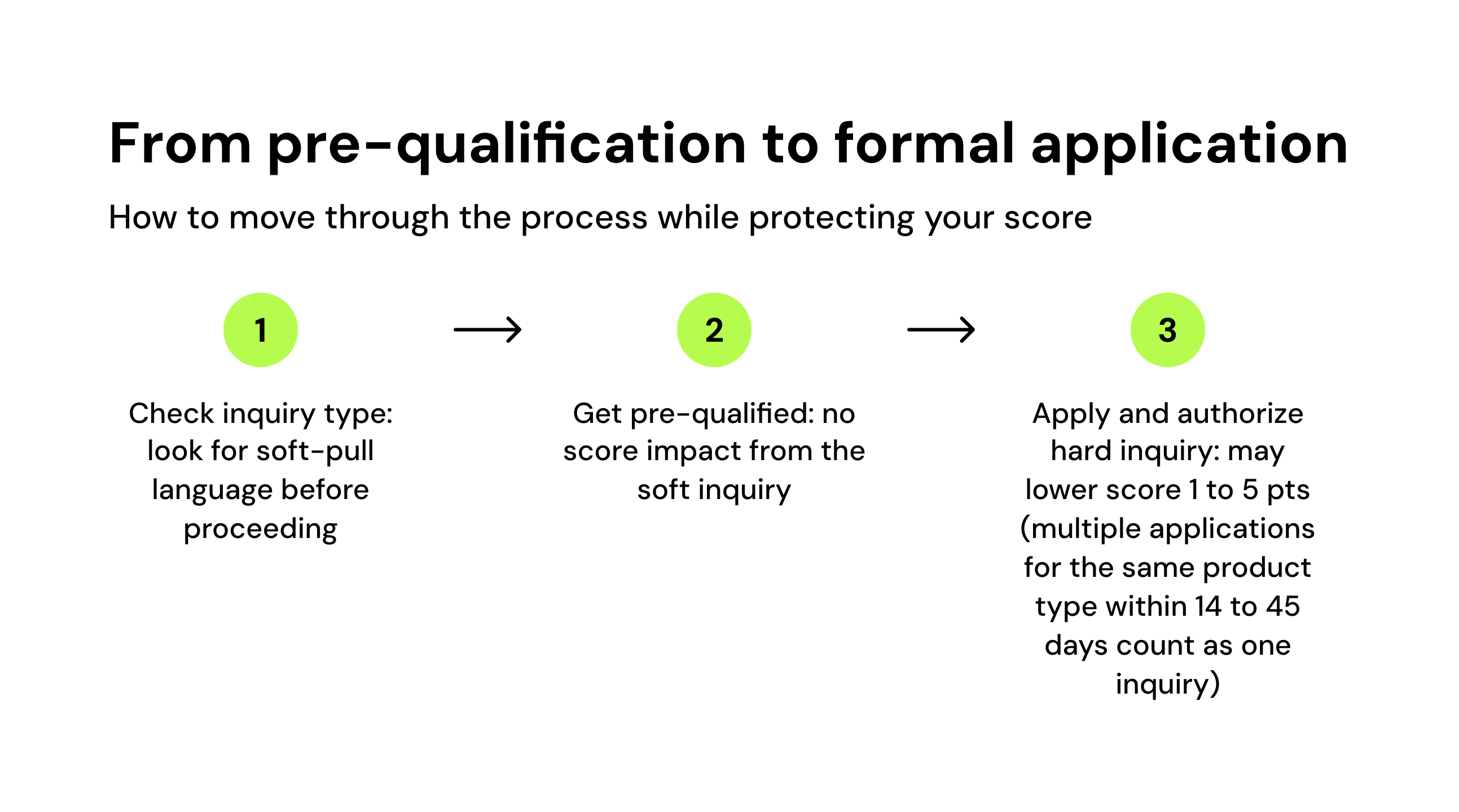
- No impact on your credit score
- Soft credit check
- Check rates without affecting your credit
If you are pre-qualified and want to apply, you will need to authorize the lender to run a hard inquiry. You can apply for the same type of product with multiple lenders in a short time period and only have it count as one hard inquiry. This allows you to compare rates and find the best option for your needs.
Conclusion
Ready to strengthen your credit history before you apply? Kikoff makes it easy to report on-time verified rent payments and add positive payment history to your credit profile.
Frequently Asked Questions
About the editor

Disclaimer: The information provided in this blog post is meant for informational purposes only and does not constitute financial advice.