.jpg)




A child can’t open a certificate of deposit (CD) alone, but you can open one for them in two ways: a custodial CD or a CD inside a 529 college savings plan. The difference is who ends up controlling the money. With a custodial CD, the money becomes your child’s. With a 529, it stays under your control.
Can you open a CD for a child?
Yes, but an adult must be on the account. Banks don’t let minors open CDs on their own, so the two main options both put you in charge, at least at first.
Custodial CDs
With a custodial CD, the money belongs to your child from the day you deposit it. You manage it as the custodian until your child reaches the age set by your state. That’s usually age 21, though some states default to 18, and several let you choose a later age when you open the account. Finaid’s state-by-state chart shows the defaults, and your brokerage can tell you which applies to yours. At that point, the money is theirs to use however they choose.
Before you open one, know:
- The gift is permanent. Money you put into a custodial account belongs to your child. You can’t take it back.
- It can affect financial aid. Custodial accounts are factored into financial aid eligibility as the student’s asset.
- Interest can be taxed. Unearned income above $2,700 is taxed at the parent’s rate (the “kiddie tax”), according to the IRS. Below that, the first $1,350 is offset by the child’s standard deduction and the next $1,350 is taxed at the child’s own rate.
If you’re weighing a custodial account against college aid or your own taxes, a tax professional or financial advisor can tell you how it plays out for your family.
CDs within a 529 plan
A 529 plan is a tax-advantaged account for education savings. Earnings accumulate tax-free while in the account, and withdrawals aren’t taxed when they pay for qualified education expenses. If you withdraw money for anything else, part of the earnings becomes taxable.
Only some 529 plans include a CD among their investment options, so check the plan’s investment list before you enroll. You can also look at plans sponsored by other states. You’re not limited to your own.
Unlike a custodial CD, a 529 doesn’t automatically pass to your child. You stay the account holder, and your child is the beneficiary.
Read more >> How to Build Credit as a Teenager
How to open a CD for your child
When you compare CDs, look at:
- The interest rate, usually shown as an annual percentage yield (APY)
- The minimum deposit
- The term length
- Any fees, including early-withdrawal penalties
For a custodial CD, you’ll typically need:
- Your photo ID
- Your Social Security number
- Your child’s Social Security number
- Proof of your address
Once the bank approves your application, you make your opening deposit.
Read more >> What Are the 6 Types of Bank Accounts?
How CDs work
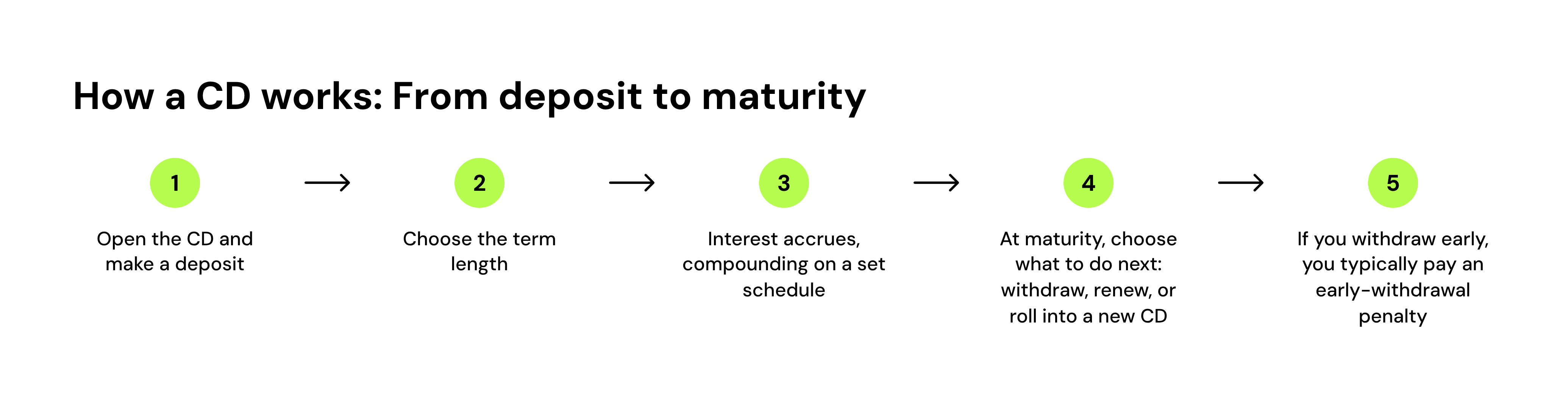
A CD is a bank deposit that pays a fixed rate in exchange for leaving your money alone for a set term:
- You deposit a lump sum and agree to leave it for a term, anywhere from a few months to five years or more.
- The bank pays a fixed interest rate, usually higher than a traditional savings account. High-yield savings accounts can pay as much or more.
- Most CDs compound, so you earn interest on your interest.
- When the term ends, you can withdraw the money or roll it into a new CD.
You can usually take money out early, but you’ll pay a penalty, typically charged against the interest you’ve earned. The bank has to tell you the penalty before you open the CD.
Run the numbers >> Use Kikoff’s CD calculator to compare what you’d earn across a 6-month, 1-year, and 5-year term.
Opening a CD for a child: Pros and cons
Pros
- Low risk. Your deposit doesn’t rise and fall with the market.
- Predictable returns. The rate is fixed for the life of the CD, so you know what you’ll have at the end.
- Federally insured up to $250,000. And the FDIC treats a custodial account as the child’s own.
Cons
- Limited access. Withdrawing early usually costs you a penalty, often several months of interest.
- Minimum deposits. The best advertised rates often require a larger opening balance.
- Lower long-term returns. Over long stretches, stocks have historically outpaced CDs, which matters more the younger the child is.
Many parents pair a CD with a savings account, so some money stays easy to reach.
Read more >> How to Create a Family Budget
Bottom line
A custodial CD gives the money to your child for good. A 529 CD keeps it under your control for education. Either way, the child needs you to open it.
A CD is a real record of saving, but no lender will ever see it. Your credit report only shows how you’ve handled credit. A Kikoff Credit Account reports your on-time payments to Equifax, Experian, and TransUnion, so each month you pay adds to a record lenders do see. There’s no credit check to sign up, and plans start at $5 a month.
Frequently Asked Questions
Article Sources
Disclaimer: The information provided in this blog post is meant for informational purposes only and does not constitute financial advice.