



A poor credit score doesn’t automatically close the door on a home equity loan, but it narrows which door. Of major lenders that publish a minimum, most sit at 660 or higher, with a few credit unions accepting 580, and the ones in between charge for the difference. Your score, your equity, and your debt-to-income ratio get weighed together, which is why two people with the same credit score can get different answers.
Can you get a home equity loan with poor credit?
Yes, you can qualify for a home equity loan with poor or limited credit, but it depends on how low your score actually is. While many lenders require at least 660, some may go as low as 580. If you’re below that, you’ll likely need to work on your credit before applying.
Either way, a lower score can mean these trade-offs:
- A higher interest rate to compensate for the lender’s risk
- A smaller borrowing limit, even if you have significant equity
- Stricter underwriting requirements, including higher income, less debt, and more paperwork to prove it
Minimum credit score requirements for home equity loans
Traditional banks typically require around 660, while some credit unions may go as low as 580.
What is CLTV — and why does it matter? Combined loan-to-value is how much you owe against what your home is worth. Combined is the important part: It counts your mortgage and the new loan together, not just the new one. Most lenders cap CLTV somewhere between 80% and 90%.
Say your home is worth $400,000 and you still owe $280,000. That puts you at 70% before you borrow a dollar. An 85% cap would leave you $60,000 to work with. An 80% cap would leave you $40,000.
This is also the number that can do the most for a low credit score. Lenders take on more risk as CLTV climbs, so asking for less than the cap allows gives them a reason to approve you. Just know that many lenders set the cap by score, so ask what CLTV yours qualifies for before you settle on an amount.
Other factors lenders consider
Besides your credit score, lenders look at several other factors when making a decision:
- Stable income. Lenders want proof you can cover the payments, usually through recent pay stubs, two years of tax returns, and bank statements.
- Home equity. This is what your home is worth minus what you still owe. Most lenders require at least 10% to 20% equity after the loan and your original mortgage.
- Debt-to-income ratio (DTI). Lenders commonly look for 43% or lower, though that’s not a rule. Requirements vary by lender and loan product.
Read more >> What Is a Good Debt-to-Income Ratio?
How to calculate your DTI. Add up all monthly debt payments, such as your mortgage, car loan, credit cards, student loans, and the minimum payment on each credit card. Then divide that number by your gross monthly income, which is what you earn before taxes.
Running the numbers, $1,500 in monthly debt payments ÷ $5,000 gross monthly income = 30% DTI. Your lender will run the math with the new home equity payment added in, so figure that in before you apply.
Home equity loan alternatives for poor credit
If you don’t qualify for a home equity loan, or the terms just don’t work for you, these options are worth knowing about.
Home equity line of credit (HELOC)
A HELOC works like a credit card backed by your home. Instead of a lump sum, you get a revolving line of credit you can draw from, usually for about 10 years. After that draw period ends, you repay what you borrowed, often over another 10 to 20 years.
HELOC rates are usually variable, so your monthly payment can change, and it can jump again when the draw period ends and you start repaying the principal. Budget for the repayment, not the draw period.
A HELOC is secured the same way a home equity loan is, so if you can’t repay on schedule, you could lose your home to foreclosure.
Cash-out refinance
A cash-out refinance replaces your existing mortgage with a new, larger one, and you pocket the difference in cash. Because this option requires closing costs up front, it might make sense when:
- Mortgage rates have dropped since you bought your home
- You plan to stay in your home long enough to recoup the refinancing costs
Two rates, one decision. A cash-out refinance reprices your entire mortgage at today’s rate. A home equity loan leaves your existing mortgage alone and prices only the new borrowing. So if your current rate is well below today’s, the refinance costs you the difference on the whole balance, not just on the cash you take out.
FHA Title I loans
Title I Property Improvement loans are government-insured loans for fixing up your home. Anything over $7,500 has to be secured by a lien on your property. At or below that, and your home typically stays out of it. These loans tend to have looser eligibility requirements than a home equity loan. But few banks still originate Title I loans, so start by searching HUD’s lender list rather than visiting your local bank.
Personal loans
Personal loans don’t use your home as collateral, which means less risk of foreclosure if you can’t keep up with the payments. But the downsides are shorter repayment terms and higher rates — up to 25% APR or more, depending on the lender, especially if you have poor credit.
Read more >> What to Know About Personal Loans
Read more >> How to Get a Home Loan With Poor Credit
How to improve your chances of approval
Spending even three to six months strengthening your application could make a difference in whether you get approved and the rate you get.
Lower your debt-to-income ratio
- Pay down credit cards where you can. It lowers your DTI and your credit utilization (the percentage of your available credit you’re using) at the same time.
- Knock out any installment loans close to payoff. If you’ve got a car or personal loan with only a few payments left, paying it off removes it from your DTI calculation entirely.
Build more equity in your home
Some lenders will work with lower credit scores when your loan-to-value ratio is low, meaning you’re borrowing a smaller share of what your home is worth.
Here are some strategies to build equity faster:
- Make extra payments toward your principal. Even one extra payment a year can shave time off your loan to build equity faster.
- Switch to biweekly payments. Paying every two weeks works out to 13 full payments a year instead of 12.
- Put windfalls toward your principal. A tax refund, work bonus, or inheritance applied to your mortgage can cut months off your loan term in just one payment. Just tell your servicer to apply it to principal — otherwise, they may treat it as an early payment on next month’s bill instead.
Improve your credit before applying
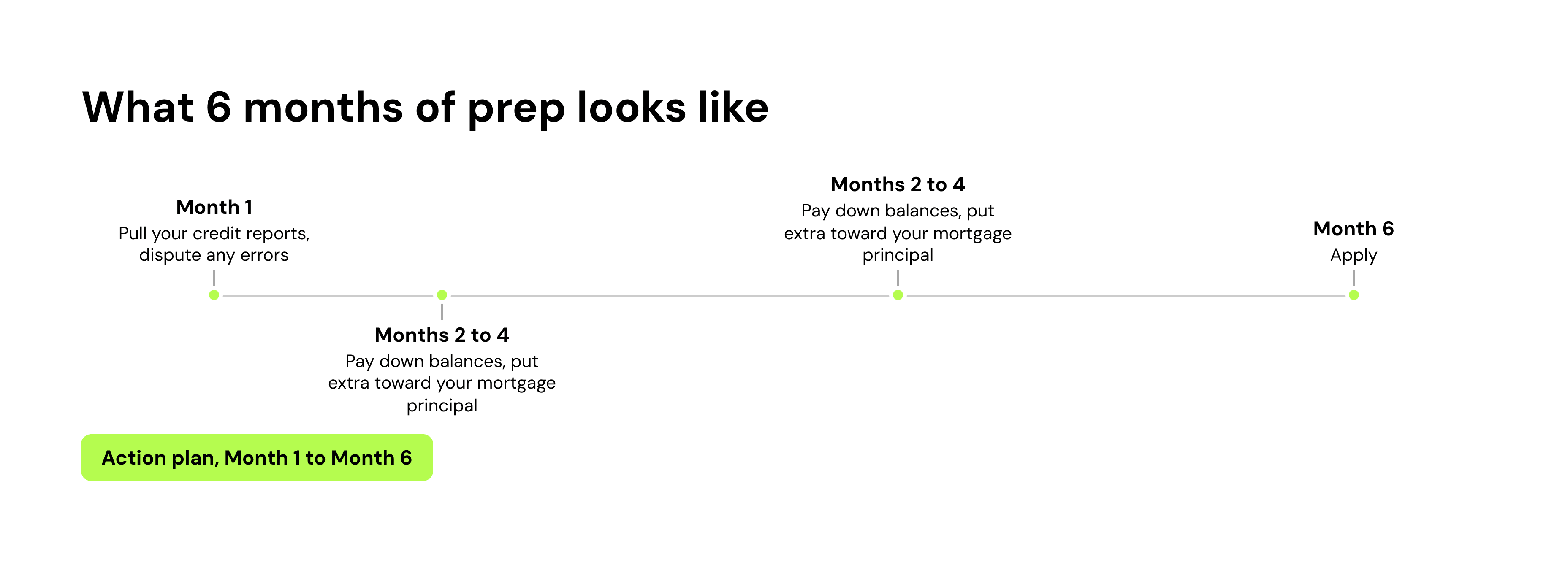
Your score won’t move overnight, but a few consistent habits can add up over a six-month stretch:
- Check your credit report for errors. Inaccurate items drag your score down, and disputing them is free under federal law. Pull all three reports free every week at AnnualCreditReport.com, and dispute anything wrong directly with the bureau. If you’d rather not write the letters yourself, Kikoff’s Credit Disputes drafts them for you.
- Make on-time payments. Payment history is the biggest factor in your credit, accounting for 35% of your overall score.
- Don’t take on new debt before you apply. New applications usually trigger a hard inquiry, which can ding your credit score for several months.
- Don’t close existing accounts. Closing a card reduces your available credit, which can push your credit utilization up.
Read more >> How to Dispute Credit Report Errors
Risks of getting a home equity loan with poor credit
The biggest risk of a home equity loan is the one that comes with every loan your house secures: if you fall far enough behind, the lender can foreclose on your home. That’s a very different risk level from falling behind on a credit card or personal loan, where the worst case is collections and a negative mark on your credit report.
You also have three business days after signing to cancel. The CFPB calls this the right of rescission, and it applies to most mortgages you didn’t take out to buy the home, including home equity loans.
Because a lien on your home is a legal claim and foreclosure rules vary by state, a licensed attorney can tell you what you’d actually be signing. If what you need is help deciding whether to borrow at all, the National Foundation for Credit Counseling (NFCC) can connect you with free or low-cost guidance at 800-388-2227.
Bottom line
A 580 can get you a home equity loan from a credit union. A 660 opens up banks. A 730 gets you the rate the banks advertise. The minimum decides whether you’re considered, but your score after that decides what the loan costs every month for the next 10 to 15 years.
The Kikoff Credit Account reports your on-time payments to all three credit bureaus with no credit check, and every on-time payment helps to build the history lenders look for. Plans start at $5 a month.
Frequently Asked Questions
Article Sources
Disclaimer: The information provided in this blog post is meant for informational purposes only and does not constitute financial advice.