


.jpg)



Many types of loans, including auto loans, mortgages, and student loans, are designed for very specific purposes. But what if you want to fund something else? In this case, a personal loan might be the right option.
How does a personal loan work, and how can you determine whether it's the right type of credit for you?
What is a personal loan?
A personal loan is a fixed amount of borrowed money you repay in monthly installments. Those installments are usually made up of principal (the amount you actually borrowed) and interest calculated on that principal. In most cases, the installments are equal or approximately equal.
How does a personal loan work?
Most of the time, the process of getting a personal loan is relatively straightforward. Here's how it works:
- You apply with a bank, credit union, or online lender
- The lender reviews your application
- If you're approved, the lender uses information in your credit report to set rates and terms
- You receive the principal in a lump sum
- You pay the loan back in installments over time
It's a good idea to compare lenders before committing. Many offer pre-approval, meaning they'll do a soft pull of your credit to tell you what terms you qualify for. Soft pulls don't impact your credit, so you won't have to worry about multiple hard inquiries compromising your score.[2]
Secured vs. unsecured personal loans
Most personal loans are unsecured, meaning you don't have to put up any collateral. Because unsecured loans are riskier for lenders, they usually come with higher interest rates.[3]
Some lenders offer secured personal loans as well. With these loans, you give the lender the right to seize an asset (like a car or cash in a savings account) if you don't pay.
If you have the option to take out a secured personal loan, you might be able to benefit from lower interest rates. Just keep in mind that if you can't pay, the lender can take your collateral.
How to use a personal loan
What is a personal loan used for? Most lenders offering personal loans don't place restrictions on what you can use the money for. These are some common options:
- Debt consolidation
- Large purchases or expenses
- Emergency costs
Before taking out a personal loan, make sure you understand how much interest you'll be paying. For example, if you want to consolidate debt, it wouldn't make sense to take out a personal loan with a higher interest rate.
How personal loans affect your credit score
If you take out a personal loan and make all of your payments on time and in full, you might find that your credit score improves over time. However, like any other kind of credit product, personal loans have possible downsides, too. Here's how a loan could impact your credit.
Hard inquiry at application
When you formally apply for a credit card, personal loan, or other credit product, the lender does a "hard pull" (sometimes called a "hard inquiry") on your credit. When this happens, your credit score might temporarily drop by a few points.[2]
This might seem counterintuitive, but each time you apply for new credit, it signals to lenders that you might be riskier to lend to. One hard inquiry will usually have minimal effects.
However, you might see a significant drop in your credit score if you have multiple hard inquiries within a short period of time. That's because sending out multiple credit applications within a short period of time signals that you could be desperate for credit, and that's a major red flag for lenders.
Payment history and credit mix
Your payment history accounts for 35% of your FICO score, and it's the most important factor in determining it.[1] Your personal loan payments are reported to credit bureaus, and each on-time payment helps build your score.
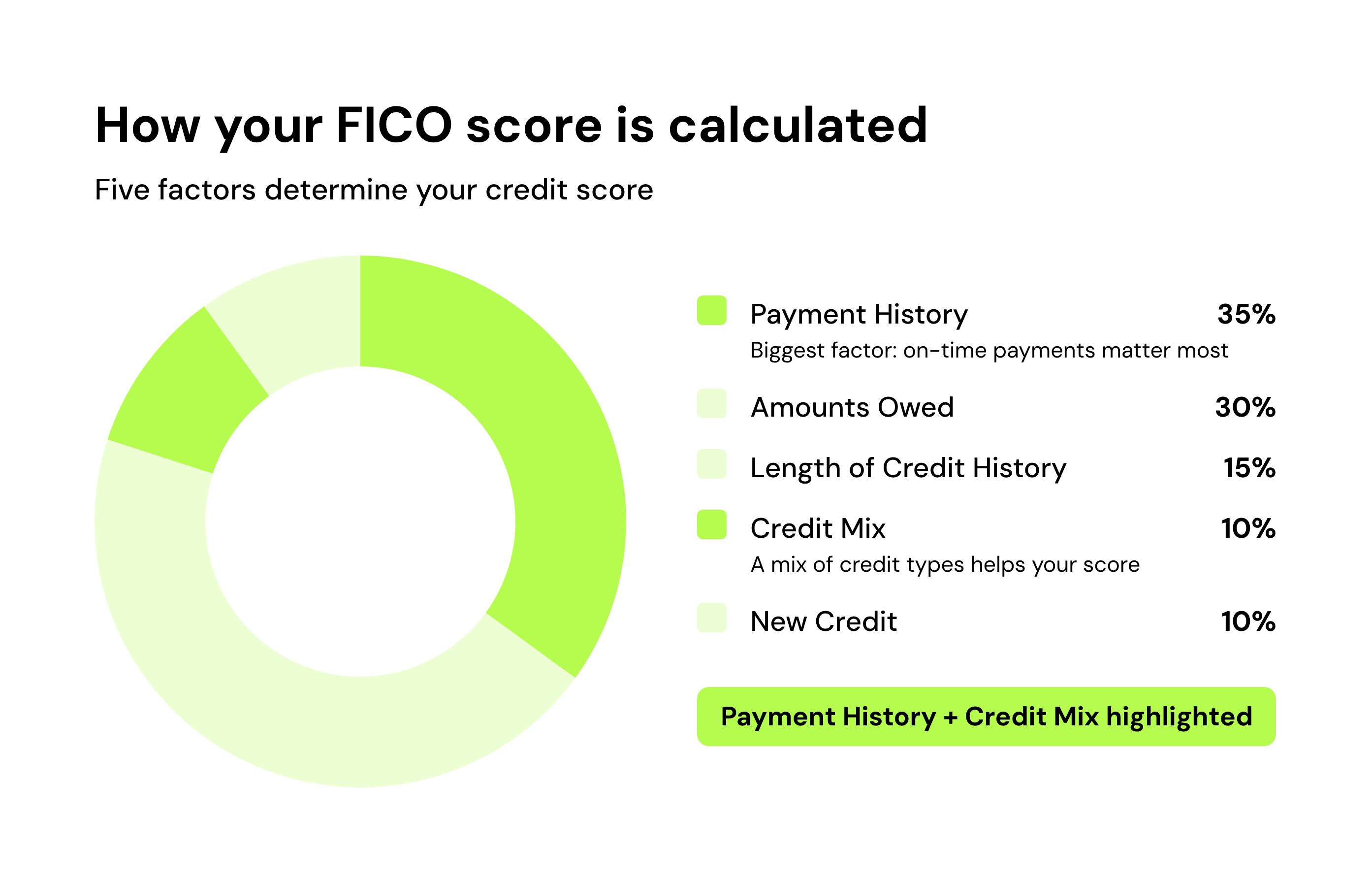
Your credit mix accounts for 10% of your FICO score.[1] Lenders want to see that you can handle multiple types of credit over time. If you have a mixture of installment credit (like personal loans) and revolving credit (like credit cards) on your report, it makes you look much less risky to lend to.
What to look for when comparing personal loans
Not all personal loans are created equal. Before making your selection, make sure to compare several factors across lenders.
APR and fees
The annual percentage rate (APR) gives you the approximate cost per year to take out a loan. Both the interest rate and additional fees are included. The lower the APR, the less you'll pay overall.[3]
Loan term and monthly payment
It's important to make sure you have an affordable monthly payment. Lenders also evaluate your debt-to-income ratio to assess your ability to repay, so keeping existing debts manageable improves your chances of approval.[4] However, you shouldn't forget about the loan term. Longer repayment periods often involve paying more interest over time. Free loan calculators are an easy way to compare loan terms and see how much each will cost in the long run.
Searching for more ways to build your credit?
In some cases, taking out a personal loan can be a great way to build your credit score over time. But if you're only qualifying for loans with sky-high interest rates and other unfavorable terms, it might be wise to start looking for better options.
Kikoff can help. We connect people who have poor credit or limited credit histories with credit-building tools and resources, including lines of credit, secured credit cards, and credit builder loans.
Want to find out how we can support you on your journey to better credit? Create your account for free (and with no credit check) today!
Frequently Asked Questions
About the editor

Article Sources
Disclaimer: The information provided in this blog post is meant for informational purposes only and does not constitute financial advice.