


Best Credit Cards for Students in 2026

Looking for the best credit cards for students in 2026? We break down the top options for building credit early, what to look for in a student card, and how to use one responsibly to set yourself up for long-term financial success.

Best Credit Cards for Students in 2026

Starting your credit journey as a student is one of the smartest financial moves you can make.

The right credit card can help you build a positive credit history early, which sets the foundation for lower interest rates, better housing options, and stronger borrowing power down the road. In this post, we'll break down the best credit cards for students in 2026, what to look for when choosing one, and how to use your card to maximize your credit-building potential.

Let's jump in.

Best credit cards for students in 2026

Every individual who starts building credit early gets a major head start on their financial future, and student credit cards are one of the most accessible ways to do it.

Here's a breakdown of our top picks for student credit cards in 2026.

1. Firstcard Student Credit Card

The Firstcard Student Credit Card is one of the best options for students looking to build credit from the ground up.

It's a secured card with 0% APR, no hard credit inquiry to apply, and reports payment activity to all three major credit bureaus: Equifax, Experian, and TransUnion. This means every on-time payment you make builds real credit history across the board.

One standout feature is that Firstcard accepts international students without an SSN, making it accessible to a wider range of students than most cards in this category. Because it's a secured card, what you deposit is what you can spend, which eliminates any risk of overspending and keeps your credit utilization in check by design.

Firstcard also offers up to 5% cashback on 12 popular educational platforms and unlimited 1% cashback on all purchases with a Premium membership. For students who want a disciplined, low-risk way to start building credit with real rewards on top, it's a super strong starting point.

2. Kikoff Secured Credit Card

The Kikoff Secured Credit Card is another excellent option for students looking to build credit from the ground up.

It's a no-fee secured card that reports your payment activity to all three major credit bureaus: Equifax, Experian, and TransUnion. This means every on-time payment you make builds real credit history across the board.

The signup process requires no hard credit inquiry, so getting started won't create any negative impact on your credit profile. It's designed for people who are new to credit or rebuilding, which makes it a natural fit for students at any stage.

Because it's a secured card, you deposit funds to set your credit limit, giving you full control over your spending exposure. For students looking for a disciplined, low-risk way to start building credit, it's a super strong starting point.

Start building credit with the Kikoff Secured Credit Card.

3. Discover it Student Cash Back

The Discover it Student Cash Back card is one of the most popular student credit cards available.

It offers 5% cash back in rotating categories each quarter and 1% on all other purchases, which is a solid rewards structure for a no-annual-fee student card. Discover also matches all cash back earned in the first year, which is a genuinely strong offer for new cardholders.

The card has no annual fee and no foreign transaction fees, making it practical for students who study or travel abroad. Discover is generally known for its customer-friendly policies, including no penalty APR for a first late payment.

For students who want a traditional credit card with real rewards potential, this is one of the better entry-level options on the market.

4. Chase Freedom Student Credit Card

The Chase Freedom Student Credit Card is a straightforward card designed for students who are just starting out.

It earns 1% cash back on every purchase and comes with a $50 bonus after your first purchase within the first three months. There's no annual fee, and it includes a credit limit increase review after five on-time monthly payments.

Chase reports to all three major credit bureaus, so consistent payment behavior will contribute to your credit history. The card also includes access to Chase Credit Journey, a free credit score monitoring tool.

This is a solid, low-friction option for students who want a simple rewards card to establish credit history.

5. Capital One Quicksilver Student Cash Rewards Credit Card

The Capital One Quicksilver Student card offers unlimited 1.5% cash back on every purchase, which is one of the more competitive flat-rate rewards structures in the student card category.

There's no annual fee and no foreign transaction fees, which is useful for international students or those who travel frequently. Capital One generally has a reputation for being accessible to applicants with limited credit history, which makes this card a viable option for students earlier in their credit journey.

It also reports to all three bureaus, so your payment activity is fully tracked and reflected in your credit profile. For students who want simplicity and a consistent rewards rate across all spending, this card is a strong contender.

6. Bank of America Customized Cash Rewards Credit Card for Students

The Bank of America Customized Cash Rewards card for students is one of the more flexible options in this category.

It offers 3% cash back in a category of your choice, 2% at grocery stores and wholesale clubs, and 1% on all other purchases. The ability to choose your 3% category, be it gas, online shopping, dining, travel, or other options, makes it unusually adaptable to individual spending habits.

There's no annual fee, and Bank of America offers a $200 online cash rewards bonus after making at least $1,000 in purchases in the first 90 days. It reports to all three major credit bureaus, which means your on-time payments are building real credit history.

This is a solid pick for students who want more control over how they earn rewards.

7. Citi Rewards+ Student Card

The Citi Rewards+ Student Card is a great option for students who make lots of small, everyday purchases.

It rounds up every purchase to the nearest 10 points, which means a $1 coffee earns 10 points rather than just 1. The card earns 2x points at supermarkets and gas stations and 1x on everything else, with no annual fee.

Citi also offers 10% points back on redemptions, up to the first 100,000 points per year. Like the other cards on this list, it reports to the major credit bureaus, so on-time payments are actively building your credit history.

For students who spend frequently on everyday items and want a rewards card that works harder on small purchases, this card is worth considering.

What to look for in a student credit card

Choosing the right student credit card comes down to a few key factors that can make a real difference in your credit journey.

Bureau reporting

The single most important thing any student credit card should do is report your payment activity to the major credit bureaus.

Not all cards report to all three bureaus, Equifax, Experian, and TransUnion, and having full reporting coverage means your on-time payments are building a more complete credit profile. This said, always confirm that any card you're considering reports to all three before applying.

Without consistent bureau reporting, your payments aren't doing the credit-building work you're counting on.

Fees and interest rates

Student credit cards generally have higher APRs than standard cards, but some are much worse than others.

Paying your balance in full each month is the most effective way to avoid interest entirely, which is mainly what you should be aiming for as a student. This said, it's still worth looking for cards with no annual fee and reasonable rates in case you carry a balance.

Watch out for hidden fees like foreign transaction fees or late payment fees that can add up quickly if you're not careful.

Rewards structure

Rewards can be a nice bonus on a student card, but they shouldn't be the primary reason you choose one.

Some cards offer flat-rate cash back on every purchase, while others offer higher rewards in specific categories, be it dining, groceries, or streaming services. Think honestly about your actual spending habits before choosing a card based primarily on its rewards structure.

The best rewards card is one that naturally fits how you spend, so you're not chasing categories you don't actually use.

Credit limit

Student credit cards typically come with lower credit limits, usually ranging from a few hundred to a couple of thousand dollars.

A lower limit is actually a useful guardrail early in your credit journey, since it makes it easier to keep your credit utilization below 30%. Utilization is calculated as your balance divided by your credit limit, so keeping that number low is super important for your credit score.

Just make sure you're not consistently bumping up against your limit, as high utilization can damage your credit score even if you pay your bill on time.

How to use a student credit card to build credit

Having a student credit card is only half the equation. Using it the right way is what actually drives credit growth.

Pay on time, every time

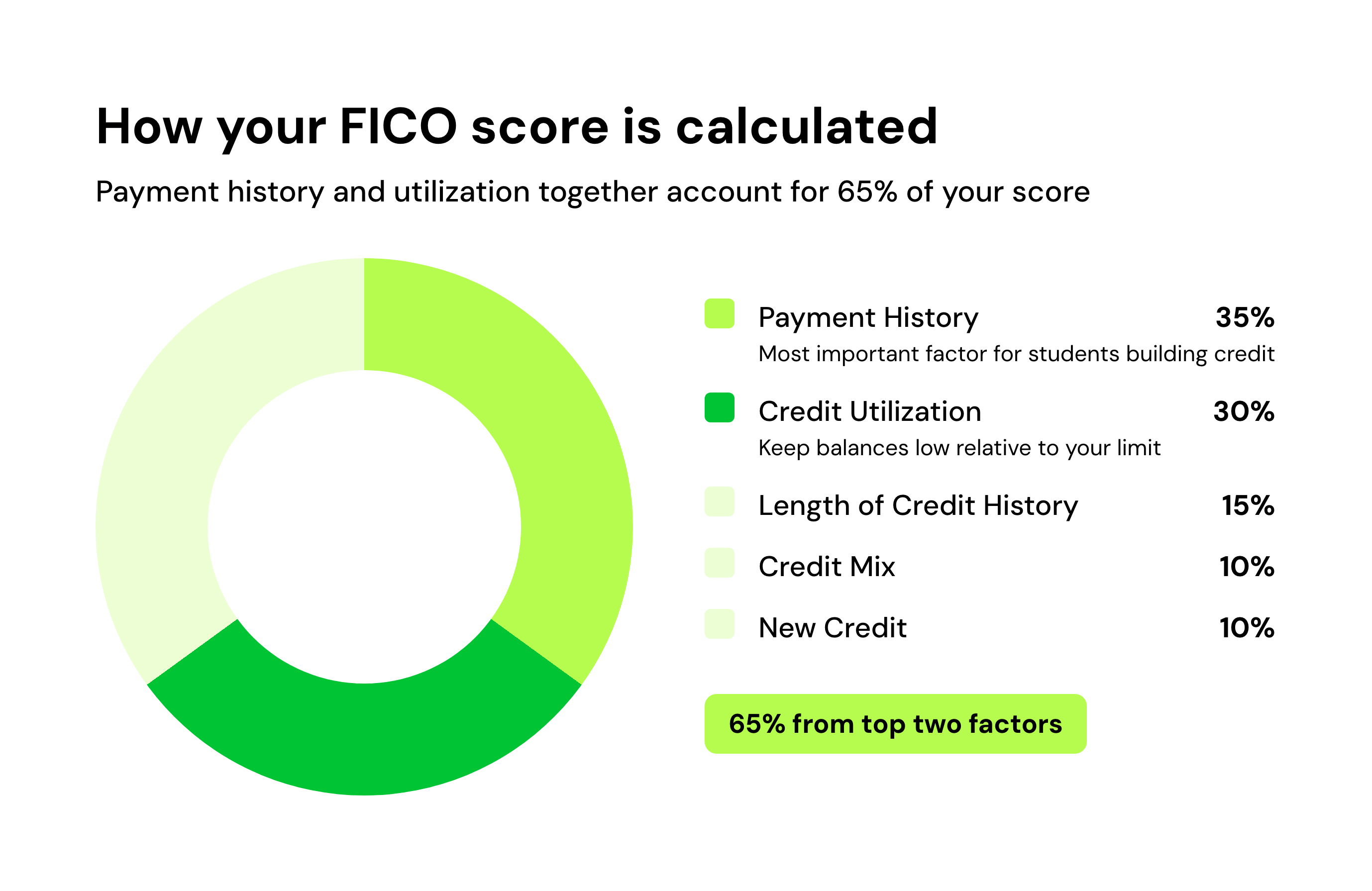
Payment history is effectively the single most important factor in your credit score, making up 35% of your FICO score.

A single missed payment can do significant damage to your credit, and that damage takes time to fade. Setting up autopay for at least the minimum payment is a no-brainer safety net to make sure you never miss a due date.
Paying the full statement balance each month is ideal, since it keeps your utilization low and avoids interest charges entirely.

Keep utilization low

Credit utilization is the second most impactful factor in your credit score, making up 30% of your FICO score.

The formula is simple: your balance divided by your credit limit equals your utilization rate. For example, if you have a $500 credit limit and a $100 balance, your utilization is 20%, which is well within the generally recommended threshold of below 30%.

Lots of credit experts recommend keeping utilization below 10% if you want to maximize your score, so treating your credit card like a debit card and paying it off frequently is a great habit to develop.

Don't apply for too many cards at once

Every new credit card application typically triggers a hard inquiry on your credit report, which can temporarily lower your score.

Multiple hard inquiries in a short period send a "financial stress" signal to lenders and can compound the negative impact. This said, spacing out applications by at least three to six months is generally a smart approach.

Starting with one card and building a track record before opening another is basically the most sensible path for most students.

Keep older accounts open

As you add cards over time, resist the urge to close your first student credit card once you've graduated or moved on to a better product.

Length of credit history accounts for 15% of your FICO score, and your oldest account is the single most influential factor within that category. Keeping older accounts open, even with occasional small purchases to prevent automatic closure, helps maintain a longer credit history.

The older your accounts look to lenders, the more stable and reliable your credit profile appears.

Secured vs. unsecured student credit cards

Student credit cards generally fall into two categories: secured and unsecured, and understanding the difference helps you choose the right one.

Unsecured student credit cards are traditional credit cards where the lender extends you a credit line based on your creditworthiness. They're generally easier to get than standard unsecured cards, but you still need to meet basic eligibility requirements, and approval isn't guaranteed.

Secured cards, on the other hand, require a cash deposit that effectively becomes your credit limit. This makes them accessible to virtually anyone, including students with no credit history at all. The tradeoff is that your credit limit is tied to your deposit, but this also means you're spending money you already have, which is a great way to build responsible habits.

Luckily, many secured cards, including the Firstcard Student Credit Card and the Kikoff Secured Credit Card, report to all three major credit bureaus just like standard cards, which means the credit-building impact is essentially the same. For students who are just getting started or who are unsure they'll qualify for an unsecured card, a secured card is often the smarter first move.

Conclusion

Choosing the right student credit card and using it responsibly can set the trajectory for your entire financial life.

Start with a card that reports to all three bureaus, keep your utilization low, pay on time every month, and avoid applying for multiple cards at once. Every individual who builds these habits early puts themselves in a dramatically stronger position when it's time to apply for a car loan, apartment, or mortgage.

If you're looking for a low-risk way to start building credit from scratch, Kikoff is a great place to begin, with no hard credit check to sign up and payment activity reported to all three major credit bureaus.

Sign up today

Frequently Asked Questions

Can a student get a credit card with no credit history?
Does getting a student credit card affect your credit score?
What happens to a student credit card after you graduate?
Is a secured card or an unsecured student card better for building credit?

Sources

About the author

Kikoff Team
Kikoff Team

Articles written by our team of expert finance writers here at Kikoff.

About the editor

Browse additional topics

Disclaimer: The information provided in this blog post is meant for informational purposes only and does not constitute financial advice.

Bonus:

On This Page

Hot off the press

Read more