



Two of the most common terms in personal finance are APR and APY, and they're also two of the most commonly confused.
Both describe interest rates, but they measure different things, apply to different products, and can meaningfully change how much money you earn or owe. Understanding the difference is one of the most practical things you can do for your financial health, and luckily, the distinction is simpler than it sounds.
Let's jump in.
APR vs. APY: what's the actual difference?
APR stands for Annual Percentage Rate, and APY stands for Annual Percentage Yield.
The key difference comes down to one concept: compounding. APR does not factor in compounding interest, while APY does.
Compounding is effectively the process of earning (or being charged) interest on interest that has already accumulated. When interest compounds, your balance grows faster than a simple percentage would suggest, because each new calculation is based on a slightly higher starting number than the last.
APR gives you the baseline interest rate without accounting for this snowball effect. APY gives you the "true" rate once compounding is baked in.
This means APY will almost always be a higher number than APR when they refer to the same underlying rate. The gap between them grows depending on how frequently the interest compounds, be it monthly, daily, or quarterly.
What APR is and when it applies
APR is mainly used when you're borrowing money.
When a bank or lender describes the cost of a credit card, mortgage, auto loan, or personal loan, they'll typically express it as an APR. It tells you what percentage of your balance you'll be charged in interest over the course of a year, expressed as a simple rate.
For example, if you carry a $1,000 balance on a credit card with a 20% APR, the basic formula looks like this: $1,000 x 0.20 = $200 in annual interest. In practice, credit cards compound daily, so the actual cost ends up slightly higher than that simple calculation suggests. That's where APY quietly enters the picture even on debt products.
When comparing borrowing products, a lower APR generally means a cheaper loan. This said, you should always read the full terms, because some products advertise a low APR but include fees that aren't captured in that number.
APR is also used on buy-now-pay-later products, student loans, and home equity lines of credit. It's basically the universal language for expressing borrowing costs across the lending industry.
What APY is and when it applies
APY is mainly used when you're earning money on a deposit or investment.
Savings accounts, high-yield savings accounts, certificates of deposit (CDs), and money market accounts all advertise their returns using APY. Because it includes the effect of compounding, APY paints a picture of what you'll actually earn over a full year, not just the raw rate.
A savings account advertised at a 5% APY, for instance, means that with compounding factored in, your money will grow by 5% over twelve months. If that same account only quoted the underlying rate (called the "periodic rate"), the number would look slightly smaller.
When comparing savings products, a higher APY is better. It means more interest hitting your account over time.
Here's a simple breakdown of the APY formula so you can see how compounding affects the final number:
APY = (1 + r/n)^n - 1
Where r is the annual interest rate and n is the number of compounding periods per year. The more frequently interest compounds, the higher the APY climbs relative to the base rate.
Why the difference matters in real life
The gap between APR and APY is small when rates are low, but it becomes meaningful at higher rates or over longer time horizons.
Lots of people focus only on the headline number without stopping to check which metric they're actually looking at. A savings account quoting a 4.8% "interest rate" and one quoting a 5.0% APY are not offering the same thing. The one using APY is giving you a more complete picture.
On the borrowing side, this same logic applies in reverse. Every individual who carries a balance on a credit card is effectively subject to compounding interest working against them, even if the card was marketed using a simple APR. This is one of the reasons high-interest debt can feel so hard to pay down. Learn how to avoid credit card interest to reduce this burden.
Generally, you want to minimize APR when borrowing and maximize APY when saving. Using these two numbers as your compass when evaluating any financial product is a no-brainer approach to making smarter comparisons.
How APR and APY relate to your credit
Your credit score plays a bigger role in the APR you qualify for than most people realize.
Lenders use your credit profile to determine how "risky" it is to extend you credit, and that risk assessment translates directly into the interest rate you're offered. Borrowers with strong credit scores usually qualify for significantly lower APRs on loans and credit cards, meaning they pay far less interest over time.
Someone with a credit score above 720 might qualify for a personal loan at 8% APR, while someone with a score in the 580 range might receive an offer closer to 20% APR or higher for the same loan amount. That difference compounds into thousands of dollars over the life of a loan.
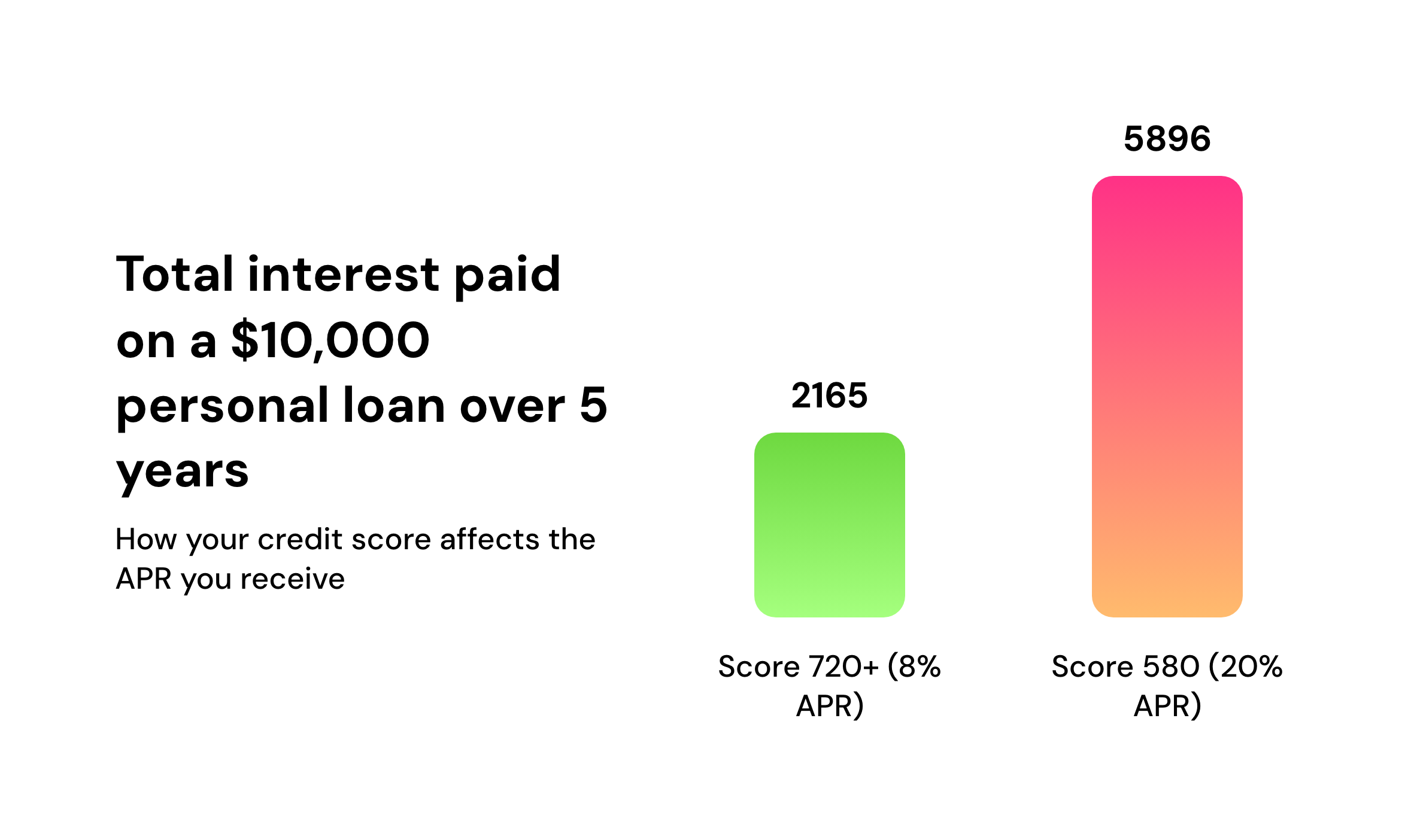
Building your credit is one of the most effective ways to lower the APRs you'll encounter throughout your financial life. Kikoff helps you build credit through a credit account that reports to all three major bureaus, so every on-time payment works toward a stronger credit profile and better rates down the road.
Conclusion
APR and APY are both interest rates, but they tell different parts of the story. APR is the rate you pay when borrowing, and it doesn't include compounding. APY is the rate you earn when saving, and it does.
When you're shopping for a loan, focus on APR. When you're comparing savings accounts, focus on APY. And when you want to make sure you're qualifying for the best rates possible, focus on your credit. Kikoff makes it easy to start building credit today.
Frequently Asked Questions
About the editor

Disclaimer: The information provided in this blog post is meant for informational purposes only and does not constitute financial advice.