



If you've spent any time researching ways to boost your credit, you've probably come across the 15/3 credit card payment hack.
The idea is simple: by making two payments per month instead of one, you can lower your reported credit utilization and, in turn, improve your credit score. But does it actually work, or is it more of a social media myth?
Let's jump in.
Does the 15/3 credit card payment hack work?
The 15/3 hack does have a real logic behind it, but it's a bit more nuanced than most posts let on.
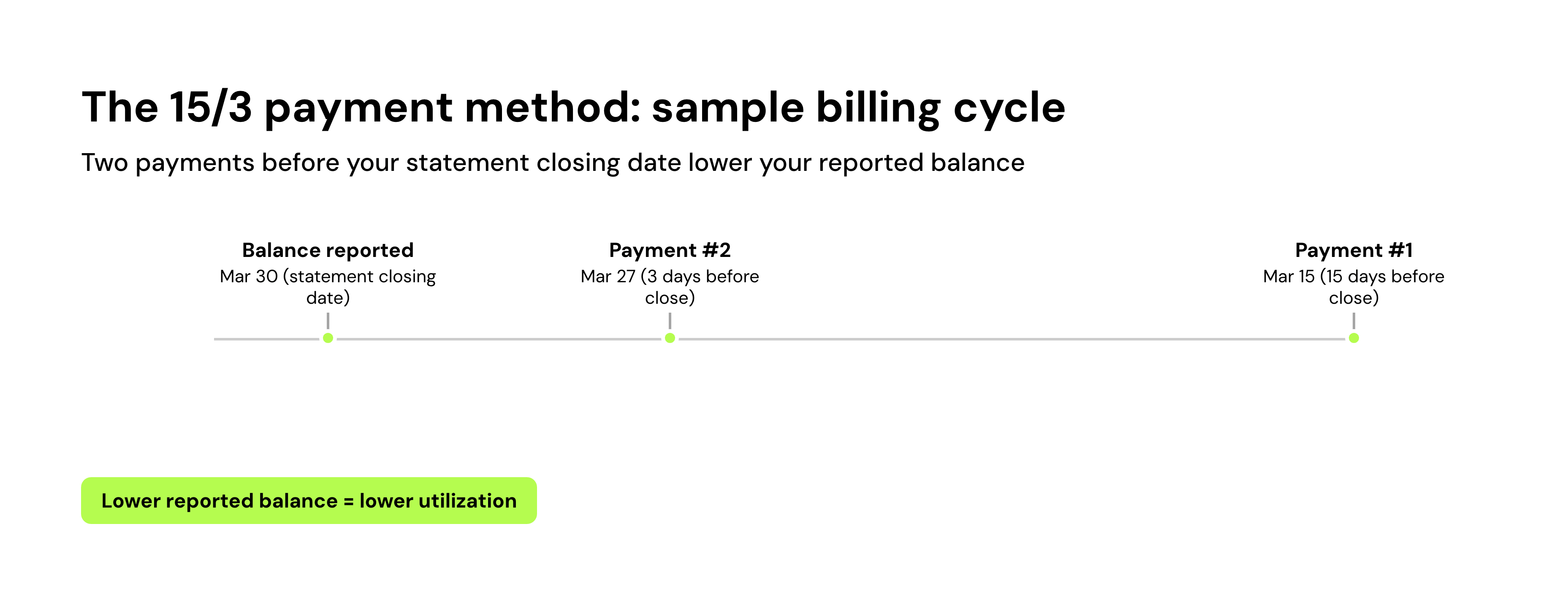
The strategy involves making one credit card payment 15 days before your statement closing date, and a second payment 3 days before it closes. The goal is to ensure your reported balance is as low as possible when your card issuer reports your balance to the credit bureaus, which is what determines your credit utilization for that cycle.
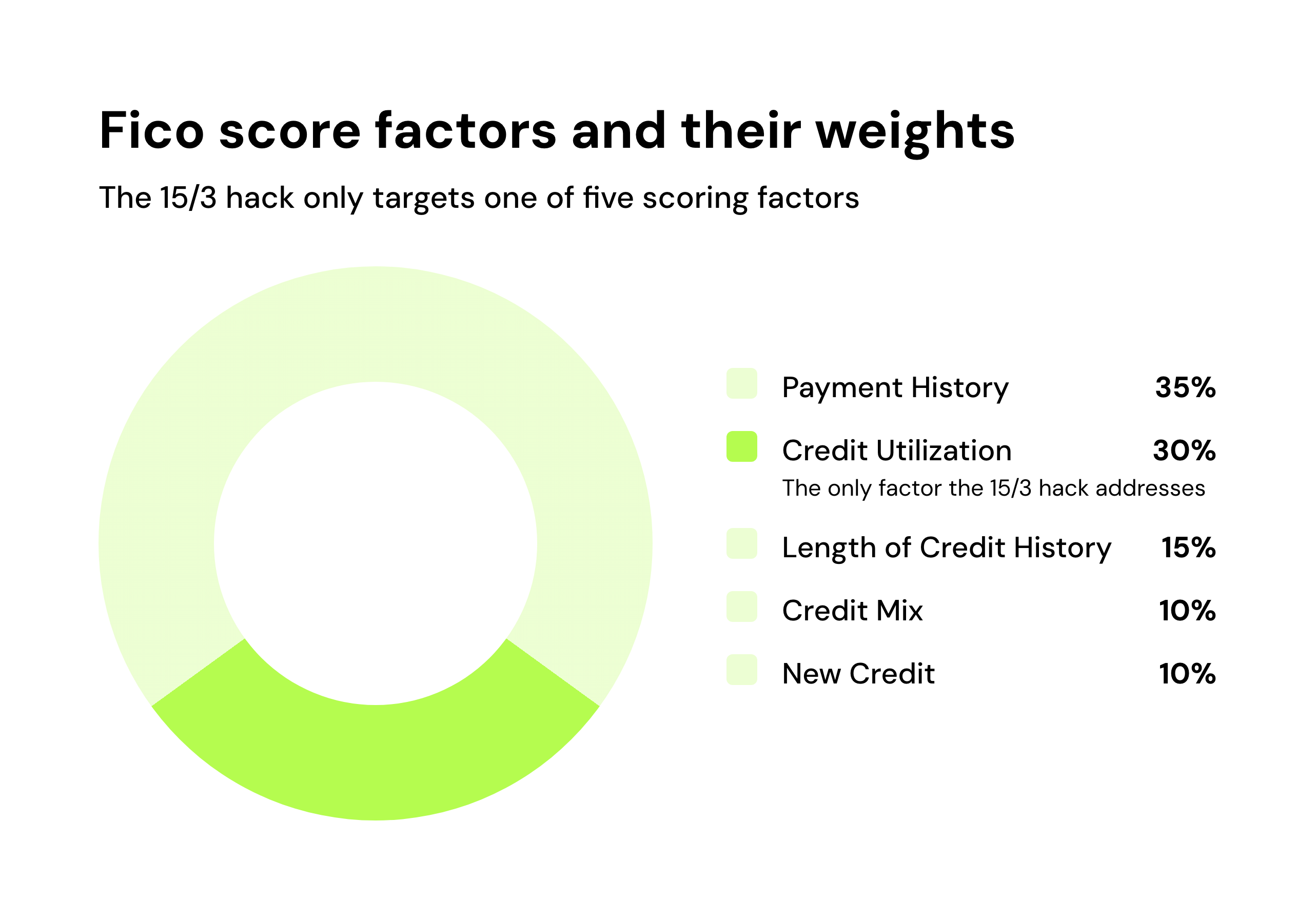
Credit utilization is effectively the percentage of your available revolving credit that you're currently using. It is the second most important factor in your credit score, making up 30% of your FICO score. This means that lowering your reported balance before your statement closes can directly reduce your utilization, which can nudge your score upward.
This said, the 15/3 hack is not magic. It does not change how much you spend, and it does not permanently improve your credit. It is essentially a timing strategy, not a credit-building strategy.
Here is what determines whether it actually moves your score:
- Your card issuer must report your balance to the credit bureaus on or near your statement closing date, which most do
- Your utilization must actually be high enough that reducing it would matter
- Your score must be sensitive to utilization in the first place, which it generally is if you carry balances
If your utilization is already low, say under 10%, the 15/3 hack is unlikely to produce any meaningful change.
How credit utilization works
Credit utilization is one of the single most impactful levers you have in managing your credit score on a month-to-month basis.
Utilization is calculated by dividing your current credit card balance by your total credit limit. The formula is: (current balance / total credit limit) x 100 = utilization percentage. So if you have a $1,000 limit and carry a $300 balance, your utilization is 30%.
Lenders generally view utilization above 30% as a signal that you may be over-relying on credit, which can ding your score. Keeping it below 30% is the standard recommendation, but the lower the better, especially if you're targeting scores above 740.
Your utilization is not a running average. It is a snapshot, specifically the balance your card issuer reports to the bureaus, which usually happens around your statement closing date. This is where the 15/3 logic comes in.
Basically, if you pay down your balance before that snapshot is taken, your reported utilization will be lower, even if you spent heavily earlier in the month.
How to use the 15/3 method
The 15/3 method is straightforward to implement once you know your statement closing date.
Every credit card has a billing cycle with a closing date, which is the day your issuer tallies your balance and generates your statement. That reported balance is what most lenders send to the bureaus. You can usually find your closing date in your card's app or on your most recent statement.
Once you have that date, here's how to apply the strategy:
- Make a payment 15 days before your closing date to pay down a chunk of your balance
- Make a second payment 3 days before your closing date to bring the balance as low as possible
- The balance remaining on your closing date is what gets reported, so the lower, the better
Just make sure you are not missing your actual due date in the process. Your minimum payment due date and your statement closing date are two separate things, and missing a due date will hurt your score far more than any utilization trick can help it.
Does it actually impact your credit score?
It can, but the impact is usually temporary and context-dependent.
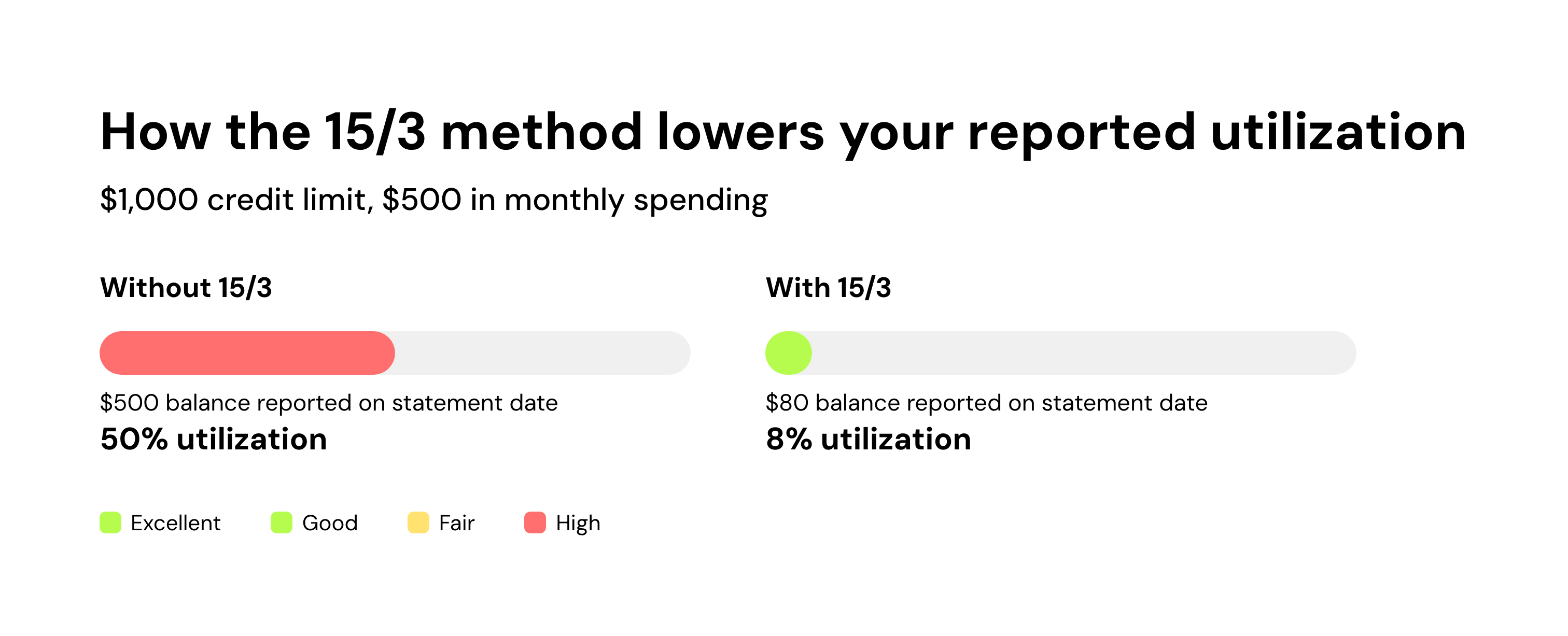
Every individual who has a high utilization rate heading into their statement closing date stands to benefit from the 15/3 approach. If you typically carry a $500 balance on a $1,000 limit, that is 50% utilization. By paying it down to $80 before closing, you drop to 8%, which can meaningfully lift your score for that reporting cycle.
This said, the effect resets every month. If you spend heavily again in the next cycle and repeat the same pattern, your score will reflect that same pattern. The 15/3 hack does not create a lasting change; it just optimizes the timing of your snapshot.
It is also worth noting that FICO and VantageScore weight utilization slightly differently. FICO gives utilization more weight overall, so this strategy is generally more useful for borrowers being evaluated on FICO-based pulls, be it a mortgage, auto loan, or credit card application.
For most people, the more durable strategy is simply spending less relative to your limit and paying in full whenever possible.
Smarter ways to build credit long-term
The 15/3 method is a useful tactic, but it is not a credit-building strategy on its own.
Long-term credit health comes from consistently addressing the five factors that determine your score: payment history, credit utilization, length of credit history, credit mix, and new credit inquiries. The 15/3 hack touches utilization only, and only for the cycle in which you apply it.
Here are the habits that will actually compound over time:
- Paying your full statement balance every month, not just the minimum
- Keeping your credit utilization below 30%, ideally below 10%
- Keeping your oldest accounts open to protect your length of credit history
- Avoiding multiple hard inquiries in a short window
- Diversifying your credit mix over time
One convenient way to add a credit-building tradeline to your profile is with Kikoff.
Kikoff gives you access to a revolving credit account that reports to all three major bureaus, Equifax, Experian, and TransUnion, targeting both payment history and credit utilization simultaneously. Unlike a credit-builder loan, which only builds payment history while locking up your funds, a credit account through Kikoff works on two of the five factors at once.
Luckily, getting started with Kikoff takes just a few minutes and starts at $5 a month.
When the 15/3 method is worth using
There are specific situations where applying the 15/3 hack makes a lot of sense.
If you are preparing to apply for a mortgage, car loan, or any other credit product within the next 30 to 60 days, your credit score at the moment of that application is what counts. In that window, using the 15/3 method to temporarily lower your reported utilization can be a super practical move. Even a 10 to 15 point lift can push you into a better interest rate tier.
It is also worth using if you had an unexpectedly high-spend month, be it a home repair, travel, or a large purchase, and you do not want that balance to drag your score before the cycle closes.
Every individual who regularly monitors their credit and knows their statement closing date can use this method opportunistically, not as a default habit, but as a targeted tool for high-stakes credit moments.
Conclusion
The 15/3 credit card payment hack is a real strategy with a legitimate basis in how credit utilization is reported.
It works by timing your payments to ensure your balance is as low as possible when your card issuer reports to the credit bureaus. Used correctly, it can temporarily reduce your utilization and give your score a modest lift, especially in the weeks before a major credit application.
That said, it is a tactical move, not a long-term solution. The foundation of a strong credit score is still consistent on-time payments, low utilization, and a diversified credit profile built over time. For a more structural approach to build credit, Kikoff makes it easy to add a reporting tradeline that works on multiple credit factors at once, starting at just $5 a month.
Frequently Asked Questions
About the editor

Disclaimer: The information provided in this blog post is meant for informational purposes only and does not constitute financial advice.