






Charge cards have been around for decades, but lots of people still confuse them with credit cards.
While they look nearly identical and are accepted at most of the same places, the two products work pretty differently under the hood.
Understanding those differences is a no-brainer before you decide which type of card belongs in your wallet.
What is a charge card?
A charge card is effectively a payment card that allows you to make purchases on credit, with the requirement that you pay your full balance at the end of every billing cycle.
Unlike a credit card, a charge card does not allow you to carry a revolving balance from month to month.
This means there is generally no preset spending limit, no interest charges, and no minimum payment option.
Every individual who holds a charge card is expected to pay what they spent in full, usually within 30 days.
If you fail to do so, the card issuer will typically charge a late fee, and in some cases, your account may be suspended.
The most well-known charge card products have historically come from American Express, which offered some of its earliest flagship cards as charge products rather than revolving credit lines.
Charge cards vs. credit cards
The single most important distinction between a charge card and a credit card is how balances are handled.
With a credit card, you can pay a minimum amount each month and carry the rest of your balance forward, though interest accrues on whatever you leave unpaid.
A charge card requires the full balance, every time, no exceptions.
Because charge cards don't carry a revolving balance, they usually don't factor into your credit utilization ratio the same way a credit card does.
Credit utilization, which is primarily the percentage of your available revolving credit that you're using, accounts for around 30% of your FICO score.
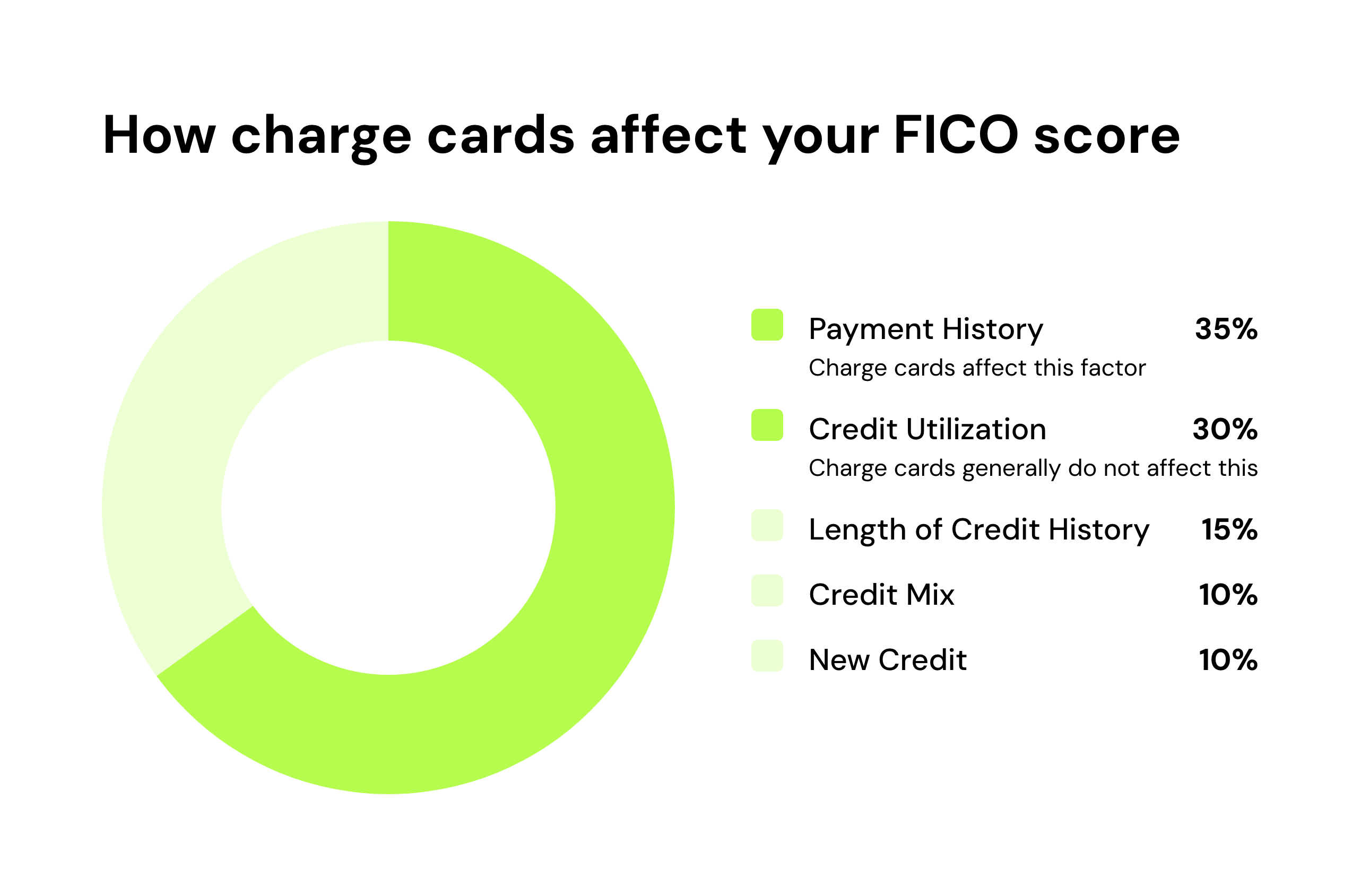
This said, charge cards still report to the credit bureaus and can contribute positively to your payment history, which is the single most important factor in your credit score at 35%.
How charge cards affect your credit
Every individual who uses a charge card responsibly can benefit from the payment history it builds.
Since you're required to pay in full each month, charge cards essentially force good payment habits, which paints a picture of reliability to lenders over time.
Because there's no revolving balance reported, your credit utilization ratio stays untouched by charge card activity, which can actually be a mild advantage if you're trying to keep utilization low.
Luckily, this also means you won't accidentally hurt your utilization score by spending a lot in a given month on a charge card the way you might on a credit card.
That said, charge cards don't help you build credit utilization history, which is a factor that becomes relevant when lenders assess how you manage revolving debt.
If building credit is your main goal, a credit account or secured credit card is generally a more effective starting point since they directly impact both payment history and credit utilization simultaneously.
Build credit with Kikoff, no hard credit check to sign up.
Who is a charge card best suited for?
Charge cards are mainly designed for people who already have strong financial habits and spend enough to benefit from premium rewards programs.
The "no preset spending limit" feature sounds appealing, but it doesn't mean unlimited spending. Issuers still monitor your activity and can decline transactions that fall outside your typical patterns.
A charge card is basically a good fit for someone who pays off their balance every month anyway and wants the flexibility of a higher spending ceiling without worrying about carrying debt.
Business owners, frequent travelers, and high earners are the most common charge card users, be it a corporate card for large recurring expenses or a travel card loaded with perks like airport lounge access and concierge services.
If you tend to carry a balance month to month, a charge card is likely not the right fit, since the requirement to pay in full could create financial stress or result in repeated late fees.
Are there any downsides to charge cards?
One of the most common downsides is the annual fee.
Charge cards, especially premium ones, usually come with annual fees that range from $95 to several hundred dollars per year.
This means you need to get enough value from the card's rewards or perks to justify that cost, which makes them less practical for lots of everyday consumers.
Another downside is the rigid full-payment requirement. Life happens, and having no option to carry even a small balance in an emergency can put you in a tough spot.
Charge cards also tend to have stricter approval requirements, making them harder to qualify for if you're newer to credit or still building your credit history.
How charge cards compare to the 3 types of credit
Charge cards fall into the "open credit" category — the third type alongside revolving and installment credit. Unlike revolving credit cards that let you carry a balance or installment loans with fixed payments, open credit requires full payment each cycle. Understanding how to avoid high costs matters too — learn how to avoid credit card interest if you use revolving credit alongside a charge card.
Conclusion
A charge card can be a super useful financial tool, but it's not the right fit for everyone.
It rewards disciplined spenders with flexibility, rewards, and a clean credit utilization slate, but it also demands consistent full payment and often comes with a steep annual fee.
If you're just starting your credit journey or want a tool that builds both payment history and credit utilization at the same time, a credit account is generally the smarter first step.
Start building a positive credit history with Kikoff, with no hard credit check required to sign up.
Frequently Asked Questions
About the editor

Disclaimer: The information provided in this blog post is meant for informational purposes only and does not constitute financial advice.