







Tier 1 credit is what many lenders call their top group of borrowers, the people who get offered the lowest rates and best terms. It isn’t an official label: Each lender decides where its own Tier 1 starts, which score it uses to decide, and what else it weighs.
If you’re new to credit, “Tier 1” can sound like a mysterious club with a locked door, but it’s not a permanent status. Your tier is set when you apply, mostly from what’s in your credit report, and that report changes as new payments are added to your file. And if your report gets you worse terms than a lender gives many of its customers, federal rules generally require it to tell you.
What Tier 1 credit means
Lenders sort applicants into tiers so they can price risk, and Tier 1 is the top. Lower tiers may come with a higher interest rate, a bigger down payment, or a smaller credit limit. You’ll hear the term most often when you shop for a car loan.
Your credit score is a big part of where you land, but it’s usually not the only factor. A lender may also look at your income, your current debts, the loan amount, and the type of loan you’re applying for.
What credit score counts as Tier 1?
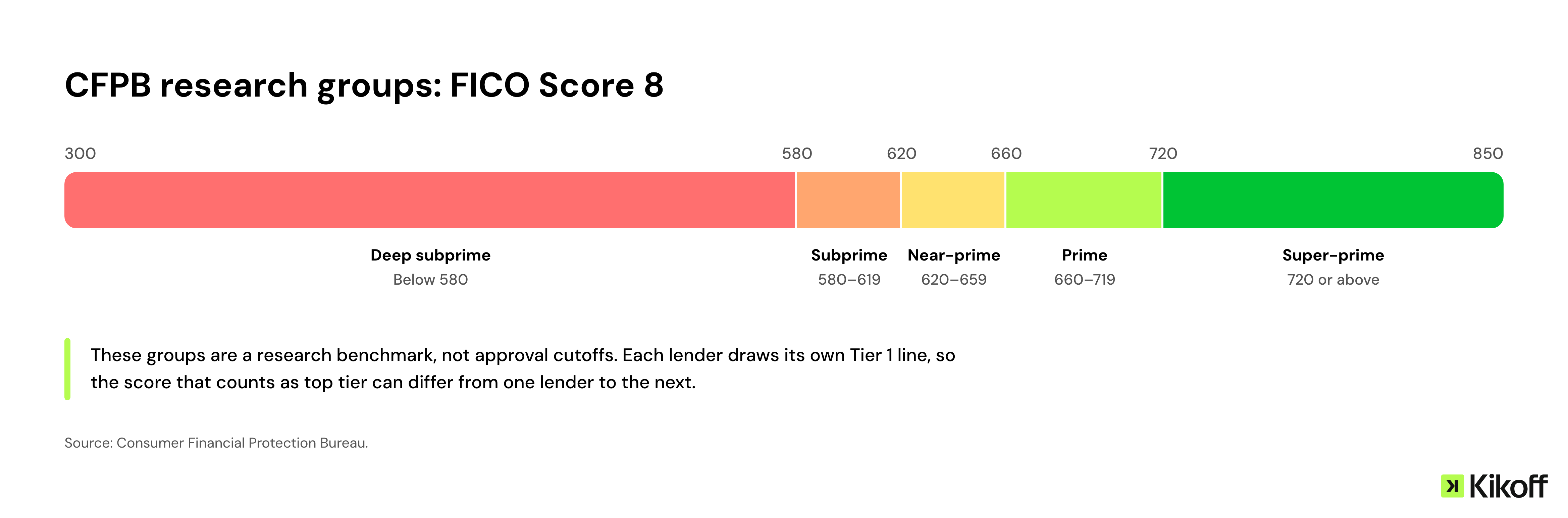
There’s no single number. The closest public benchmark comes from the Consumer Financial Protection Bureau (CFPB). In its auto loan research, the CFPB sorts borrowers into five risk groups based on FICO Score 8.
These are research groups, not a rate sheet. A lender’s Tier 1 might start higher or lower than the super-prime line, so ask which score range gets the best rate and which score it uses.
Read more >> What is a subprime credit score?
Why your score might not match the lender’s
You don’t have just one credit score. Your number can change depending on the scoring model and which bureau’s data goes into it.
The two big names are FICO and VantageScore. Base FICO Scores and VantageScore 3.0 use a base range of 300 to 850. But the same range doesn’t mean the same number. Two models can read the same report and land on different scores.
Some lenders use a different kind of score altogether. FICO’s industry-specific scores, such as those built for auto lending, range from 250 to 900. FICO also says it’s up to each lender to decide which score it uses.
Your banking or credit scoring app might show a VantageScore from one bureau, while a car lender pulls a FICO Auto Score from another. Ask the lender which score and bureau it checks before you apply.
Read more >> How to Save Up for a Car
What missing Tier 1 can cost
Tiers matter most for price. Here’s the same $20,000 car loan over 60 months at two example APRs. These aren’t market rates, just round numbers to show the math.
That’s about $39 more a month, or roughly $2,330 more over the loan, for the same car.
You don’t have to guess where you landed. If a lender uses your report to give you terms “materially less favorable” than the best terms it gives a substantial share of its customers, it generally has to send you a risk-based pricing notice. When a score helped set your terms, the notice must show that score, the model’s range, the company that supplied it, and the main factors that pulled it down.
Some lenders skip the notice and give every applicant a credit score disclosure instead, which shows your score, its range, and how it compares with other people’s scores. Either way, carefully read it.
Run the numbers >> Kikoff’s auto loan calculator shows what a rate difference costs on the car you’re after.
How to move toward a better tier
- Check your reports for free first. You can see your Equifax, Experian, and TransUnion reports once a week at AnnualCreditReport.com. Checking your own report doesn’t hurt your score. If you find an error, you can dispute it for free with the bureau showing it. If you’d rather not draft dispute letters yourself, Kikoff’s AI Credit Disputes can help you challenge the errors.
- Pay on time every month. If you’ve missed a payment, the on-time months that follow still count.
- Keep balances low compared with your limits. Lenders look at how much of your available credit you’re using. For example, a $300 balance on a $1,000 limit is 30%. Paying it down to $100 brings it to 10%.
- Shop for rates in a short window. For auto loans, the CFPB says lender checks generally count as a single inquiry within 14 to 45 days of each other. Newer FICO versions use any 45-day span and older ones 14 days, so two weeks is the safe bet.
- Ask about the tier before you sign, and what your rate might be one tier up.
Red flags before you pay anyone. Be wary of anyone who promises to get you into Tier 1 or promises a specific score or point gain by a certain date. Under the federal Credit Repair Organizations Act, companies that charge to work on your credit report can’t make you pay until they’ve done the work they promised. You can dispute errors on your reports yourself for free, and accurate information generally stays on your report no matter who you pay. If someone asks for money upfront, report it to the FTC at ReportFraud.ftc.gov or file a complaint with the CFPB.
Bottom line
Tier 1 credit is each lender’s label for its best price, and no single score unlocks it everywhere. But a lender can only tier you on what’s in your report. If your file is thin, there isn’t much on-time history to judge, and that can cost you on both approval and price. That’s why it helps to build credit before you apply. Kikoff’s Credit Account reports your on-time payments to all three credit bureaus, with no credit check to sign up. Plans start at $5 a month.
Frequently Asked Questions
Article Sources
Disclaimer: The information provided in this blog post is meant for informational purposes only and does not constitute financial advice.