
A car’s book value is an estimate of what it’s worth right now, from a pricing guide like Kelley Blue Book, Edmunds, or J.D. Power. It’s built from your car’s year, make, model, trim, mileage, condition, and ZIP code. There’s no single book value, though. The same car has a trade-in, a private-party, and a retail value, and the one that counts depends on who’s buying.
Why your car has more than one book value
Each buyer is paying for something different. A dealer taking your trade-in has to recondition the car and resell it at a profit, so it offers less. A private buyer skips the middleman. A dealer’s retail price covers its costs and any warranty it adds.
How to look up your car’s book value
Looking up your car’s value is free and doesn’t affect your credit.
- Start with your vehicle identification number (VIN). It’s on your registration and insurance card, and usually on the dashboard by the windshield on the driver’s side. The VIN helps the guide match your exact trim and options.
- Next, enter your exact mileage and ZIP code, since values shift by region.
- Pick the condition a buyer would see, counting dings, worn tires, and warning lights. An optimistic rating gives you a number nobody will pay.
- Then check at least two guides, since each uses its own data. Write down the trade-in and private-party values from each.
- Finally, compare those numbers with local listings for the same model, year, and mileage. That’s your car’s market value, or what cars like yours are selling for near you.
Book value vs. what you still owe
If you’re still paying off the car, ask your lender for your payoff amount, or what it would take to close the loan today. Then compare it with your trade-in or private-party value.
Here’s an example. Your payoff amount is $14,000, and your trade-in value is $11,000. You owe $3,000 more than the car is worth. That $3,000 is called negative equity.
A dealer may offer to add that leftover balance to your new loan, which makes the loan bigger than the car it pays for. The CFPB found that borrowers who rolled negative equity into a new loan were more likely to have their accounts assigned to repossession.
If you’re in this spot, you can:
- Keep the car and keep paying, so your balance can catch up with its value.
- Pay the difference in cash when you trade in, if you’re in a position to.
- If you roll it in, ask the dealer to show the negative equity on the contract and how it changes your payment and loan length.
If your car is totaled, your insurance company usually pays what the car was worth just before the crash, not what you owe. Gap insurance is optional coverage that can pay the difference. Ask your insurer and lender whether you already have it before you buy it at the dealership.
Where your state’s rules come in
Some states build guide values into their own rules, and those rules vary.
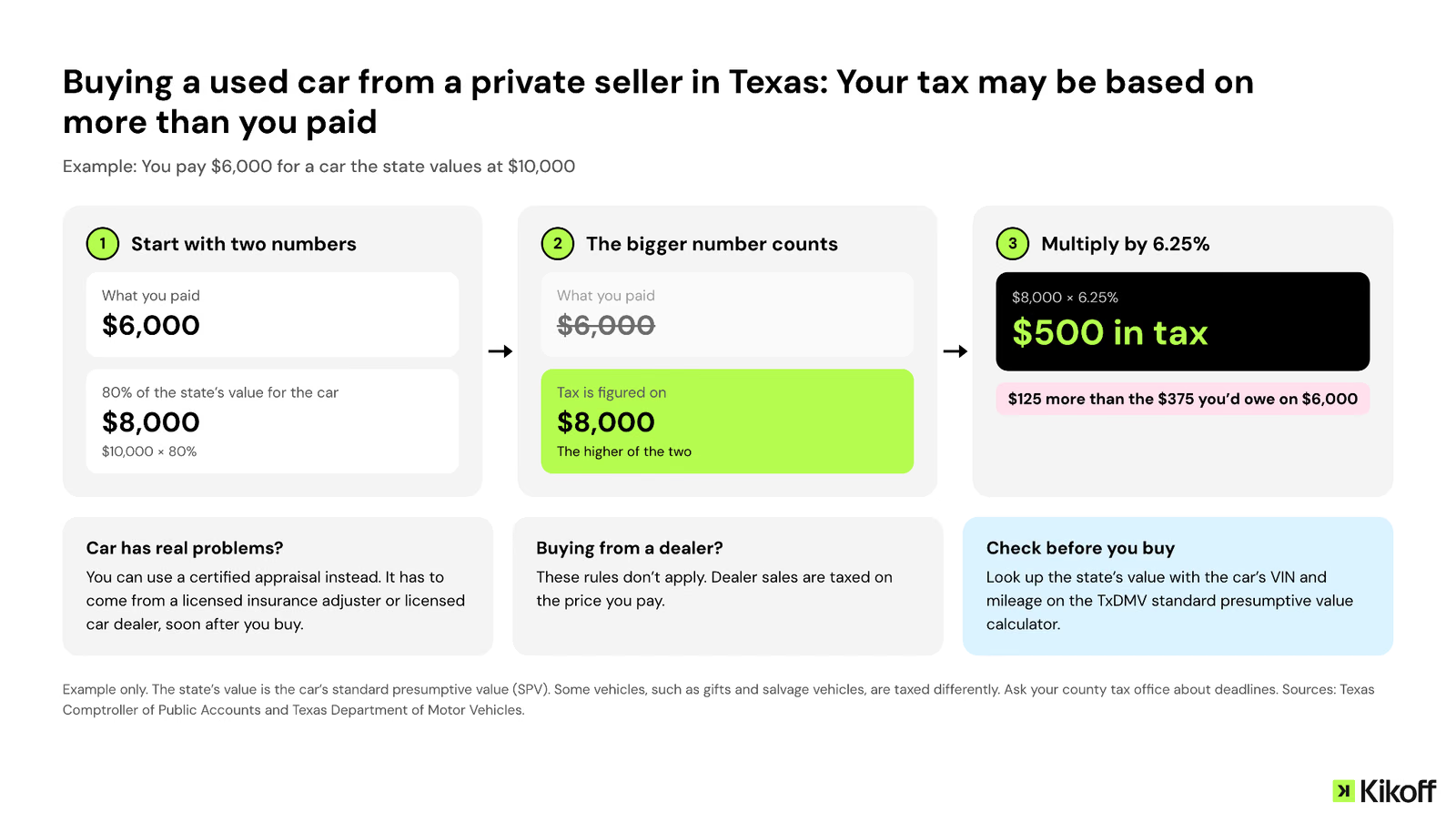
- Taxes on a private sale. In Texas, when you buy a used car from a private seller, sales tax is based on the greater of the price you paid or 80% of the car’s standard presumptive value. That’s a state value drawn from Black Book’s average wholesale prices, and the tax rate is 6.25%. Say you pay $6,000 for a car with a standard presumptive value of $10,000. Tax is figured on $8,000, so you’d owe $500 instead of $375. If the car has real problems, you can use a certified appraisal instead. It has to come from a licensed insurance adjuster or licensed car dealer, within 20 working days of purchase. These rules don’t apply to dealer sales.
- Title transfers. Each state sets its own forms, fees, and deadlines. Before you buy or sell privately, check your state’s motor vehicle agency website for what the buyer and seller each need to file.
- Repossession. If a financed car is repossessed, the lender sells it, and the sale price decides what’s left on your loan, not the book value. In most states, the lender can sue for the deficiency, the difference between what you owed (plus certain expenses) and the sale price, if it followed the rules for repossession and sale. If the car sells for more than you owe, you’re entitled to the surplus. Some states let lenders repossess without warning after a missed payment, while others require notice.
Behind on payments? Call your lender as soon as you can and ask whether it can move your due date or defer a payment. A payment 30 or more days late can show up on your credit reports, so calling early protects your credit as well as your car.
- Know your state’s rules: Your state attorney general or consumer protection office can explain them for free.
- Get counseling: The National Foundation for Credit Counseling (NFCC) can connect you with free or low-cost debt counseling at 800-388-2227.
- Facing a deficiency lawsuit? Talk with a licensed attorney.
Bottom line
Your car’s book value is a starting estimate, and the version that counts depends on how you’re selling or buying. The car’s value sets how much a lender will lend against it, but your credit history helps decide the rate you pay. Kikoff’s Credit Account reports your on-time payments to all three credit bureaus, so you can build that history in your own name before your next car loan application. There’s no credit check to sign up, and plans start at $5 a month.
Frequently Asked Questions
Article Sources
Disclaimer: The information provided in this blog post is meant for informational purposes only and does not constitute financial advice.