



Risk-based pricing is how lenders decide what to charge you. Two people can apply for the same car loan on the same day and get different interest rates. The lender looks at each person’s credit history and prices in how likely it thinks each one is to pay on time.
Lenders typically save their lowest rates for borrowers with long, clean credit histories, and the difference between tiers can add up to thousands of dollars over a loan. If a lender charges you more because of your credit report, it generally has to tell you, and you can check that report for free.
How risk-based pricing works
Lenders typically sort applicants into pricing tiers, then attach a rate, fees, or a down payment requirement to each tier. To decide where you land, a lender typically looks at:
- Your credit scores and the credit reports behind them
- Your payment history, including any late payments, collections, or bankruptcy
- How much of your available credit you’re using
- Your income and how much of it already goes to debt payments
- The loan itself, such as its length, the down payment, and whether a car or home secures it
Each lender sets its own tiers and cutoffs, so the same credit history can get a different offer from each lender you try.
What one tier can cost
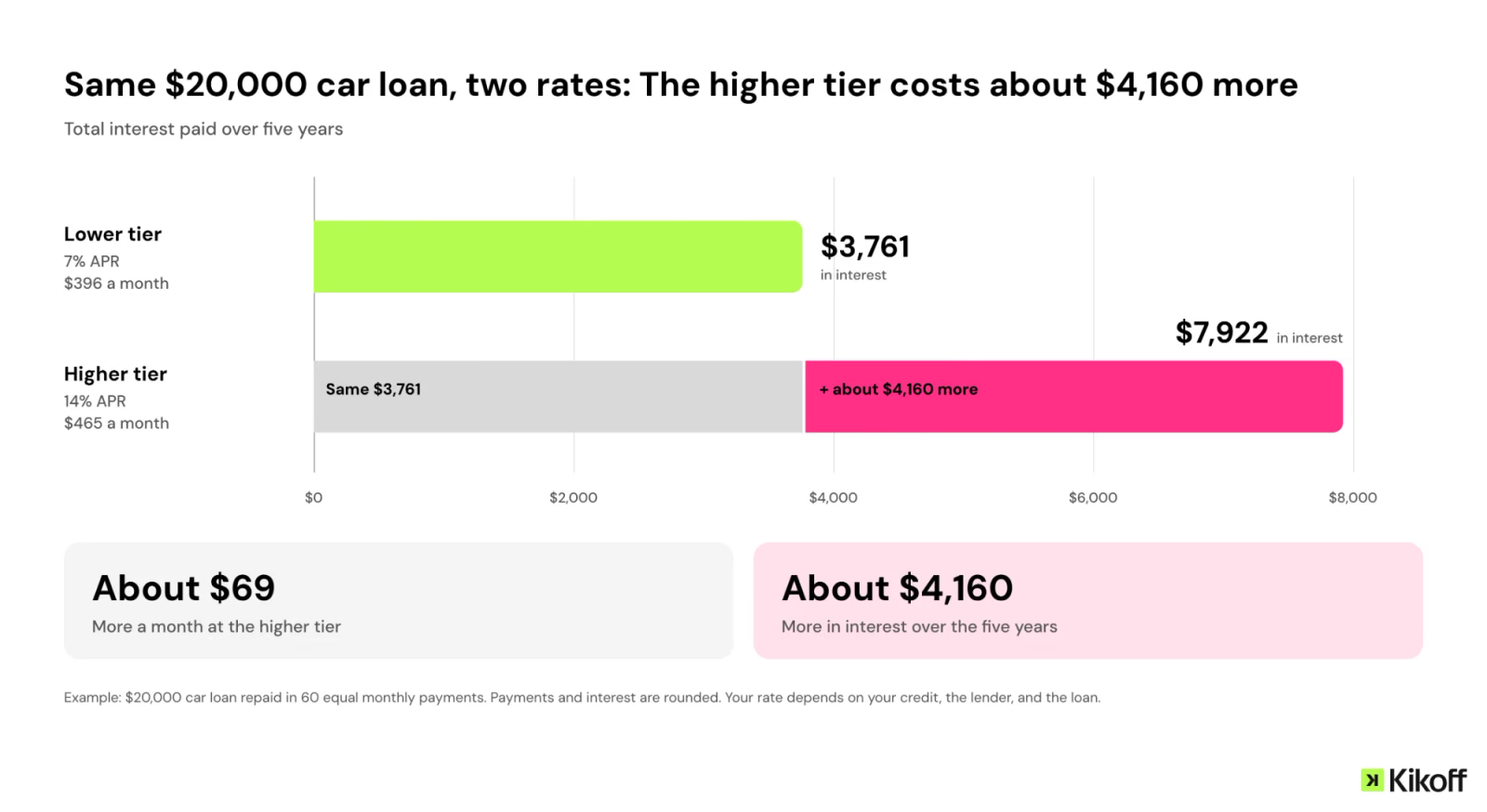
Here’s a $20,000 car loan paid over five years at two example rates.
In this example, the higher tier costs about $69 more a month and about $4,160 more over the five years.
Read more >> The Impact of Credit Scores on Auto Loans
The risk-based pricing notice
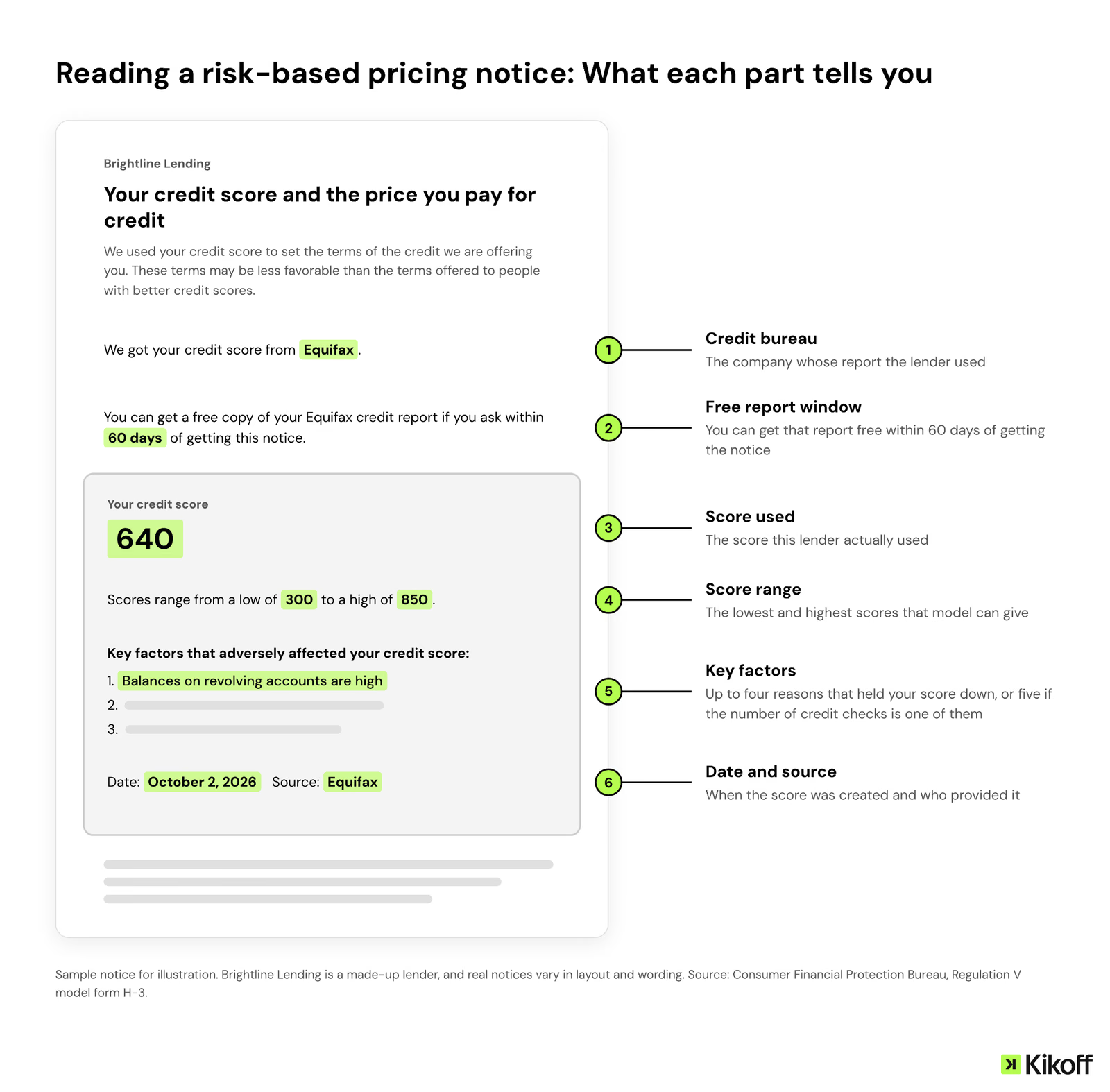
Under Regulation V, the federal rule that carries out part of the Fair Credit Reporting Act, a lender generally has to send you a risk-based pricing notice when it uses your credit report to give you terms that are worse than the best terms it gives a large share of its customers. The rule also covers an existing account: if a lender reviews your credit report and raises your APR because of it, it generally owes you a notice, either when it tells you about the increase or within five days after the new rate starts.
Some lenders decide who gets a notice with a score cutoff. The rule has them set it where about 40% of their borrowers score higher and about 60% score lower, then send a notice to everyone below the line. That’s a wide group, so a notice by itself doesn’t mean your credit is poor.
For a loan, the notice comes after you’re approved but before you sign. For a credit card, it comes before you first use the card. Read it before you commit.
If you get a different notice
You might get something else instead. If you’re denied, you get an adverse action notice, and you still have 60 days to request a free report from the bureau it names. Some lenders, typically mortgage lenders, instead send every applicant a credit score disclosure showing your score and how it compares with other people’s scores.
Got a notice? Before you sign, pull your free reports at AnnualCreditReport.com. You also have 60 days to request the specific report in the notice. Checking your own report doesn’t affect your scores.
What to do if you get a higher rate
Start with the free path, and work through it in order:
- Get the report the lender used. Request the free copy named in the notice within 60 days. You can also get free reports from all three bureaus every week at AnnualCreditReport.com.
- Check the key factors against the report. Look for an account you don’t recognize or a late payment you didn’t make. If you find an error, dispute it for free with the bureau and the company that reported it. Kikoff’s AI Credit Disputes is included at no extra cost for Kikoff members and works on inaccurate items only.
- Compare other lenders in a short window. For auto loans, mortgages, and student loans, the CFPB suggests keeping your shopping within 14 to 45 days so the credit checks count as one inquiry. Older FICO versions use 14 days and newer ones use 45. You usually won’t know which version a lender uses, so aiming for 14 days covers you either way. (Credit card and personal loan applications don’t get this treatment.)
- Ask what would change your tier. A larger down payment or a shorter loan term may move you into a lower-priced tier with some lenders. Ask each lender which changes it would price differently.
Bottom line
Risk-based pricing means your credit history helps set what you pay, not only whether you’re approved. Correcting an error brings your report back to accurate, but it doesn’t add anything to it. The next lender still prices from the history it sees, and on-time payments are what build that history before you apply. Kikoff’s Credit Account reports your on-time payments to Equifax, Experian, and TransUnion, with no credit check to sign up. Plans start at $5 a month.
Frequently Asked Questions
Article Sources
Disclaimer: The information provided in this blog post is meant for informational purposes only and does not constitute financial advice.