
Credit card churning means opening new credit cards over and over to collect their sign-up bonuses, then closing them or moving on to the next offer. To earn a bonus, you usually have to spend a set amount in the first few months, and an annual fee or a few months of interest can wipe it out. Each new card also lands on your credit report as a hard inquiry and a new account, and both carry more weight when your credit history is short.
How credit card churning works
A sign-up bonus, also called a welcome offer, is cash back, points, or miles you earn after spending a set amount within a set window. Churning repeats that cycle:
- You apply for a card with a big bonus. The card company checks your credit, which adds a hard inquiry.
- You hit the spending requirement listed in the offer terms, usually within the first few months.
- You collect the bonus.
- You close the card or stop using it, often before a second annual fee comes due. Then you apply for the next one.
Card companies know about churning. Some offers exclude people who’ve had the same card before, and some let the card company take a bonus back if you close the card soon after. Read the offer details before you apply, and ask whether the bonus can be reversed if you close the account in the first year.
Is credit card churning legal?
Yes. Opening and closing credit cards isn’t against the law. Breaking an offer’s terms can still cost you: the card company can deny the bonus, take back rewards, or close your account.
If you met an offer’s terms and the bonus never showed up, contact the card company first. If that doesn’t resolve it, submit a complaint to the CFPB. In a 2024 report, the Consumer Financial Protection Bureau (CFPB) found that nearly 1 in 10 rewards dollars people earned came from sign-up bonuses, and it flagged complaints about hidden conditions on those offers.
What federal rules cover on a new card
The Credit CARD Act of 2009 and Regulation Z, the federal rule that carries it out, protect you on every new card, including the ones churners open:
- Ability to pay. The card company has to consider your income or assets and your current debts before opening an account. If you’re under 21, you need your own income or a cosigner.
- First-year fee cap. Fees you’re required to pay in the first year, such as an annual fee, can’t top 25% of your starting limit. On a $500 limit, that’s $125. Late and returned-payment fees don’t count toward the cap.
- First-year rate lock. Federal rules generally bar card companies from raising your APR in the first year, unless you fall more than 60 days behind.
- Notice before costs go up. After that, you get written notice at least 45 days before a higher APR or fee takes effect. That’s your window to decide whether to keep the card.
- Time to pay. Your statement has to be mailed or delivered at least 21 days before the due date. On a card with a grace period, paying the full statement balance by then generally means no interest on those purchases.
These rules don’t limit how many cards you can open. Bonus terms are up to each card company.
How churning affects your credit
According to FICO, new credit makes up about 10% of a FICO Score, and payment history about 35%. Churning touches both:
- Hard inquiries. For most people, one inquiry takes less than five points off their FICO Scores. Inquiries stay on your report for two years, but FICO Scores count them for one. Several applications add up.
- New accounts. FICO says opening several accounts in a short time signals more risk, especially without a long credit history. Each new card also lowers your average account age.
- How much of your credit you’re using. Spending to hit a bonus can leave a big balance on your statement, which is usually what gets reported. Closing a card removes its limit, which can push that percentage up.
- Payment history. More due dates make it easier to miss one, and a payment 30 days late can show up on your credit reports. Set up autopay for at least the minimum on every card.
Applying for a mortgage, car loan, or apartment soon? Hold off on new cards until you’re approved, so a lender doesn’t see a run of fresh inquiries.
When a sign-up bonus pays off
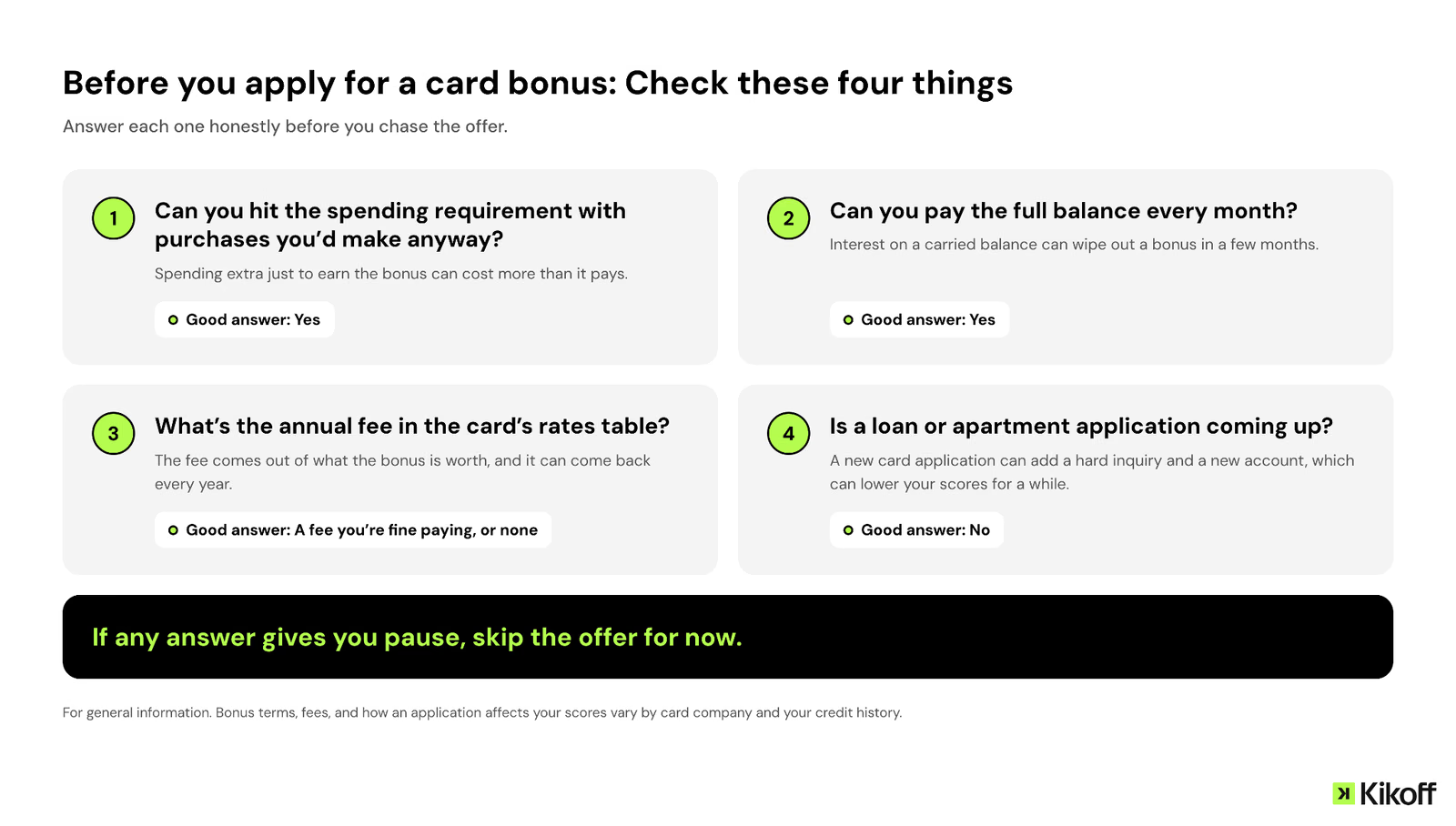
A bonus pays off when you’d spend the money anyway, pay in full, and the bonus beats the fees. This example uses a $200 bonus for spending $1,000 in three months.
The interest math: 24% a year is 2% a month, so a $1,000 balance costs about $20 a month, or about $120 over six months. Real interest depends on your daily balance. For context, Federal Reserve data put the average credit card interest rate at about 21% to 22% in the first three quarters of 2026, depending on the measure.
If you’re still building credit
The cards with the biggest bonuses usually look for good to excellent credit. With a short history, each new account and inquiry makes up a bigger share of your file. That’s not a reflection of you. It’s how scoring models read a thin file. A steadier path is one no-annual-fee card you keep for years, used lightly and paid in full.
Bottom line
Credit card churning can earn real rewards if you already have strong credit, pay in full, and track every term. It runs on new accounts and short stays, though, and lenders weigh a long record of on-time payments most. If you’re still building that record, Kikoff’s Credit Account reports your on-time payments to Equifax, Experian, and TransUnion, with no hard credit check to sign up. Plans start at $5 a month.
Frequently Asked Questions
Article Sources
Disclaimer: The information provided in this blog post is meant for informational purposes only and does not constitute financial advice.