
An insurance quote is an estimate of what a policy would cost you. The insurance company builds it from the details you give it and the coverage you choose. Asking for one is free, and it doesn’t commit you to buy anything. A quote is a starting price, though, and it’s no promise of coverage. Before your policy starts, the insurer checks records such as your driving history and, in most states, your credit. If those records don’t match what you entered, the price can go up, or the insurer can turn you down. If money is tight, a bigger bill than you planned for is the real worry, and most of those surprises trace back to a few details you can check ahead of time. Shopping around won’t cost you on the credit side, either. An insurer’s credit check is a soft inquiry, which doesn’t affect your credit scores.
What’s in an insurance quote
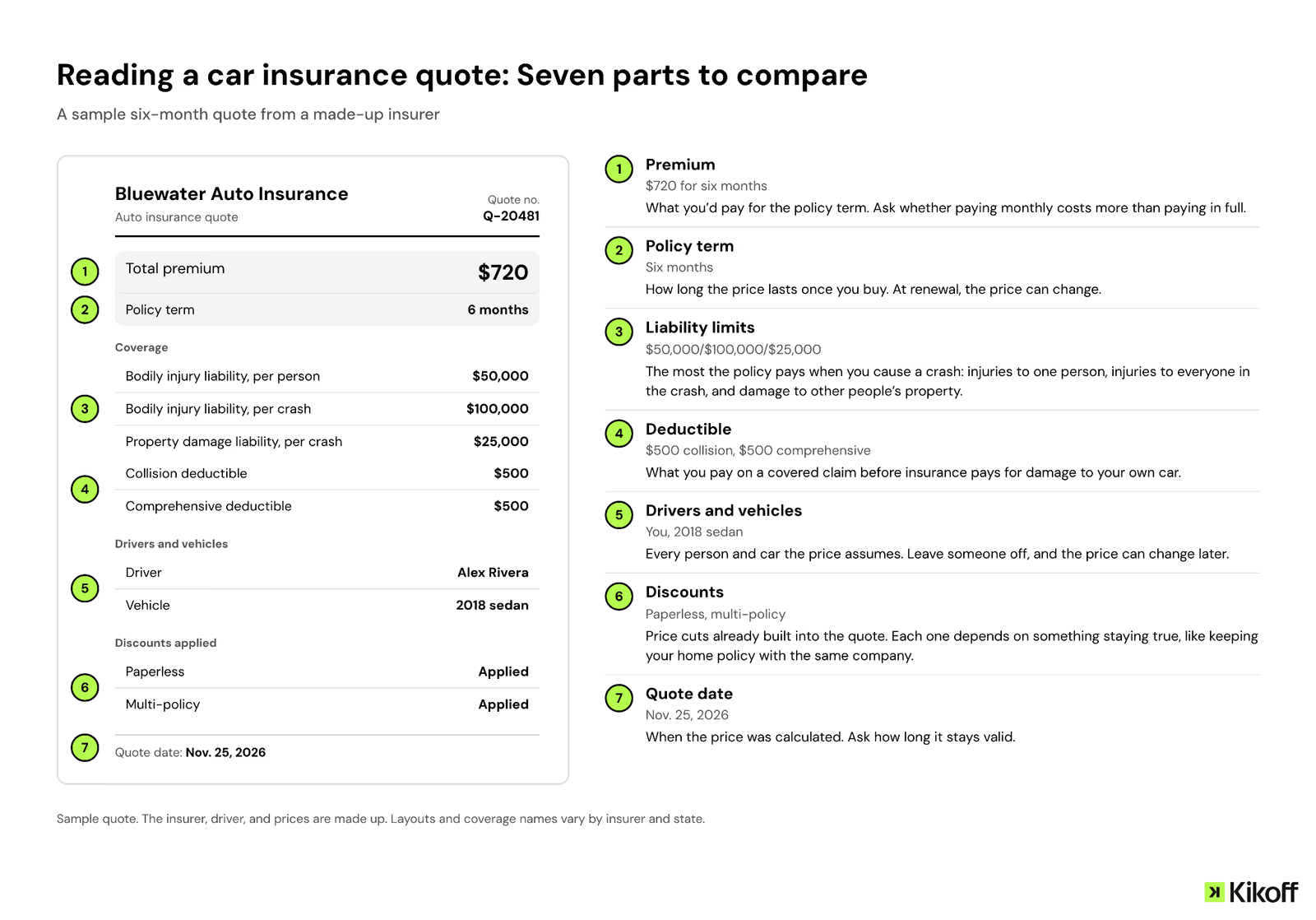
Most quotes cover the same core pieces, whether you’re pricing car, renters, or home insurance. Labels vary by company. Here’s an example of what to look for.
Once you buy, your declarations page takes over as the record of what you actually bought. It lists your drivers, vehicles, limits, deductibles, and premium. Check it against your quote line by line as soon as it arrives, so a mistake doesn’t sit there until you need to file a claim.
How a quote turns into a policy
A quote is the first of four steps, and the price or terms can change at each one.
- You ask for quotes. You can go straight to an insurance company’s website or app, call it, or work with an insurance agent. A captive agent sells one company’s policies. An independent agent can quote you from several companies. Agents are licensed by the state, and you can ask how they’re paid, so you know whether they earn more on one company’s policy than another’s.
- You apply. You confirm your details and sign. The NAIC advises you to include every driver in your quote and to disclose everything the application asks for. A missing driver or an accident you left off can change the price later.
- The insurer checks your records. That usually means your driving record, your claims history, and, where your state allows it, a credit-based insurance score.
- You get coverage. Some insurers issue a binder first, which is temporary proof of coverage until the policy is ready. Then you get the policy, a policy number, and your declarations page. The reference number on a quote usually isn’t your policy number. Your policy number is the one you’ll give for proof of insurance or when you file a claim.
Why your final price can change
A quote assumes everything you entered is right and complete. After you apply, the insurer checks for itself. These are the usual places a price moves:
- Your driving record. A ticket or accident you forgot to mention can raise the price. The NAIC notes that insurers treat drivers with past violations or accidents as higher risk.
- Your claims history. Insurers can look up past claims on your cars or home, including claims you filed with another company.
- Your credit. A credit-based insurance score is a rating built from your credit report to predict how likely you are to file a claim. FICO estimates about 95% of auto insurers and 85% of homeowners insurers use these scores in states that allow them, according to the NAIC. As of its January 2024 update, the NAIC listed eight states that ban insurers from using them to set rates or to offer or renew a policy.
- Details that changed. A new address, a different car, or a new driver in your home can each change the price.
If you’re new to credit, a thin file can cost you here even if you’ve never missed a payment. When an insurer can’t find meaningful credit history for you, Wisconsin’s insurance regulator says you may pay a higher rate. That’s not a reflection of you. It’s how risk-based pricing works when there’s little on your report to read.
Federal law gives you a way to see what happened. Under the Fair Credit Reporting Act, if an insurer raises your price, turns you down, or ends your policy based partly on your credit report, it has to tell you. That’s true even if the report played a small part, according to the FTC. The notice has to name the credit bureau that supplied the report and explain your right to a free copy from that bureau if you ask within 60 days.
If your final price is higher than your quote. Ask the insurer which detail changed. If it was your credit, request your free report within 60 days, or get all three reports free every week at AnnualCreditReport.com. Dispute anything wrong with the bureau that lists it, for free. Then ask the insurer whether it will hold off on using your credit information until the correction goes through.
How to compare insurance quotes
Prices for the same coverage can differ from one company to the next, so it pays to compare. A comparison only works when the quotes describe the same coverage. Start by deciding what you need, then walk each quote through these checks.
- Match the coverage. Line up the limits, deductibles, and drivers on every quote. If they don’t match, the NAIC suggests asking for a revised estimate so you’re comparing the same thing.
- Give every company the same details. Use the same address, vehicles, drivers, and driving history each time. The NAIC calls this crucial for a fair comparison.
- Price the deductible you’d actually pay. A lower premium often comes with a higher deductible. Pick the one you could cover after a crash without borrowing.
- Check the company. Before you buy, confirm the company and any agent are licensed in your state, and ask about complaints. You can reach your state’s insurance department through the NAIC’s directory of state insurance departments.
- Know where your information goes. Some quote websites send your details to a local agent, who then contacts you to quote and write the policy. If you don’t want calls, read the site’s privacy notice before you enter your phone number.
To see what the deductible does to your costs, take these two sample quotes for the same driver and car:
The lower-premium quote saves you $120 a year. If you file one claim, though, you’d pay $500 more out of pocket. If $1,000 would be hard to come up with on short notice, the lower-deductible quote may be the safer choice, even though it costs $60 more every six months.
Your state sets the minimum
Most states require some kind of car insurance to drive legally, according to the NAIC, and each state sets its own minimum. You’ll often see those minimums written as three numbers, like 30/60/25. That means $30,000 for one person’s injuries, $60,000 for everyone’s injuries in one crash, and $25,000 for other people’s property, all when you cause the crash.
Three states show how far apart the minimums can be as of November 2026:
California’s minimum comes from the California Department of Insurance, and Texas’ minimum comes from the Texas Department of Insurance. Virginia raised its minimum for policies that take effect on or after Jan. 1, 2025. Policies before that needed $30,000/$60,000/$20,000.
States differ in other ways, too. Some let you show financial responsibility without a policy. In California, for example, you can deposit $75,000 with the DMV or get a $75,000 surety bond instead. States also choose between a no-fault system and a fault-based one, and they set their own rules on how insurers can use your credit. Before you compare quotes, check your state insurance department’s website for its current requirements.
A state minimum is a legal minimum, not a recommendation. If you cause a crash and the costs run past your limits, you could owe the rest yourself. If you’re financing or leasing a car, your lender may also require more, such as collision and comprehensive coverage. Some quotes offer gap insurance too. It can cover the difference between what you still owe on the car and what it’s worth if it’s totaled or stolen. Ask your lender what it requires before you shop, so every quote includes it.
Quotes for other kinds of insurance
The idea is the same for every type of coverage. What changes is the information each quote leans on.
- Renters and homeowners insurance: where the home is, what you want covered, how much coverage you choose, and the deductible. For homeowners insurance, the insurer may also want to inspect the home.
- Life insurance: your age, health, the amount of coverage, and how long you want it. Some policies require a medical exam before the price is final.
- Health insurance: your age, where you live, whether you use tobacco, and the plan you pick. Each quote then shows the monthly premium, deductible, and out-of-pocket maximum.
- Short-term car coverage: if you only need a car covered for a few weeks, ask each company about its shortest policy term and whether you can cancel early and get back the unused premium.
Whatever the type, the limits and deductible on your quote decide what happens when you file a claim. Read them as what you’d pay, and what the insurer would, if something went wrong.
Bottom line
An insurance quote is a free estimate of what a policy would cost, and it can change once the insurer checks your records. Matching the coverage, checking the company, and knowing your state’s minimum make quotes fair to compare. Shopping around can’t change one input, though. In most states, your credit report can help set the price, and a thin file may mean a higher rate. Kikoff’s Credit Account reports your on-time payments to Equifax, Experian, and TransUnion, with no credit check to sign up, so the reports insurers read can start to show a payment record in your name. Plans start at $5 a month.
Frequently Asked Questions
Article Sources
Disclaimer: The information provided in this blog post is meant for informational purposes only and does not constitute financial advice.