
A preapproved credit card offer means a card company looked at your credit report and decided you fit the profile it wants for a card. Federal law calls it a prescreened offer, or a “firm offer of credit.” You still have to apply, the card company can check your credit again, and your rate can land anywhere in the range the offer lists. Opening the envelope won’t hurt your credit. The screening behind it is a soft inquiry, which doesn’t affect your credit scores.
How card companies pick you for an offer
A card company starts by deciding who it wants to reach. It might set criteria such as a minimum credit score. A credit bureau then pulls a list of people whose credit reports match, and those people get the offer.
That screening is a soft inquiry, which doesn’t affect your scores. A hard inquiry happens only if you decide to apply.
Two groups tend to see fewer of these offers:
- People under 21. Federal law bars the credit bureaus from putting you on prescreened lists before 21 unless you agree to it. The Credit CARD Act of 2009 added that rule.
- People with short credit histories. A card company’s filter can only work with what’s on your credit report, and that’s common if you’ve mostly paid with cash or debit.
What is a firm offer of credit?
A firm offer of credit is the legal name for a prescreened offer under the Fair Credit Reporting Act (FCRA). Under the FCRA, it’s an offer the card company has to honor if you meet the criteria it used to pick you. It can still say no if you don’t meet one of three conditions it set before picking you:
- Your application meets its standards, such as a minimum income.
- You still match when it checks your credit again.
- You provide any collateral the offer disclosed, such as a deposit for a secured card.
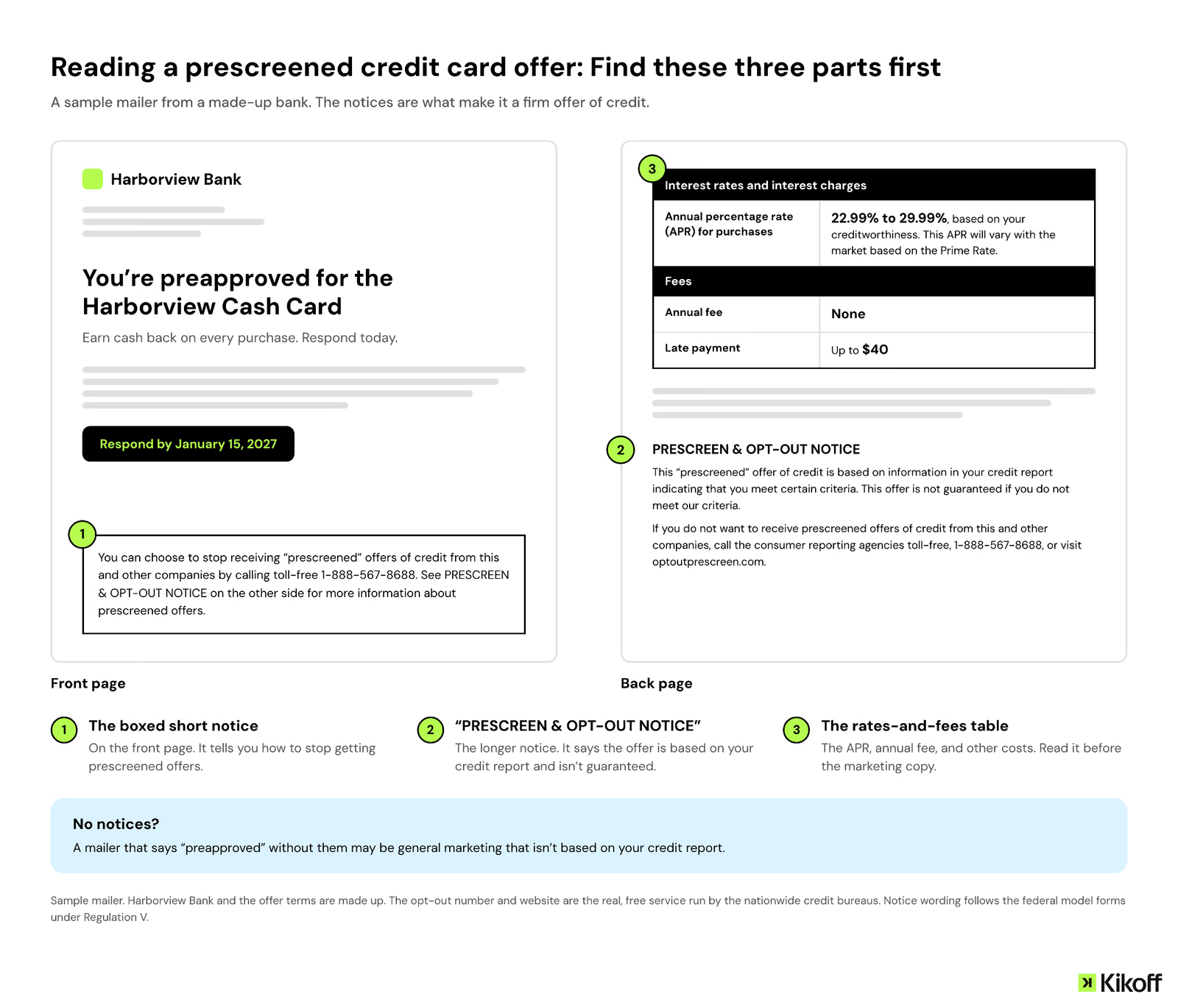
Every written prescreened offer has to include a notice explaining your right to opt out: a short version on the front of the first page, printed larger than the surrounding text and set apart in bold, italics, underlining or a different color, and a longer one headed “PRESCREEN & OPT-OUT NOTICE.” A mailer that says “preapproved” without it may be general marketing that isn’t based on your credit report.
Preapproved vs. prequalified
Neither word appears in the FCRA, and card companies use them in different ways. Who starts the process and which credit check it uses tell you more than the label.
What to check before you apply
Under Regulation Z, the federal rules for credit cards, a mailed card offer has to include a table of key rates and fees, often called the Schumer box. When your rate depends on your credit, the card company can show a range of rates instead of one number, but it can’t show only the lowest rate.
The Credit CARD Act of 2009 added protections that apply to new cards, including ones from a preapproved offer:
- The card company has to check that you can pay. It must consider your ability to make the minimum payments, usually by asking about income. If you’re under 21, you need your own income or a cosigner who’s at least 21.
- First-year fees have a ceiling. The fees you’re required to pay in the first year can’t top 25% of your starting credit limit. On a card with a $300 limit, that’s $75. Late fees and returned-payment fees don’t count toward the ceiling.
- Your rate generally can’t go up in the first year. Federal rules limit APR increases in the first year after you open the card. Exceptions include an intro rate of at least six months ending, a variable rate moving with its index, and a payment more than 60 days late. If a payment slips, pay at least the minimum as soon as you can. Before 30 days late helps keep it off your credit reports. Before 60 days late helps keep a higher rate off your balance.
Red flags in a “preapproved” offer:
- A caller asks for your Social Security number or card details.
- Someone wants a fee by gift card, wire, or payment app before you get the card.
- There’s no opt-out notice telling you how to call 1-888-5-OPTOUT, or the website doesn’t match the card company’s name.
What to do instead: go to the card company’s website yourself and ask whether the offer is real.
Read more >> Common credit card scams and how to avoid them
How to stop preapproved offers
You can opt out of prescreened offers at OptOutPrescreen.com or by calling 888-5-OPTOUT (888-567-8688).
- Online or by phone, your opt-out lasts five years.
- To opt out permanently, mail a signed Permanent Opt-Out Election form. You can get it by calling the same number.
Your request takes effect within five business days, though offers already mailed may still arrive. You can opt back in the same way. Opting out doesn’t affect your credit scores or stop you from applying for a card on your own.
Read more >> How to Stop Getting Credit Card Offers in the Mail
Bottom line
A preapproved offer means a card company picked you from your credit report, and it still makes the final call when you apply. Your credit history shapes whether you get these offers and where you land in the APR range. If that history is short, adding on-time payments before you apply gives card companies more to go on. Kikoff’s Credit Account reports your on-time payments to Equifax, Experian, and TransUnion, with no credit check to sign up. Plans start at $5 a month.
Frequently Asked Questions
Article Sources
Disclaimer: The information provided in this blog post is meant for informational purposes only and does not constitute financial advice.