

.jpg)



Filing and paying taxes is a critical part of financial wellness. But life can get unexpectedly busy, and if you don't file or pay on time, you could find yourself facing financial trouble.
If you were unable to pay on time this year, you might wonder, "Does paying taxes late affect credit scores?"
Does tax debt affect credit scores?
Paying taxes late does not directly affect your credit score. Many people are surprised to hear that the IRS does not report to the credit bureaus. Delinquent tax debt is usually only reported to credit bureaus if the IRS hires a third-party collection agency.[2]
However, that doesn't mean that unpaid tax debt can't lead to serious problems. There are a number of reasons that tax debt is treated differently from other debt:
- It's usually not dischargeable in bankruptcy
- The IRS doesn't have to sue you to put liens on your property, garnish your wages, or take funds from your bank account
- The IRS usually takes priority over other creditors trying to collect your assets
Notably, you may face jail time for deliberately failing to pay your taxes. This is rare, and it's usually only done in extreme cases. You can't be imprisoned for failing to repay credit cards, personal loans, and other debts.
When unpaid taxes can start to affect your credit
Does tax debt affect credit scores? Even though the IRS doesn't report back taxes to credit bureaus, failing to pay taxes on time without making payment arrangements (like setting up a payment plan) can impact your credit score.
Tax liens and how they worked historically
If you own your home and have unpaid tax debt, the IRS may put a tax lien on your home. This means the government has an ownership claim on the property, and it can usually only be removed when you repay the debt.
In the past, tax liens appeared on your credit report. However, in 2018, all three credit bureaus, Experian, Equifax, and TransUnion, removed tax lien information from all consumer credit reports.[3]
Though tax liens no longer have a direct impact on credit scores, because they're a matter of public record, lenders can easily find them. Having a tax lien may make it difficult to get approved for new credit.
When the IRS sends tax debt to collections
If you don't pay your taxes, your account won't go to collections right away. You'll typically receive multiple notices beforehand.
In many cases, the IRS will only send older, "inactive" tax debts to third-party collection agencies. For newer tax debts, the IRS is more likely to use a bank levy (removal of funds in your bank account) or wage garnishment to recover the amount you owe.
Other consequences of paying taxes late
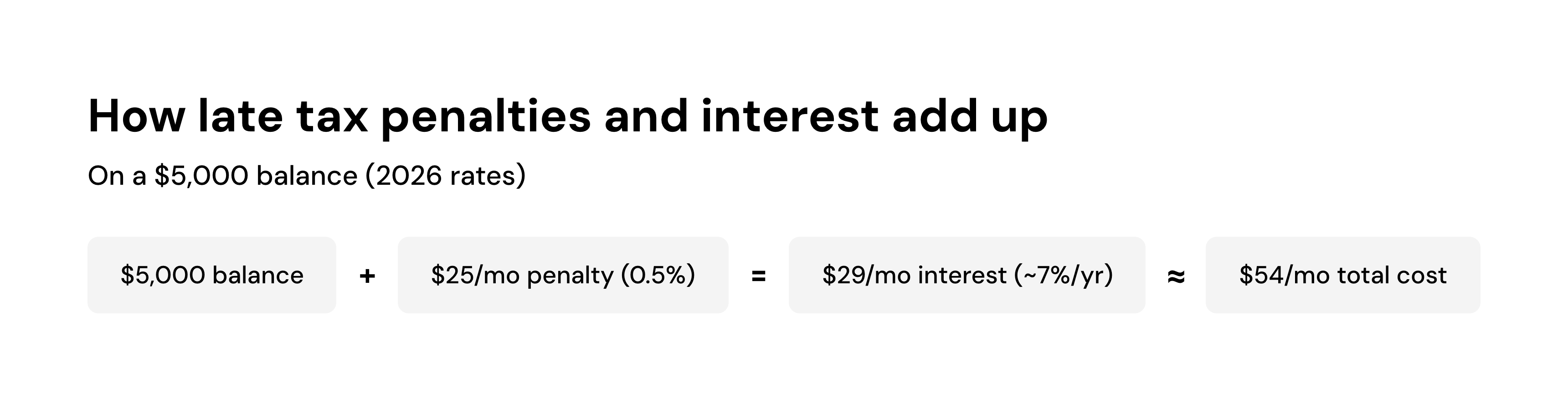
Paying taxes late comes with other consequences, too. Even if you're on a payment plan, your unpaid balance continues to accrue penalties and interest. When you're on an approved payment plan, the failure-to-pay penalty is reduced from 0.5% to 0.25% per month. For 2026, interest accrues at a rate of roughly 7% per year.[1]
Wage garnishment and bank levies
The IRS doesn't have to get a court order to take money from your bank account or garnish your wages. It doesn't report these actions to credit bureaus, but garnishment and levies may make it difficult to pay other bills, indirectly leading to credit damage.
What to do if you cannot pay your taxes on time
Did you end up owing taxes this year and have no way to pay them immediately? Don't panic! There are steps you can take to pay over time, and the IRS is typically willing to work with you if you're trying to pay what you owe (as opposed to trying to get out of it).
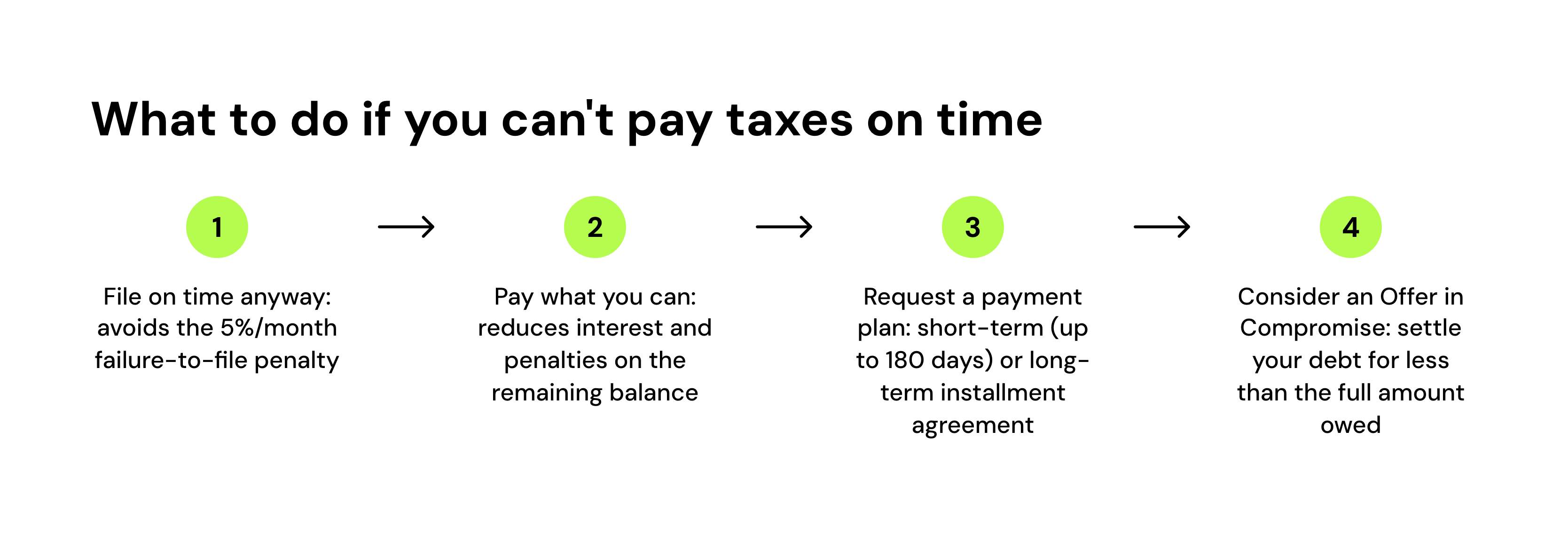
There are a few suggestions for how to handle the situation if you can't pay on time.
File anyway
If you haven't filed yet and know that you won't be able to pay on time, you should still file on time. Otherwise, you might end up owing a failure-to-file penalty. The penalty is usually 5% of your unpaid taxes for each month you don't pay, and it's capped at 25% of the unpaid tax.[1]
Pay what you can
Even if you can't pay all of what you owe, partial payments can reduce the total interest and penalties you'll owe over time.
Request a payment plan
The IRS offers short-term (up to 180 days) or long-term payment plans if you can't pay your taxes right away.[1] You can usually request a payment plan online at IRS.gov/paymentplan. If you can't apply online, you can call the IRS and ask an agent to help you.
Think about an offer in compromise (OIC)
In some cases, an OIC might be the best option. This lets you settle your tax debt for a portion of what you owe.[1]
Looking to boost your credit score?
You might be relieved to hear that in most cases, paying taxes late won't impact your credit scores. But if you're looking for ways to boost your credit score anyway, there are resources available to help.
Kikoff is one of those resources. We're a credit-builder app designed to help people with poor credit, no credit, or limited credit work toward their financial goals. Our members can access lines of credit, secured credit cards, rent reporting, and other tools to help them build and improve credit over time.
There's no fee to join, and we don't check your credit. Create your account today to get started!
Frequently Asked Questions
About the editor

Article Sources
Disclaimer: The information provided in this blog post is meant for informational purposes only and does not constitute financial advice.