
A payment protection plan is an optional add-on to a credit card or loan. If you lose your job, become disabled, or die, the plan can pause your payments or cancel some or all of what you owe. You pay a fee for it every month, usually based on your balance, and plans typically come with waiting periods and exclusions.
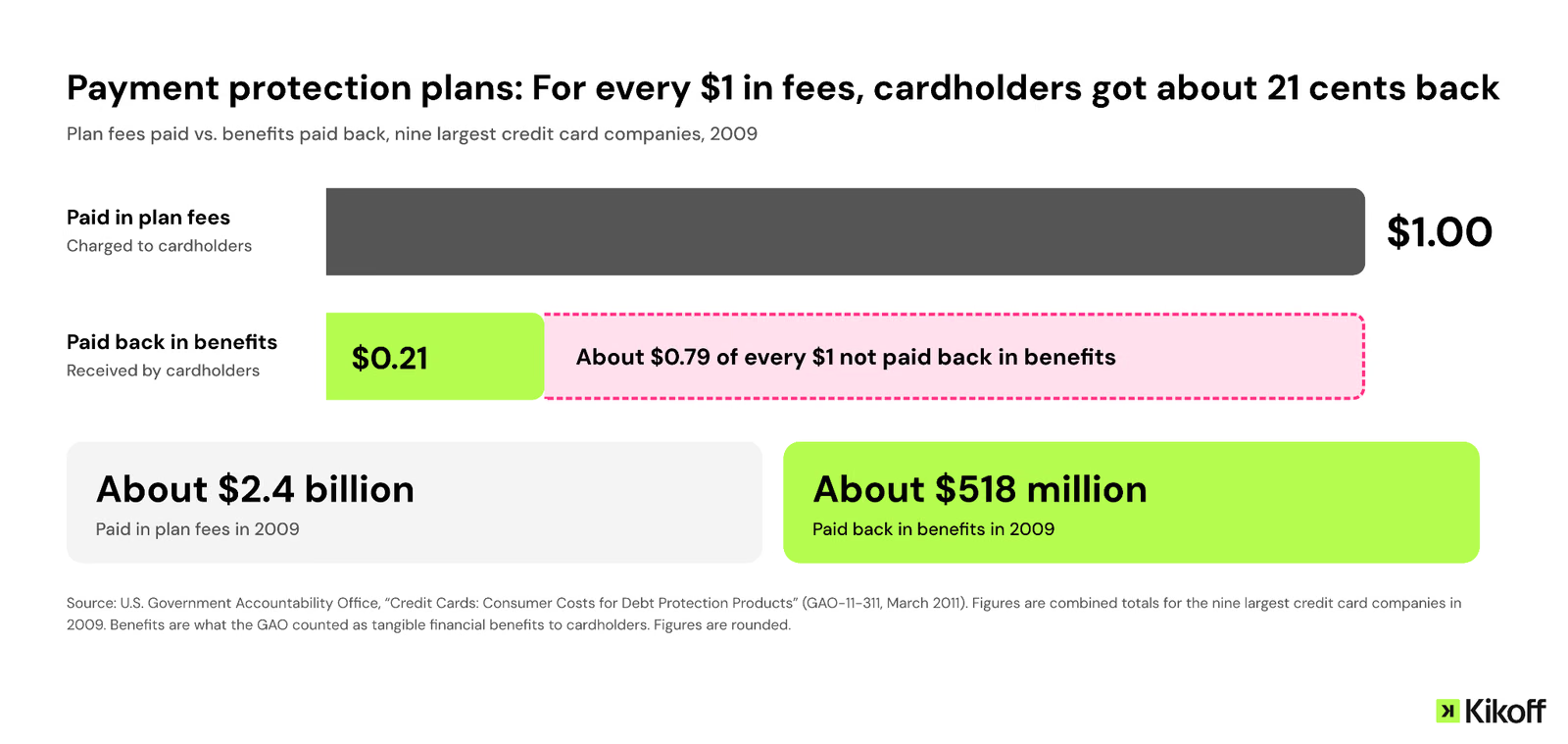
If you spotted the charge on your statement or got offered a plan with a new card, you’re really asking whether it’s worth the fee. In a 2011 review of the nine largest card companies, the Government Accountability Office (GAO) found that cardholders got back about 21 cents in benefits for every dollar they paid for these plans in 2009.
How a payment protection plan works
You typically sign up by checking a box on an application or agreeing on a call, and a fee shows up on your bill each month. If a covered event happens, you file a claim and send proof, such as a layoff notice or a doctor’s statement. If the claim is approved, the plan works in one of three ways.
Debt suspension and debt cancellation plans are contracts with your lender, and according to the CFPB, state insurance officials don’t regulate them.
Before you count on a plan, ask the card company whether there’s a waiting period before you can file a claim, how many months it will cover, and whether it covers you if you’re self-employed, part-time, or seasonal.
What a payment protection plan typically costs
Plans typically charge a monthly fee for every $100 of your balance, so the fee rises with your balance.
Here’s an example with a made-up rate. Say a plan charges $0.89 per $100 each month. On a $2,000 balance, that’s $17.80 a month, or about $214 a year, more than 10% of the balance. That fits the GAO’s 2011 finding that the annual cost often exceeded 10% of a cardholder’s average monthly balance.
Your rights before and after you sign up
- The terms have to be in writing. For a lender to leave the plan’s fee out of the finance charge, Regulation Z requires it to tell you in writing that the plan isn’t required and what the fee is. You have to agree to the coverage after getting these disclosures, either by signing or initialing a request or, for a card sold by phone, by saying yes on a call, with the written terms mailed to you afterward. With debt suspension, the lender also has to tell you that interest keeps adding up during the pause.
- A national bank can’t make the plan a condition of your credit. Federal banking rules bar national banks from approving you, or setting your terms, based on whether you buy the plan.
- You may get fees back if you cancel. Under the same rules, a national bank generally has to refund any fees you paid for coverage you won’t use, unless your contract says otherwise.
If your card isn’t from a national bank, ask the card company whether turning down the plan affects your approval or your terms.
How to check whether you’re paying for one
Start with your most recent statement, in the fees section. These plans often appear under names like “payment protection,” “credit protection,” or “balance protection.”
If you find one and don’t want it, call the number on the back of your card and ask to cancel. Ask whether you’ll get back any fees you’ve already paid. Write down the date and the name of the person you spoke with, in case the fee shows up again. Then check your next statement to make sure the charge is gone.
Don’t remember signing up? Ask your card company to cancel the plan and refund the fees. If it won’t, you can submit a free complaint to the Consumer Financial Protection Bureau.
What to do if you’re worried about losing income
- Build a small cushion. In the example above, saving the $17.80 a month instead comes to about $214 after a year, and it stays yours whether or not anything goes wrong.
- Call your card company early. If you can see trouble coming, ask whether it offers a hardship program, such as a lower rate or smaller payments for a few months.
- Get free help with a plan. The National Foundation for Credit Counseling (NFCC) can connect you with free or low-cost debt counseling at 800-388-2227.
Does a payment protection plan affect your credit?
The plan doesn’t show up on your credit reports as its own account. What counts is how your card payments are reported. Claims can take time, so keep paying at least the minimum until yours is approved, if you’re in a position to. A payment can show up as late on your credit reports once it’s about 30 days past due. Once a pause is approved, those months shouldn’t be reported as late.
If a paused payment shows up as late anyway, that’s an error. Get your free credit reports every week at AnnualCreditReport.com, then dispute the error with the credit bureau and the card company. Disputes are free and correct inaccurate information only. Kikoff’s AI Credit Disputes can help you dispute errors on your credit report for free with a few taps..
Bottom line
A payment protection plan can keep one account current during a hardship, but you pay for it every month, and the benefits often come to less than the fees. It can’t show you what’s being reported on the rest of your credit. Kikoff’s Credit Monitoring can help. Kikoff Basic includes weekly credit monitoring focused on one bureau, so you can spot a late payment or an account you don’t recognize there, and Premium adds scores from all three bureaus. Plans start at $5 a month.
Frequently Asked Questions
Article Sources
Disclaimer: The information provided in this blog post is meant for informational purposes only and does not constitute financial advice.